The R.I. Science and Technology Advisory Council (STAC) is calling on legislative leaders and the governor to continue state support for early-stage research and development, saying the funding is an important investment in Rhode Island’s economic future.
STAC’s top priorities for 2009 are to ensure state leaders do not cut the council’s $100,000 budget or the $1.5 million allocated to grants for collaborative-research projects. They also hope to create a center to nurture startups slated to be named the Center for Innovation and Entrepreneurship.
In determining their key priorities for 2009, members of the three-year-old council appeared to accept that the state’s grim fiscal picture leaves little room for funding new initiatives. Instead, the focus will be on programs that leverage outside money or deepen connections between businesses, universities and other research-oriented institutions in the state.
“It’s all about collaboration,” Jeff Seemann, dean of the College of the Environment and Life Sciences at the University of Rhode Island and the council’s co-chair, said at a Jan. 28 meeting where the year’s priorities were unveiled.
For example, he said, “there has never been any kind of partnership between [the state’s] institutions of higher education, and now we have all 11 at the table.”
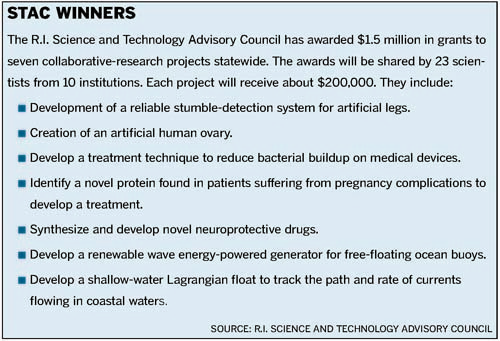
A primary focus for the council is the continuation of the Rhode Island Research Alliance, which allocates grants to researchers from multiple institutions who join together for a project. This year, the program gave seven awards of roughly $200,000 each.
“The state’s research and development community has never been more closely connected,” said Clyde Briant, STAC co-chair and vice president of research at Brown University. “Our focus is to foster and transfer discoveries that will create new companies and increase jobs and wealth throughout our state economy.”
Apart from the backing it provides for innovative research, council members noted that the $1.5 million investment in the project grants is a requirement in order for the state to be eligible for funding from the National Science Foundation’s Experimental Program to Stimulate Competitive Research (EPSCoR).
Rhode Island won a three-year, $6.75 million EPSCoR grant in 2006, and state officials are currently in the process of applying for a renewal of the grant, which could bring up to $20 million to the state over the course of five years.
In addition, the proposal to create the Center for Innovation and Entrepreneurship was described as a means of boosting the formation of startups and the growth of young businesses in the state.
The proposed center was not discussed in detail at last week’s meeting, but a document released by STAC said it would be “a multiinstitutional partnership” that would provide “a central location for early-stage enterprise to access the collaboration, support and expertise.”
Much of the economic stimulus package Congress is considering would direct funding toward science and technology, Washington, D.C.-based lobbyist James P. Fabiani said, particularly energy research and educational institutions. In response, Lt. Gov. Roberts said: “I think we will be in an ideal spot to take advantage of these resources, if they become available.”
However, John Williams, a professor of chemistry at Rhode Island College who was one of this year’s collaborative-research grant recipients, expressed concern about the stimulus package’s focus on applied research as opposed to basic research.
“New knowledge is going to have to be generated somewhere down the line” to fuel further technological advances, he said. •