
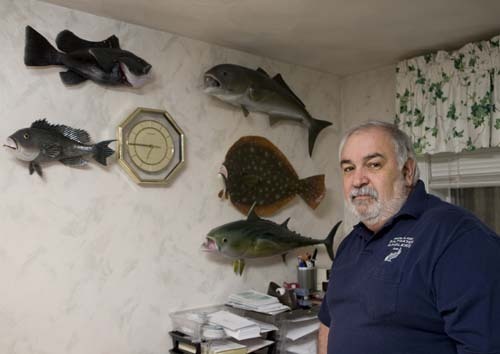
Uncle Sam wants to know how many anglers are casting their lines in federal waters – between three miles and 200 miles offshore – and he’s given all the coastal states a choice: create your own registry of recreational fishermen or become part of the National Saltwater Angler Registry.
The Magnuson-Stevens Reauthorization Act of 2006 created the federal registry and it goes into effect in January 2009.
[Update: The National Oceanic and Atmospheric Administration (NOAA) has opted to delay implementation of the federal requirement until Jan. 1., 2010, citing a flood of public comments the agency has received at its Web site. READ MORE]
Rhode Island, one of only five coastal states without registries, isn’t certain whether it ought to to create one, R.I. Department of Environmental Management (DEM) Assistant to the Director Robert Ballou said in a recent interview.
So three months ago, a 15-member group, led by the Rhode Island Saltwater Anglers Association, under a partnership agreement with DEM, started to study whether the Ocean State should register its saltwater fishermen in-state. The federal registry is set to start in January 2009 and will be fee-free until January 2011, but after that it could cost about $25 per year for each fisherman.
“If the fee is starting in 2011, there’s this big question: Do we pay the feds or do we pay the state?” said Stephen Medeiros, president of the anglers’ association, who helped form and is serving as co-chairman of the panel – formally, the R.I. Marine Recreational Fishing License / Registry Study Group.
The change in the law will affect all fishermen, he added, because it also requires the registration of anyone fishing for anadromous species such as striped bass. That means that all saltwater fishermen in Rhode Island would have to register, even if they only fish in state waters.
“So we say, ‘What if a guy doesn’t fish for striped bass?’ And they say, ‘Well, if you throw a worm in the water anywhere where there’s a chance that a striped bass might eat it, you better be registered,’” Medeiros said. “So that’s just about all water, everywhere.”
With an annual fee that would likely be between $15 to $25 and 400,000 saltwater fishermen who are from the state or come to the Ocean State to fish each year, Rhode Island would likely bring in about $8 million in annual fees. The study group will work to figure out a more precise figure and will attempt to find out if it’s enough to support a registry.
On Dec. 15 the study group held its third monthly meeting and told DEM officials that it had found enough initial support and need for the registry and that it would start a full-scale study, Medeiros said the day after the meeting.
Medeiros has also spent time explaining to fishermen that this isn’t an attempt by Rhode Island to squeeze more money out of taxpayers. “This is federal law, it’s done, there’s no way around it. Starting in 2011, you have to pay,” he said, “or never go saltwater fishing again.”
Within a few months the group, which meets in a different location around the state each month, should have a recommendation for the state. Medeiros added that the group isn’t entering the research process with the preconceived notion that a Rhode Island registry would be best. At any time during the investigation process, the group could find that a Rhode Island registry would be too costly.
Although the DEM agreed to the study and is following it, officials haven’t yet taken a stance on whether Rhode Island needs a registry. Nor have they officially agreed to take the steps that the RISAA group recommends, Ballou said.
Once DEM has a recommendation, the Rhode Island General Assembly might have to create legislation to create the registry. But there is a law on the books, created in 2001, that says that DEM “is authorized to propose a licensing system for recreational fisheries…”
Ballou said that law is unclear about whether DEM could create the registry without further legislation.
Massachusetts – one of the other states that doesn’t yet have a registry – has already decided to create one, Medeiros added.
As states decide to opt out of the federal program, the cost for each angler will be determined. That basically means that the fewer states involved, the higher the fees will be.
“If only three states are paying for this thing, Rhode Island being one of them, we’re going to be footing the bill,” Medeiros said. “All these other states already have registries, so they won’t be involved.”
There isn’t a deadline for states to create a new registry, Ballou said.
The federal registry is also an attempt to create national angler statistics and any state registry will have to report data to the federal registry.
Locally, too, the new registry – either federal or state – will also allow for better tracking of saltwater fishing and its impact on the Rhode Island economy. In January 2007, RISAA released a report compiled by Ninigret Partners that put the recreational saltwater fishing business at about $159.6 million in direct and indirect expenditures each year.
“Recreational fishing is a little different than commercial fishing, which has a hard quota that’s reported every day,” Medeiros said.
But with a registry to supply a more exact head count for those fishing in the state, the industry could create new economic-impact estimates. “An actual count of the number of people coming in would help to prove these statistics,” he said. “They say that 60 percent of all people fishing in the state are from out of the state.”
There are also questions of exemptions, including passengers on charter boats and whether seniors and military personnel on leave will be exempt from a Rhode Island registry, Medeiros said.
“If everybody and his brother are exempt, that means there’s going to be less of a pool to pay for this thing,” he added. “We don’t want a $25 registry in Rhode Island. We want it to be as inexpensive as possible.” •



