WEST WARWICK – Michael Shunney, an industrial technology teacher at West Warwick High School, posed a question to his students on March 23, the state’s first day of distance learning for public schools.
Citing plastic face shields designed by Czech inventor Josef Prusa, who developed the idea recently over the course of just a few days, Shunney asked his students if they believed they could create something similar.
Rhode Island's Market Has Changed. Developers, Builders, Investors and Sellers Must Change With It.
By Emilio DiSpirito IV License Partner | Engel & Völkers Oceanside Leader | The DiSpirito…
Learn More
“I just wanted to show my students if you have a problem to solve and you have the ability to create a design, you can solve a problem from beginning to end,” he said.
The question got students thinking, but Shunney as well.
Knowing that health care and other essential workers in Rhode Island are in need of protective gear amidst the coronavirus pandemic, Shunney wondered what students could do to help.
“I wanted them to realize they could actually make this thing if they had to, that they have the ability,” he said.
Shunney, with the help of other teachers in the industrial technology department and the West Warwick Teacher’s Alliance, got permission to take the school’s five industrial printers out of the school building and distribute them to students.
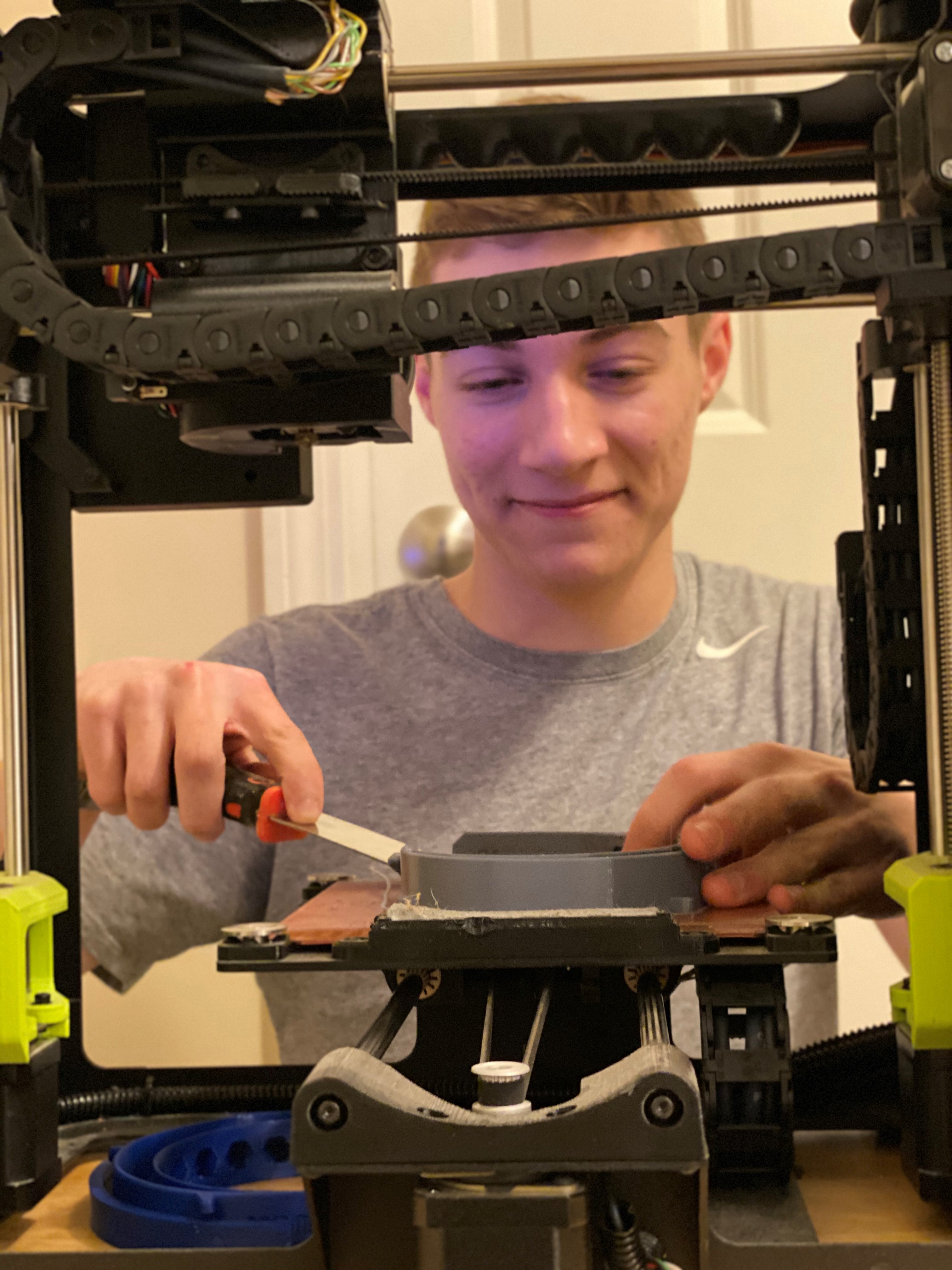
Using the open-source face shield design developed by Prusa, four students produced 126 face shields by last Wednesday, enough for deliveries to Kent County Memorial Hospital, West Warwick’s ambulance crews and the Rhode Island Federation of Teachers & Health Professionals.
Students are printing plastic head and chin straps designed to be attached to clear plastic sheets for shielding workers’ faces.
Alec Montaquila, a pre-engineering student, got the last of the printers on Tuesday. That night, he figured out a way to modify the design of the face shield to speed up the assembly process.
His improvement allows for three holes in the plastic sheets instead of four, so that those putting the masks together can make all the holes at once with a standard three-hole punch.
Montaquila, 18, a senior, is printing the shield parts along with juniors Jake Spencer, Seth Giguere and Johanna Gallo.
Shunney, who is also printing parts, and his family are assembling most of the shields.
It takes about an hour and a half to print the head and chin straps, Montaquila said.
With seven classes to stay on top of for the spring semester, he’s checking on the printer’s progress in between assignments.
“It’s a satisfying feeling knowing there are people out there that I’m helping,” Montaquila said. “To [be able to] reduce the odds of catching this or spreading this, I think it’s pretty insane.”
Equipment limitations, and the need for social distancing, are the only reason that printing is being done by just four students, Shunney said.
“These four are excellent students, but I think if the opportunity was given to many others, they would have embraced it and done just as well,” he said.
As word of the project spreads, requests for the shields are pouring in, and the effort now includes other residents who own 3-D printers.
“Our plan is to print masks until our machines break or we run out of supplies,” Shunney said.
Providence Business News is spotlighting nonprofits, companies and workers stepping up to challenges presented by the spread of the new coronavirus.
Elizabeth Graham is a PBN staff writer. You may reach her at Graham@PBN.com.