
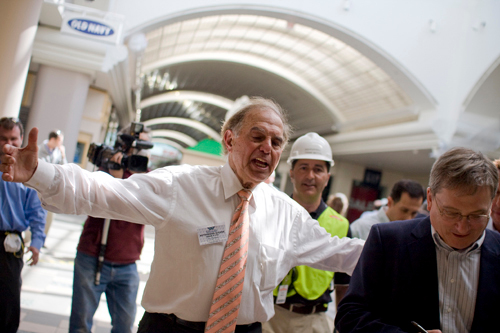
A week after the Pawtuxet River crested at almost 21 feet, Ron Nunes was busy showing an insurance adjuster the damage the raging river wrought on his business, R.T. Nunes & Sons in West Warwick.
The water swept away his sand and gravel piles like the ocean sweeps away a sand castle. Water inundated his buildings and destroyed the utility company’s computer system and stocks of inventory. But Nunes, the company’s president, said he would not dream of moving to higher ground.
“We have buildings here,” he said. “We have employees here. We have a good staff. I got my sons who are in business with me here. What do you do? Where do you go?”
As Rhode Islanders take stock of the damage caused by record amounts of rainfall and flooding two weeks ago, those in the real estate industry said they hope business owners share the attitude of Nunes, rather than start a mass exodus from flood-prone areas. Such a flight could alter the dynamics of a state centered around water since the construction of Slater Mill on the banks of the Blackstone River in 1793.
“I think there will be a fundamental readjustment of people’s attitudes of being near the water. No question,” said Laurie White, president of the Greater Providence Chamber of Commerce.
Images of the Warwick Mall surrounded by water, sandbags along rivers and hundreds of flooded basements around the state will inevitably give those owning or considering space along the state’s rivers and lakes pause, real estate brokers said.
Some businesses are already moving into temporary space while workers repair flood-ravaged buildings. But Tom Sweeney, vice president at Rodman Real Estate Inc., and Michael Giuttari, president of MG Commercial, said they expected many displaced businesses to ultimately return to their original locations.
Although for some, particularly in the hard-hit areas along the Pawtuxet River, flooding two weeks ago coupled with flooding earlier in the month could be difficult to overcome for businesses forced to shut down twice in the span of three weeks.
“How many times can you do that before you say, ‘I just can’t do that anymore?’ ” Giuttari said.
For those in the commercial real estate world, the big question is whether potential renters will chalk up the March flooding as a once-in-a-lifetime occurrence or a deal breaker.
Gov. Donald L. Carcieri described the flooding as a once-in-a-century event. But meteorologists said despite such characterizations, the chance of major flooding – about 1 percent each year – stays true regardless of the calendar date. And they cautioned against taking comfort in descriptions that peg the probability of floods in terms of once in so many years.
“That doesn’t mean that once you had it you have to wait 500 years before you get it again,” said Alan Dunham, a meteorologist at the National Weather Service. “We could get another [weather] system in a week or two.”
For Rhode Island businesses along rivers such as the Pawtuxet and Blackstone, another storm could also deliver more flooding. But people tend to have short memories and structures such as the Warwick Mall are impractical to move.
The mall suffered heavy damage and flooded as high as two feet in some places, said Warwick Mall owner Aram Garabedian. The flooding put the mall’s 70 shops temporarily out of business. But Garabedian remained confident that the mall and its shops would come back, despite their proximity to the Pawtuxet River.
In Cranston, where the Pawtuxet River swamped at least 860 homes and businesses, the city planner said he did not expect people to flee the banks of the river.
“This is going to be the floods of 2010,” said Peter Lapolla, director of the city’s planning department. “We’ll be more cognizant of it, but will it change the development pattern, especially in eastern Cranston? The pattern is there. You can’t move the pattern.”
And rarely do cities force the issue, said James Schwab, who manages the American Planning Association’s Hazards Planning Research Center in Chicago. After Hurricane Katrina, New Orleans raced to rebuild despite its location below sea level. And construction along waterways across the country has made rivers more prone to flooding as water rushes off paved surfaces and buildings and into rivers.
“This is a study in human psychology in a lot of cases … They’ve been there, and they just don’t want to deal with the hassles of relocating,” Schwab said. “There are a lot of rationalizations. Not all of them stand up to very close scrutiny.”
For some businesses, like Custom Key Way in Warwick, there is a sentimental attachment to the location where the company has operated for decades. Three days after the flooding, Custom Key Way owner Dan Drew was still attempting to reach his building near the Pawtuxet River. An owner of a neighboring business told him the damage was extensive and Drew feared that the water ruined his expensive equipment that makes pieces for industrial gears.
But he wavered when asked if he would consider moving, saying he’d likely take one more chance.
“I think it’s just a fluke,” he said of the flooding. “I don’t think it’s going to happen again, hopefully. But we can’t see that again. Then, it’s moving time.”
For some homeowners, moving time came after water swept over the banks. Hundreds of residents were displaced and some face extensive repair work in their homes as they fight mold and structural damage. Ron Phipps, a Warwick Realtor and president-elect of the National Association of Realtors, said real estate agents could not yet guess the long-term impacts of the floods.
“We’re in virgin territory,” he said.
Phipps said he had not heard of deals falling through after potential buyers re-thought purchasing a riverfront home, but he suspected many of his peers were attempting to reassure skittish buyers.
More concerning to agents, according to Phipps, were people who found themselves unemployed in the flood’s wake. Those people could have trouble making mortgage payments or have less spending money to drive the economy.
“We’re concerned about the employment repercussions of the storm,” he said. “Economic activity is really, really important for the housing market.” •












Homeowners’ insurance isn’t a luxury, it’s a necessity. In fact, most mortgage companies won’t make a loan or finance a residential real estate transaction unless the buyer provides proof of coverage, contact me for free home insurance quote http://bit.ly/ajc5p7