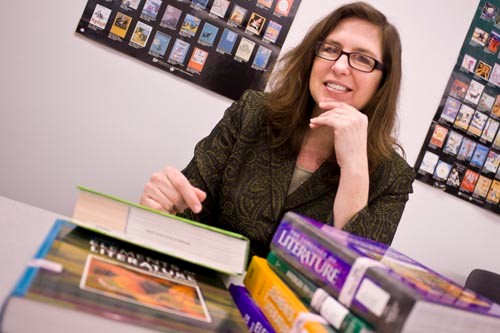
Ever wonder who prepares those standardized tests that can have such a powerful impact on local schools? Diane E. Kern, an assistant professor at the University of Rhode Island, is the state representative for English language arts to a national group preparing an assessment system for high school students across the country, part of the U.S. Department of Education’s “Race to the Top” program. The new test is scheduled to be ready in 2014, but will be field-tested in pilot programs in Rhode Island in the fall of 2012. Among her other accomplishments, Kern is the lead author of the International Reading Association’s Standards for Reading Professionals – Revised 2010.
She recently spoke with Providence Business News about the assessment system and the newly adopted common-core standards in education.
PBN: In March, you were named the state’s higher education representative to help guide development of a national English language arts assessment system. Can you tell us what that means? PBN: Where do you begin? PBN: How big is the group? PBN: And what is it that you have been charged to do? PBN: How often will the assessment exam be given? PBN: Is there any emphasis in the common-core standards given to practical, business-based kinds of reading and writing? INTERVIEW
KERN: Forty-plus states – the number is continuing to change – have agreed to adopt common-core standards for English language arts and mathematics. This is an unprecedented opportunity for schools to have similar standards across state lines. This is very different in the history of United States education.
The Common Core State Standards were completed about a year ago. This past summer, Rhode Island agreed to be part of adopting the common-core standards. They were written in a three-year process by teachers, principals, policymakers and other higher education folks across the country. Rhode Island also is one of 14 governing states to agree to use the assessment system that is being developed and that will be ready in the fall of 2014 … and that is where my position comes in.
KERN: Our first task is to develop the high school assessment system for English language arts and also for mathematics. I am the English language arts higher education representative for the state and Mary Sullivan, a professor at Rhode Island College, is the mathematics higher education representative. Each of the 40-plus states has representatives.
KERN: There are 100 of us, across math and English. … The group is not as huge as you imagine because there are two consortia creating assessment systems, not just one. So, while we have one set of core standards, there are two groups designing assessments and states are going to get to choose between these two: [the Partnership for the Assessment of Readiness for College and Careers, which Rhode Island is part of, and the Smarter Balance Assessment Consortium.] … The R.I. Department of Education is in a leadership role in this consortium as well. …
KERN: We have been charged to create an English language arts assessment that aligns with the common-core standards for high school students to demonstrate their college and career readiness.
KERN: It is not going to be a one-time exam. It is going to be what’s called a “through-course” examination. … Students will take the exam each quarter, over the course of one school year.
KERN: The goal is to provide clear expectations through the common-core standards so that educators have a common language that they are sharing with students, that expectations are clear school to school to school, whether it be Central Falls or Pawtucket or Providence. …
Plans are being made to support students when there are gaps in their achievement so by the time they take the final exam prior to graduating high school, they are ready for either a career in industry or a credit-bearing college course that they do not need remediation for.
KERN: Absolutely. One of the studies that we are using to inform this assessment system says that, in schools today, students are reading too many narrative texts and not enough informational texts, meaning business-type, career-type reading. So what we are now doing is shifting the emphasis to more informational texts at earlier grades. … So, for example, we have 10 anchor [common-core] standards for reading and one of those is to “integrate and evaluate content presented in diverse media and formats, including visually and quantitatively, as well as in words.” … [This would address] what you would anticipate a student doing on the job, interpreting PowerPoint presentations in a boardroom meeting, for example, and then writing about it, or preparing an Excel sheet to quantitatively interpret information. •
Diane E. Kern
POSITION: Assistant professor in the School of Education at the University of Rhode Island
BACKGROUND: At URI for the last six years, she previously was an assistant professor in the reading master’s degree program at Rhode Island College from 2001 to 2004 and, from 1998 to 2001, a lecturer at URI. She also has been an elementary school teacher on Block Island and in South Kingstown and Barrington.
EDUCATION: Bachelor’s degree in elementary and secondary education, 1984; master’s in K-12 reading education, 1993, both from URI; and a doctorate in education from a joint URI and RIC program, 2003
FIRST JOB: She worked at Gray’s Ice Cream Inc. at Tiverton Four Corners.
RESIDENCE: South Kingstown
AGE: 48