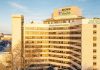
Finding new and viable uses for 111 Westminster St., known to generations of Rhode Islanders as the “Superman” building, should be a top priority of Gov. Lincoln D. Chafee, Mayor Angel Taveras and the Providence business community.
I do not own, and do not wish to own, this downtown property. But as a lifelong resident of Providence, as a real estate investor, a former mayor, and former head of economic development for the state, I know how important it is to find new uses for 111 Westminster – and how difficult it will be.
At 428 feet, this landmark skyscraper is Rhode Island’s tallest office building. It is also a distinguished example of Art Deco architecture, one of the city’s largest taxpayers, and a real estate anchor in the financial district. With Bank of America poised to vacate the property, 111 Westminster will lose the only tenant that we have known during our lifetimes – and Providence will soon have a very large and very empty building on its hands.
This is why I have been publicly declaring that the best option for this building and our city is to keep Bank of America in this location. All other options are going to be difficult at best. It’s been more than 25 years since the last new office building, Fleet Center, opened in the financial district. And even Fleet Center became reality only because the city secured a multimillion-dollar federal grant to help finance the bank project.
In recent years, GTECH relocated to Capital Center from West Greenwich, but only because the state gave GTECH a no-bid, 20-year contract to handle its lottery business. Blue Cross & Blue Shield of Rhode Island also moved to a new office building in Capital Center, but that was after vacating three buildings elsewhere in the downtown and receiving a $25 million tax incentive from the city.
Today’s real estate market in the downtown area is dominated by tax-exempt colleges and hospitals, which are continually buying commercial properties.
What many people don’t realize is that downtown Providence has always had difficulty attracting and keeping office tenants. Private investors are reluctant to construct office buildings without some kind of governmental assistance – grants, loans, tax abatements or property-tax stabilization plans. That is why the universities, with their strong cash flow, have become so important to the city. Their expansion should be allowed to continue, as long as they are willing to make tax payments on their downtown properties.
When the old Hospital Trust building faced similar circumstances a few years ago, Rhode Island School of Design stepped in, reconfiguring that old bank building for RISD’s first-floor library and upper-floor dorm space. Hundreds of youthful, creative people now live in downtown because of RISD.
We need to consider new, financially viable options for 111 Westminster as well. Here are several options – with two important provisos: first, the building must remain on the tax rolls, and second, parking must be provided nearby for the new occupants.
• Move Roger Williams Law School from Bristol to 111 Westminster. This would place the law school close to state and federal courtrooms and major law firms, and it would free up space on the Bristol campus for other uses.
• Move the Superior and Supreme Courts from South Main Street to 111 Westminster, and sell the courthouse building to Brown University. Brown would pay full taxes on the courthouse property. The courts would benefit from a modern configuration in the converted office building.
• Move Brown’s School of Engineering from its current East Side campus location. This school has 550 undergraduate and graduate students, 40 faculty, and a $13 million research budget. A major focus of the school is biomedical engineering, which is also the focus of the new Knowledge District a few blocks from 111 Westminster. Brown just moved its medical school to the Knowledge District.
• Relocate state-office functions from the Pastore Complex in Cranston. Gov. Chafee has talked of making Rhode Island’s capital city a true capital city by consolidating state-office functions here. My experience – as a former mayor of Providence and as the fourth generation of a family real estate business – strongly indicates that this must be done.
• There is one last option for the Superman building: Recruit a developer to convert 111 Westminster into an entertainment complex, with a fully licensed casino on the first floor and a grand hotel on the upper floors.
All of these options have potential, but only if the parking issue is adequately addressed. One possibility is to provide garage parking on the long-vacant lot next to the Arcade.
The worst option is for the state and city governments to do nothing. An empty, 26-story skyscraper in the center of the capital city would send a terrible message to the marketplace. But a fully revitalized Superman building would continue the renaissance of downtown Providence, and send a strong signal that Rhode Island’s civic leadership is unified and decisive.
While there are many new and viable options for the building, however, the best option is the tenant that has been occupying the property for the last 80 years, that is, Bank of America. •
Joseph R. Paolino Jr. was the mayor of Providence from 1984 to 1991 and director of the R.I. Department of Economic Development from 1991 to 1994. He currently manages his family’s commercial real estate business in Providence.
Building a Strong Data Foundation in the Age of AI
Artificial intelligence (AI) has become a key priority in the boardroom and across management —…
Learn More