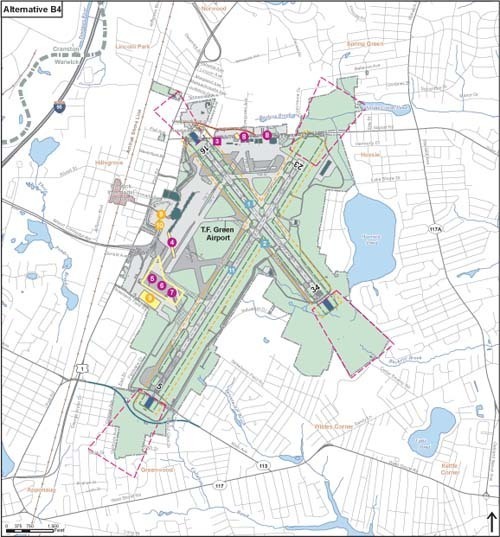
The T.F. Green Airport runway expansion option now favored by the Rhode Island Airport Corporation would extend the main runway southward and shift the shorter runway. It would require the acquisition of 11 homes and 10 businesses, with potential acquisitions of up to another 201 homes if the owners approve.
The plan would also require that a bend be put in Main Avenue and the intersection of Airport Road and Post Road be pushed north, to Hasbrouck Avenue, Rhode Island Airport Corporation Executive Director Kevin A. Dillon said.
The extension, one of three proposals that the Federal Aviation Administration could choose from this spring, would cost about $170 million just for runway repairs and property acquisitions. The FAA would likely pick up about 75 percent of the bill, Dillon said, with the rest coming from RIAC revenue.
Under that RIAC-preferred plan, dubbed “B4,” the main north-south runway would be extended with 1,534 feet of pavement and a 600-foot safety area, called an Engineered Material Arrestment System. If given FAA approval, the plan would include the possible acquisition of 67 homes and one business in the “Runway Protection Zone.” That’s an area that the FAA would “prefer to have vacant, but does not require,” Dillon said. Because pushing the runway south would also change the amount of noise over other homes, there would also be 134 noise-impacted homes that would qualify for acquisition if approved by the owners.
The plan also includes resurfacing and adding safety areas to the crosswind runway, which would require the intersection of Airport Road and Warwick Avenue to be moved north. That would require a mandatory acquisition of 10 businesses and one home.
The plan then could include up to 212 home acquisitions and 11 business acquisitions.
But Warwick Mayor Scott Avedisian said his office isn’t convinced that it is the best possible proposal.
“The latest iteration is certainly better than anything we have seen this far,” he said in a recent interview.
“All these big business leaders in Providence want to talk about having a bigger airport,” Avedisian said. “No one wants to come up with a funding formula to compensate us for all the lost revenue that we see.”
But aside from Avedisian’s fiscal concerns, there are also looming questions about the airport expansion’s impact for the city’s quality of life, preservation of neighborhoods, air quality and wetlands. “We are well aware that there is a positive spinoff of having an airport in Warwick,” Avedisian said. “However, that’s all the airport ever talks about. We need to look at what the negatives are.”
The city and its residents will have a chance to give input on the plans – the public meeting where the preliminary plan chosen for study by the FAA will be introduced is scheduled for June 3, Dillon said. FAA will likely release a final environmental impact statement early in 2010, followed by a decision in spring 2010 on whether to move forward with the plan. Property acquisitions and construction could then begin. Construction could be completed as soon as 2013, Dillon said. With possible private expansion of cargo facilities and parking, the RIAC-preferred plan could cost more than $400 million.
Dillon, who has been the airport’s chief since January 2008, added the RIAC-preferred alternative when he came aboard. Although unlikely, there is a possibility that the FAA will come to the conclusion that no runway extension is needed.
The shorter alternative, “B2,” would require the acquisition of 69 homes and 42 businesses. With voluntary acquisitions added, that plan could mean 317 total property acquisitions and a cost of $545 million not including private expansion.
And the longer of those extensions, “B1,” would require 97 home and 45 business acquisitions. With owner-approved acquisitions factored in, property purchases could reach 492 and a project cost of $582 million, again exluding private expansion.
As part of another study that is projecting T.F. Green’s traffic load by 2020, additional acquisitions are expected regardless of expansion plans.
Dillon said the RIAC-preferred option is an attempt to build competitive infrastructure – the proposal would lengthen the runway to 8,700 feet, the same length as one of the higher-impact scenarios – while keeping those acquisition impacts to the city at a minimum.
“This alternative is really a balance,” he said. “8,700 feet really does give us everything we would need to serve those markets we project that we will have the opportunity to compete in.” T.F. Green carriers would be able to fly nonstop to the West Coast and much of continental Europe, he said.
That could help entice more carriers to the airport, including some foreign ones, Dillon said.
“Carriers have opportunities to serve so many cities across the country,” he said. “So would you come to a city that has the proper infrastructure to make that flight as profitable as possible or would you come to T.F. Green and say, ‘I’m going to make less money or operate a flight that isn’t profitable.’ That’s not rocket science.” •