Verizon Communications, which has been losing Rhode Island telephone customers to Cox Communications for years, could finally begin competing head-to-head for Cox’s cable television customers, at least in part of the state.
New York-based Verizon, the nation’s second-largest telephone company, expects to get state approval this week to offer its fiber-optic TV service (FiOS) in R.I. Service Area 6, which includes Coventry, East Greenwich, Exeter, North Kingstown, Warwick, West Greenwich and West Warwick. A final public hearing is scheduled for Wednesday, May 16, at the R.I. Division of Public Utilities.
Following approval, Verizon could begin offering TV service by early June, spokeswoman Lillian McGee said.
Currently, Verizon offers only telephone and broadband Internet service in Rhode Island, but Cox offers all three services. “The only way we can compete is to offer this third piece of the puzzle,” McGee said. “We need to have that triple play, where we can offer phone service, high-speed Internet and cable TV. I mean, that’s where the savings is, to be able to offer the bundled package.”
Between 2001 and 2006, Verizon lost a total of 45.3 percent of its telephone lines in Rhode Island, more than in any other New England state, according to data Verizon submitted to the FCC. Atlanta-based Cox has been so successful with its cable-based phone service in Rhode Island since introducing it to the market in 2000 that Verizon’s state market share is the smallest in the nation for an incumbent carrier, at about 60 percent.
Last year alone, the number of resident telephone lines that Verizon carried in the state fell 14.5 percent to 224,000. Verizon’s business lines fell by 7.3 percent to 130,600, McGee said.
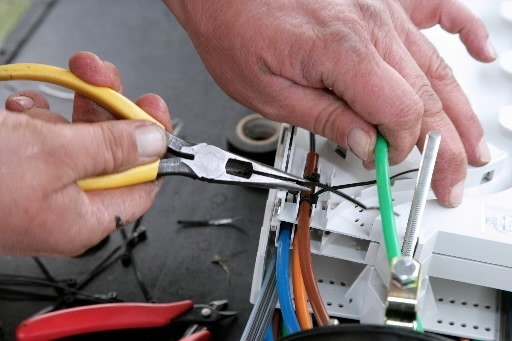
The company, which has invested $750 million in its fiber network in Rhode Island in the past 10 years, has been working for more than two years to break into the TV market in Rhode Island and across the nation.
The PUC considered Verizon’s first bid to offer cable TV in the state for almost a year before issuing a favorable ruling in December.
Nationally, Verizon and AT&T succeeded late last year in a bid before the Federal Communications Commission for a faster regulatory process to enter local cable television markets nationwide.
The FCC measure, approved in a 3-2 vote along party lines, will require local franchise authorities to decide within 90 days on some phone-company applications to offer TV in competition with cable providers.
The FCC ruling represented a victory for the telecom companies after a failed two-year effort to establish a national TV licensing system that would have superseded local and state regulations. The effort was derailed by “net neutrality” advocates in Congress and in other industries, who fear that another provision in the bill would allow telecom companies to create a tiered system for the delivery of online content to consumers.
Verizon, AT&T and other telecom companies dismiss such concerns as unwarranted, and argue that regulatory roadblocks preventing them from entering the cable TV market threaten their existence in an environment where many consumers are no longer interested in paying for traditional phone service.
“We can’t be just a phone company any more,” McGee said, speaking of Verizon’s future. “We’re going to be a broadband and entertainment company.”
Verizon is also seeking regulatory approval to offer its FiOS TV in Service Areas 2, 3 and 8, which encompass Providence, North Providence, Cranston, Foster, Johnston, Scituate, Charlestown, Hopkinton, Narragansett, Richmond, South Kingstown and Westerly.
Initial public hearings on Verizon’s initial certificates in those service areas are scheduled for May 16 in Providence, May 17 in Cranston and May 24 in South Kingstown, McGee said.
Ultimately, Verizon plans to seek operating licenses in all nine cable TV service areas in the state, she said.
Verizon has been adding charges and raising the rates for several of its telephone services in recent years, but McGee said that entering the cable TV market will make it easier for the company to reverse that trend. Head-to-head competition between Verizon and Cox would benefit Rhode Island consumers, she said.
“Choice is good,” McGee said. “I mean, normally when you have a choice in anything, it drives the prices down and the service up.”
A modernized health plan: Supporting cost management and the employee experience.
The Surest health plan came from a group of innovators wondering: What if health care…
Learn More