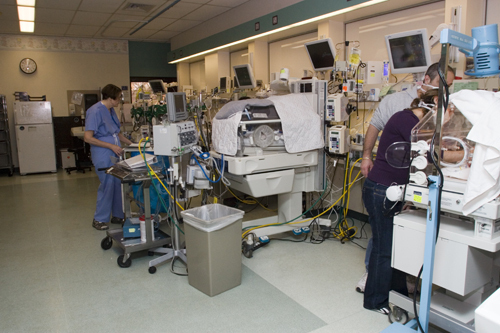
Citing studies that have shown that newborns delivered by cesarean section prior to 39 weeks gestation are twice as likely to need intensive care, UnitedHealthcare has launched a campaign to discourage doctors from scheduling elective C-sections before that point.
The insurer is reaching out to hospitals and obstetricians, sharing an analysis of claims data for mothers and their newborns that showed 48 percent of newborns admitted to neonatal intensive-care units had been delivered in scheduled C-sections, many before 39 weeks.
United’s campaign comes at a time when the C-section rate is rising rapidly. In 2006, federal statistics show, a record 31.1 percent of babies were delivered surgically, up 50 percent since 1996. In Massachusetts, one-third of births were by C-section in 2006, up from one-fifth in 1997. In Rhode Island, the C-section rate rose from 17.3 percent in 1994 to 28.8 percent in 2004.
Cesarean sections are considered medically necessary under many circumstances, such as when there is fetal distress or the baby has a high-risk condition, when labor can’t be induced, or when the baby is too big or is coming out feet first (a “breech” position).
Women who’ve had a previous C-section are also strongly encouraged to deliver surgically, and because of the higher risk of complications, older and obese mothers, as well as those with certain health problems, tend to have more C-sections too.
But some women just prefer C-sections. One Web site, www.cesareansectionondemand.com, notes that Madonna, Britney Spears, Catherine Zeta-Jones and other celebrities all had elective C-sections and encourages women to decide for themselves: “Your baby, your choice.”
In a news release announcing its outreach campaign, United noted that more than 1.2 million C-sections are performed annually in the United States, at a cost of more than $14.6 billion per year, according to the federal Agency for Healthcare Research and Quality. And according to the the agency, more than half of all C-sections are medically unnecessary.
Those are also the types of C-sections that are increasing most rapidly, United noted. But the flip side is that, unlike emergency C-sections, these can be carefully timed to avoid needless risks – so educating doctors about the 39-week cutoff could really make an impact.
The American College of Obstetricians and Gynecologists (ACOG) has been discouraging scheduled C-sections prior to 39 weeks for some time, even though it does not discourage elective C-sections in general, and the nation’s top experts have done the same.
Most notably, in 2006, a panel of specialists convened by the National Institutes of Health examined the body of research and decided it lacked enough evidence to advise for or against elective C-sections, since they’re safer in some ways and riskier in others.
Thus, the panel recommended, decisions should be “carefully individualized and consistent with ethical principles.” However, the panel specifically discouraged elective C-sections for women who want to have multiple children, and it said scheduled C-sections “should not be performed” prior to 39 weeks of gestation or without verification of lung maturity, because of a “significant danger” of neonatal respiratory complications.
According to United, a “growing body” of research shows that babies delivered prior to 39 weeks’ gestation are twice as likely to require intensive care as babies born at 39 to 42 weeks.
Dr. Donald R. Coustan, obstetrician and gynecologist in chief at Women & Infants Hospital and a professor at Brown University’s Warren Alpert School of Medicine, said the Providence hospital is very aware of the 39-week cutoff, and no C-section can be scheduled there before 39 weeks without his approval.
When a request comes in – and they are not common, he said – Coustan will talk with the doctor and encourage him or her to wait. If there’s a good reason to proceed, tests will be performed to ensure that the baby is ready, he said.
United, for its part, has found that hospitals that have policies like Women & Infants’ have fewer babies delivered by scheduled C-sections that end up in the neonatal intensive care unit, and raising doctors’ and hospitals’ awareness of the issue makes a big difference.
In a recent pilot program in the Southwest, United shared claims data with doctors and hospitals showing a variation in NICU rates in connection with C-sections. In the first three months after that, United found a change in practice patterns and a 46-percent decrease in NICU admissions. The lower rates have held steady for five quarters since then, United said.
The insurer has also found that hospitals that have delivery protocols based on ACOG guidelines, along with review processes to ensure adherence or required approval by a review committee, typically have lower NICU admission rates.
“Reducing the overall number of elective cesarean sections would significantly decrease health risks for mothers and their newborns,” said Dr. Tina Groat, national medical director of women’s health for UnitedHealthcare, in the news release.
Along with reaching out to providers, United is expanding its Healthy Pregnancy Owner’s Manual to help cover elective deliveries in more detail and warn women about the risks to mothers and their babies when they elect to have a C-section prior to 39 weeks.
The manual, available at www.healthy-pregnancy.com, also warns that inducing labor can make it likelier that a woman will need a C-section or experience other complications. •