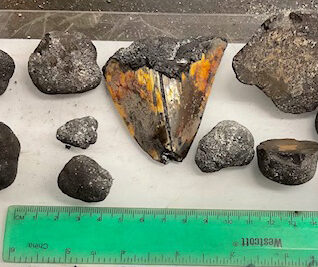
NARRAGANSETT – Every day, researchers sort through an abundance of marine samples that come through the University of Rhode Island’s Marine Geological Samples Laboratory.
Less common, however, do they come across the type of sample Assistant Curator Danielle Cares and graduate students Molly Robinson and Jason Almeida recently uncovered – a fossil from a massive shark that went extinct 2.6 million years ago.
Your Business Has Gone Global. Has Your Insurance?
A decade ago, “doing business internationally” was mostly a large-company concern. Today, a manufacturer in…
Learn More
At the URI Narragansett Bay Campus facility, one of just four National Science Foundation-funded repositories in the U.S., researchers are used to dealing with marine samples such as sediment core and volcanic rocks, which they preserve, log and store for further research and education.
But the team knew they had something different in their hands when, searching through 20 boxes of rocks gathered from 10,000 feet below the surface of the Pacific Ocean, Robinson noticed small ridges along one of the samples. Upon chipping away the surrounding crust, she revealed a tooth about the size of a person’s palm.
“It was so exciting,” Robinson said in a statement. “We get a lot of cool rocks here, but we don’t get fossils.”
While the researchers didn’t immediately know the exact source of the fossil, they knew they’d made a significant discovery.
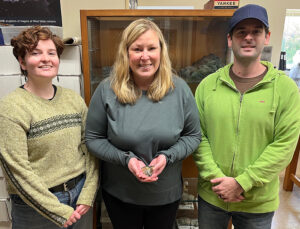
“We were giddy like it was Christmas for a week,” Cares said of the discovery. “There were a couple of people in different labs down the hall and we got them in here. We were all like, ‘Oh my God, this is the best thing ever.’”
After reaching out to a shark researcher and a paleontologist, both experts agreed that the fossil belonged to a shark species known as the Megalodon, which were about triple the size of modern sharks with teeth to match.
While Megalodon teeth aren’t exceedingly rare finds in general, it’s possibly the first time one of the samples has been unearthed in the specific area of the Pacific Ocean, located to the south of Hawaii, where the fossil was gathered, said David Ebert, the shark researcher who helped the URI team confirm the sample’s identity.
“I think this is a new record for this part of the Pacific Ocean,” Ebert said in a statement. “I do not know the range of these sharks, but I think they were global in their distribution as their teeth have been found on most all continents.”
Like other samples in the lab, the fossil will potentially be loaned out to researchers, educators and museums.
Jacquelyn Voghel is a PBN staff writer. You may reach her at Voghel@PBN.com.