WASHINGTON – The federal government’s pledges to pour $700 billion into buying up downgraded mortgage assets and $400 billion into stabilizing money-market funds may backfire, some analysts say. In the long run, “the downdraft on the dollar from the hit to the balance sheet of the U.S. government will dwarf the short-term gains from solving the banking crisis,” David Woo, London-based global head of foreign-exchange strategy at Barclays, told Bloomberg News. “As we get to the other side of this, the dollar will get crushed,” agreed John Taylor, chairman of New York-based International Foreign Exchange Concepts Inc.
The Bush administration yesterday broadened its bad-debt bailout plan beyond mortgage-backed securities, as U.S. Treasury Secretary Henry M. Paulson Jr. announced plans to allow the possible purchase of other “troubled debt,” including consumer automobile loans or credit-card debt.
“The Treasury’s thinking is to make it as big and wide as possible, so they have the flexibility to act if need be,” Shane Oliver, Sydney-based head of investment strategy at AMP Capital Investors, told Bloomberg News. “There have been losses on a whole range of U.S. debts, and as the economy deteriorates in response to the housing slump, those losses could escalate.”
But lawmakers and analysts were critical of the move as increasing costs far beyond the initial estimate of $700 billion. The tab “will be significantly higher than originally considered or acknowledged,” Josh Rosner, an analyst with independent research firm Graham Fisher & Co. in New York, told Bloomberg News. “How, given these changes, can the administration and Federal Reserve believe they are being forthright in their unrevised expectation of future losses?”
Congressional leaders have been meeting with Federal Reserve and Treasury officials about the tentative bailout plan Paulson submitted to Congress on Saturday. His Troubled Asset Relief Program (TARP) – which would raise the nation’s debt ceiling to $11.315 trillion, an increase of 6.6 percent – states that decisions by the Treasury secretary “may not be reviewed by any court of law or any administrative agency.”
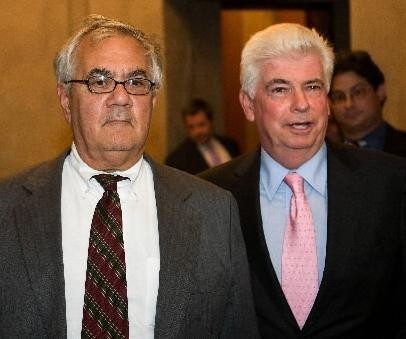
But Democrats, led by U.S. Rep. Barney Frank of Massachusetts, the chairman of the House Finance Committee, are pressing for both protection for consumers and oversight by the Government Accountability Office. Frank’s proposal calls for the budget watchdog agency to have full access to bailout records, and to report its findings to lawmakers. It also seeks limits on executive compensation at companies accepting bailout funds.
“We need this to be clean and quick, and we need to get it in place,” Paulson said today in an interview on ABC News’ “This Week,” according to Bloomberg News.
But Frank told CBS’ “Face the Nation” that he and Paulson “have a difference on what’s clean. … It’s kind of hard to tell the average American that we’re going to continue to have foreclosures that destabilize neighborhoods and deprive cities of revenues they need, but we’re going to buy up the bad paper.”
Analyst David Kotok, chairman of Vineland, N.J.-based Cumberland Advisors Inc., told Bloomberg News that, “As much as I disagree with Barney Frank on many things, he is absolutely right” on the need for outside supervision. “The greater you empower government, the greater the risk that power is abused,” Kotok said.
For Leaders Who Don't Have Time to Get Sick
Top performers guard their calendars, delegate relentlessly and optimize every hour of the day. Health,…
Learn More
Meanwhile, the Treasury last night issued a “clarification” of its money-market fund stabilization plan. Both taxable and tax-exempt funds will be eligible for coverage under the “temporary guaranty program,” the statement said. But coverage will be limited to assets held in such funds at the close of business Friday, Sept. 19.
That asset deadline was lauded by the American Bankers’ Association LLC as eliminating a possible drain on bank accounts. If no time limit were imposed, “this proposal would have threatened to take money out of local FDIC-insured banks, which have paid for their insurance, and put it into firms that have no incentive for community reinvestment,” ABA President Edward L. Yingling said in a statement posted late yesterday at www.aba.com.
Further details of the money-market bailout remain to be determined, the Treasury added. So far, no cap has been set on the amount of assets per fund account or per shareholder.
The finance ministers and central-bank governors of the G-7 nations issued a statement today, after a morning conference call, that was posted on the Web sites of the U.S. Treasury and other agencies:
“We reaffirm our strong and shared commitment to protect the integrity of the international financial system and facilitate liquid, smooth functioning markets, which are essential for supporting the health of the world economy,” they said.
“We strongly welcome the extraordinary actions taken by the United States to enhance the stability of financial markets and address credit concerns, especially through its plan to implement a program to remove illiquid assets that are destabilizing financial institutions. We also strongly welcome the measures taken by other G-7 countries,” the statement continued. “Major central banks have been coordinating to address liquidity pressures in funding markets, which has been critical in addressing disruptions in global financial markets.”
In addition, the G-7 leaders said, “We recognize the importance of making regulation more effective and bringing investors back into a liquid and stable marketplace. … We are ready to take whatever actions may be necessary, individually and collectively, to ensure the stability of the international financial system.”
Additional information about the government bailout plans is available from the Federal Reserve Board at www.FederalReserve.gov and the U.S. Treasury Department at www.treas.gov.