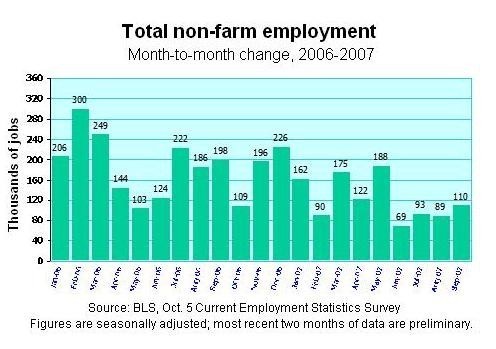
WASHINGTON – Total non-farm employment nationwide rose by 110,000 workers last month compared with the month before, according to a report today by the U.S. Department of Labor’s Bureau of Labor Statistics. The increase was well above the 90,000 per month average job growth in June through September, but below the 147,000 per month average for January through May, the BLS noted.
“The unemployment rate was essentially unchanged at 4.7 percent,” Acting BLS Commissioner Philip L. Rones said in a statement today. “Health care, food services and professional and technical services all continued to add jobs, while employment in manufacturing, construction, and employment services remained on a downward trend.”
Among service-providing industries, the education and health services (+44,000) and leisure and hospitality (35,000) sectors were notable, adding a combined total of 79,000 jobs last month. By contrast, employment at building material and garden supply stores dropped 17,000 jobs over the month, the largest decrease since April 2001, and the financial service industry lost 14,000 jobs over the month, led by mortgage lenders and other credit intermediation companies, as the nationwide housing slump and credit crunch deepened.
Construction employment fell by 14,000 jobs, to 112,000 below its peak in September 2006. The greatest year-over-year losses were in residential construction, with specialty trade contractors shedding 155,000 jobs in the past 12 months. “In contrast, employment in the nonresidential and heavy construction industries has been relatively flat,” the BLS wrote.
Employment in goods-producing industries fell by 33,000 in September, the BLS said. Manufacturing employment fell by 18,000 jobs in September and 223,000 over the past year.
The average work week for production and nonsupervisory workers was unchanged from August at 33.8 hours. But average hourly earnings rose by 7 cents last month to 4.1 percent above their level at the beginning of the year.
“Total employment and the civilian labor force both rose over the month, after edging down in August,” Rones noted. “Both the August and September changes reflected large movements in the highly seasonal teen labor force.
“In September, the overall labor force participation rate was 66.0 percent and the proportion of the population that was employed was 62.9 percent. Both measures remained below their recent peaks reached in December 2006.”
Additional information, including the 29-page Employment Situation Summary and the BLS Commissioner’s Statement on the Employment Situation release, is available from the U.S. Department of Labor’s Bureau of Labor Statistics at www.bls.gov.