CHICAGO – The U.S. mortgage delinquency rate rose for the sixth consecutive calendar quarter in the April to June period, according to the latest figures from credit data giant TransUnion LLC.
The average delinquency rate nationwide – the percent of mortgage borrowers who had fallen behind on payments by 60 days or more – rose to 3.53 percent in the second quarter, TransUnion found. That represented an increase of more than 9 percent from the first quarter’s 3.23 percent and about 51 percent from the second quarter of 2007.
Building a Strong Data Foundation in the Age of AI
Artificial intelligence (AI) has become a key priority in the boardroom and across management —…
Learn More
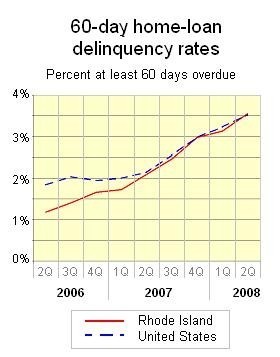
Delinquencies on home loans in the Ocean State surged to above the U.S. rate for the first time in at least two years, based on data TransUnion provided to Providence Business News. Rhode Island’s delinquency rate surged to 3.55 percent in the second quarter, an increase of 13.4 percent compared with the first quarter of this year and 69.9 percent compared with the 2007 second quarter.
Since the second quarter of 2006, the loan-delinquency rate for residential mortgages in Rhode Island has more than tripled, from 1.18% to 3.55%, while the national rate has nearly doubled, from 1.84% to 3.53%, TransUnion data show.
“The continued increase … was not surprising,” Keith Carson, a senior consultant in TransUnion’s financial services group, said in a statement accompanying today’s national report.
“The second quarter of 2008 showed not only a substantial increase in the nation’s unemployment rate and unprecedented gas prices, but also a continued decline in consumer confidence,” he wrote. “Furthermore – and as we expected – the downward trend for housing prices continued at the national level, as supply continues to exceed demand in certain markets.”
Second-quarter mortgage delinquency rates were highest in Nevada (6.63 percent) and Florida (6.47 percent), two states particularly affected by the recent housing slump. Delinquencies were lowest in North Dakota (1.10 percent), South Dakota (1.50 percent) and Montana (1.54 percent), TransUnion said.
Average mortgage debt nationwide edged up 0.4 percent compared with the first quarter to $192,681. That was a 3.35-percent increase from the 2007 second quarter’s $186,432 average and an 11.9-percent increase from the second quarter of 2006.
Home-loan debt in Rhode Island edged up to $194,174, an increase of about 0.8 percent from both the preceding and the year-ago quarter, but 11.4 percent from two years ago, TransUnion data show.
Going forward, Carson wrote, “The national 60-day mortgage delinquency rate among mortgage borrowers is expected to continue to rise throughout 2008, from a value of 3.53 percent in the second quarter of 2008 to just over 4 percent by year end. This is primarily due to the continued economic weakness in certain segments of the country combined with the continuing fallout of the mortgage crisis.”
By year’s end, the delinquency rate in Nevada is expected to hit 8.7 percent, “while North Dakota (1.3 percent) is expected to show the lowest level of delinquency,” TransUnion wrote.
In 2009, however, mortgage delinquencies are expected to “taper off as economic conditions improve and home prices begin to stabilize,” the company said.
The quarterly mortgage delinquency report is part of a broader consumer-lending analysis by TransUnion that also evaluates credit-card and auto-loan data. The reports are based on the company’s Trend Data, “a one-of-a-kind database consisting of 27 million anonymous consumer records randomly sampled every quarter,” TransUnion said.
TransUnion LLC, founded in 1968, is a credit information, data management and analysis company with operations in all 50 U.S. states. TransUnion has more than 3,100 employees in 25 nations on five continents. For more information, visit TransUnion.com.