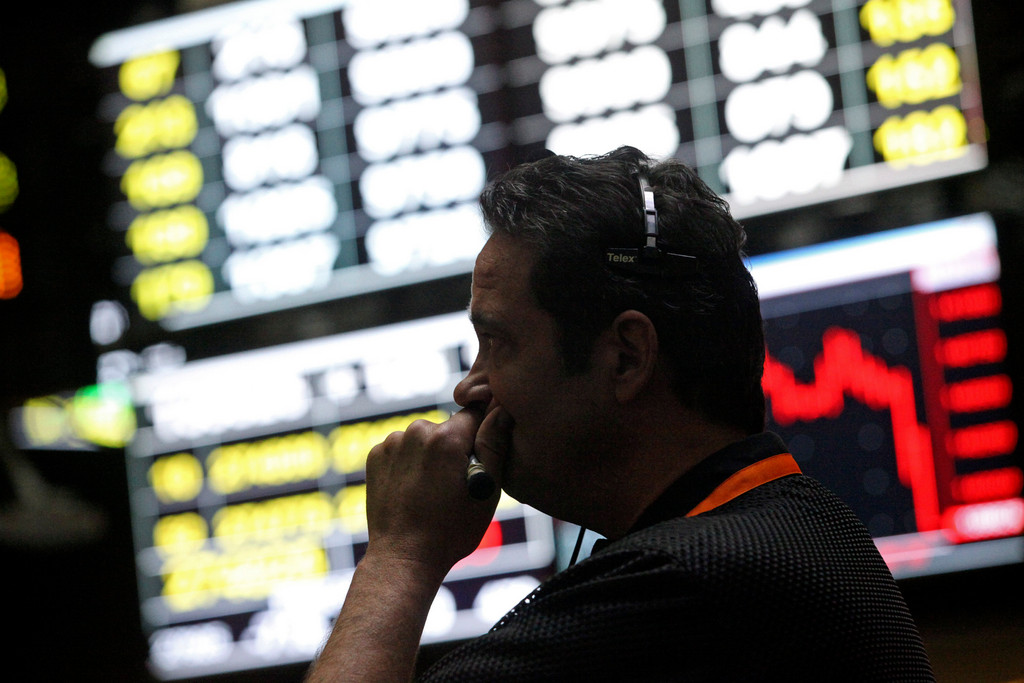
NEW YORK – U.S. stocks fell, following a two- week decline in the Standard & Poor’s 500 Index, as data showed American manufacturing contracted in August, fueling concern the economic recovery is slowing.
Netflix Inc. slumped 8 percent, the most in the S&P 500, after Amazon.com Inc. reached a deal with pay-television channel Epix. Peabody Energy Corp. lost 4 percent as Dahlman Rose & Co. cut its recommendation on the company’s stock. Morgan Stanley rose 1.8 percent after CLSA Ltd. recommended buying the shares. Valeant Pharmaceuticals International Inc. rallied 14 percent after agreeing to buy Medicis Pharmaceutical Corp. for $2.6 billion. Medicis surged 38 percent.
The S&P 500 declined 0.6 percent to 1,398.43 at 11:08 a.m. New York time. The Dow Jones Industrial Average retreated 98.65 points, or 0.8 percent, to 12,992.19. The U.S. market was closed yesterday for a holiday. Trading in S&P 500 companies was down 4.7 percent from the 30-day average at this time of day.
“Economic data continues to be soft all over the world and that’s just the basic reality,” John Kattar, chief investment officer at Eastern Bank Wealth Management in Boston, which manages $1.7 billion, said in a telephone interview “But more important than that is speculation on what the ECB is going to do this week and what the Fed is going to do next week,” he said, referring to policy meetings by the European Central Bank and the Federal Reserve.
Manufacturing shrinks
Rhode Island's Market Has Changed. Developers, Builders, Investors and Sellers Must Change With It.
By Emilio DiSpirito IV License Partner | Engel & Völkers Oceanside Leader | The DiSpirito…
Learn More
Equities fell as the Institute for Supply Management’s U.S. factory index dropped to 49.6 in August from 49.8 a month earlier. Economists in a Bloomberg survey projected an August reading of 50, which is the dividing line between expansion and contraction. A report over the weekend showed China’s manufacturing contracted at the fastest pace since March 2009.
European leaders are meeting in Rome and Berlin today, two days before the European Central Bank holds its policy meeting. ECB President Mario Draghi is due to distribute his bond- purchasing plan to national banks after he was said to tell officials he would be comfortable buying three-year government bonds to lower borrowing costs.
The S&P 500 rose 2 percent in August, capping its longest monthly rally since March, amid expectations global central banks would stimulate the economy. Federal Reserve Chairman Ben S. Bernanke said on Aug. 31 at an annual forum in Jackson Hole, Wyoming, that he wouldn’t rule out steps to lower a jobless rate he described as a “grave concern.” Payrolls probably grew at a slower pace in August and unemployment exceeded 8 percent for a 43rd month, economists said before a report this week.
“People are coming back from a long weekend and trying to get their minds wrapped around the market again,” said Tom Wirth, who helps manage $1.6 billion as senior investment officer for Chemung Canal Trust Co., in Elmira, N.Y. “The latest economic numbers have shown a bit of a pick-up. Yet it’s nothing to shout about. We continue in this slow growth area.”
Companies whose earnings are most tied to economic growth fell the most in the S&P 500, with industrial and commodity stocks sliding at least 1.3 percent. The Morgan Stanley Cyclical Index retreated 1.4 percent. Caterpillar Inc., the world’s largest maker of construction and mining machines, dropped 3 percent to $82.75.
Netflix slumped 8 percent to $54.93. Amazon.com reached a deal with Epix to add movies such as “The Hunger Games” to the roster of films available through Amazon Prime Instant Video, ratcheting up competition with Netflix.
Peabody, Nvidia
Peabody Energy dropped 4 percent to $20.76. The company was cut to hold from buy at Dahlman Rose, which also lowered its outlook for metallurgical coal used in steelmaking.
Nvidia Corp. slid 4.9 percent to $13.35. The maker of graphics processors was cut to neutral from positive at Susquehanna Financial Group LLP.
Morgan Stanley added 1.8 percent to $15.27 after being raised to buy from outperform at CLSA by equity analyst Michael Mayo. The 12-month share-price estimate is $23.
Valeant rallied 14 percent to $58.62, while Medicis surged 38 percent to $43.58. Canada’s largest publicly traded drugmaker said yesterday it will pay $44 in cash for each share of Scottsdale, Arizona-based Medicis, 39 percent more than the Aug. 31 closing price. The transaction, which will expand a lineup of wrinkle treatments and skin-care products, will close in the first half of 2013, Montreal-based Valeant said.
Gamestop Corp. advanced 4.9 percent to $20. The electronic game and software company was boosted to buy from neutral at Goldman Sachs Group Inc.
Rewarding investors
Profits are moving U.S. equity prices more than any time since the bull market began 3 1/2 years ago, rewarding investors for picking stocks based on company data instead of following the herd rocked by Europe’s crisis and the slowing U.S. economy.
Companies in the S&P 500 rose or fell an average of 4.4 percent the day after releasing results since July, according to data compiled by Bloomberg. The last time they moved more was in the second quarter of 2009. Daily swings in the benchmark gauge narrowed to 0.4 percent last month from 2.2 percent a year ago, as economic and policy changes battered investors. More than 475 S&P 500 stocks moved in the same direction in six of the first nine days of August 2011, with all 500 down on Aug. 8.
Bulls say lockstep moves are diminishing because investors are changing their behavior, making choices based on corporate results at a time when analysts estimate profits for companies in the S&P 500 will rise almost 10 percent a year through 2014. Bears say the focus on earnings won’t bring back individuals who have drained more than $420 billion from U.S. equity mutual funds over the past four years even as stocks rallied 108 percent since March 2009 and net income was unchanged in the second quarter.
“I’m not saying it’s an easy job to be a stock picker in this environment, but it’s certainly easier,” Sandy Lincoln, the Chicago-based chief market strategist with BMO Global Asset Management, which oversees about $100 billion, said in an Aug. 28 interview. “Stock selection does have the opportunity here to finally show a face with a smile.”