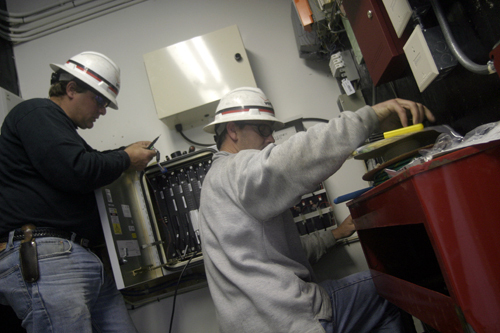
Continuing its push into Rhode Island’s cable television market, Verizon Communications will spend $86 million in the state by year’s end to continue laying fiber-optic cable lines directly to the homes of customers who sign up for the company’s FiOS TV offering.
State regulators have approved the offering of FiOS in Charlestown, Richmond, Scituate and Westerly. Verizon is currently seeking licenses to offer FiOS TV in Burrillville, Central Falls, Cumberland, East Providence, Glocester, Lincoln, North Smithfield, Pawtucket, Smithfield and Woonsocket.
The service is already available in Coventry, Cranston, East Greenwich, Exeter, Foster, Hopkinton, Johnston, Narragansett, North Kingstown, North Providence, Providence, South Kingstown, Warwick, West Greenwich, and West Warwick.
By the end of this year, Verizon expects to offer FiOS TV in all 29 of these communities, which account for 80 percent of Rhode Island households and business, said Lillian McGee, a regional spokeswoman for the company.
McGee declined to discuss specific numbers regarding Verizon’s rollout of FiOS in the state because of competitive considerations. But she said that FiOS has exceeded the company’s expectations in the early going.
“It’s beyond our expectations,” McGee said. “I think [FiOS is] a very strong product, the quality is definitely a factor, and I think, too, it’s because people have a choice now. There’s someone else in town that they can get their cable services from.”
Verizon also announced it would hire 50 new technicians and customer service representatives in Rhode Island, mostly to work in its Fiber Solutions Center, a customer service call center that Verizon opened in Providence in 2006. The call center’s staff will increase to 350.
“With this capital investment plan we are making a major commitment to our customers and our employees in Rhode Island,” said Donna Cupelo, Verizon’s regional president. “We believe the time and the climate are right for growing our investments and expanding our technology deployment.
In fact, Verizon is investing heavily in its all-digital, fiber-optic network across the nation, as the company positions itself to compete directly with traditional cable providers as technology blurs the lines between the two industries.
In Rhode Island, the company has launched ubiquitous marketing campaigns – including door-to-door sales and free high-definition television giveaways – in each community it has been cleared by regulators to offer FiOS.
To a certain extent, Verizon is staking its future on the ability to win cable customers from cable television providers like Cox Communications Inc., the third-largest cable company in the nation and Rhode Island’s dominant cable provider, which began luring local telephone customers from Verizon a decade ago.
Not all of Verizon’s new FiOS customers in Rhode Island switched over from Cox – the company is also competing with satellite television providers, and the number of Verizon’s own DSL high-speed cable customers is dropping as some switch to FiOS, according to market reports.
In an April 29 note to investors regarding Verizon’s quarterly financial results, UBS Investment Research said that “FiOS appears to be doing better than expected but the remaining services have lagged our expectations, preventing improvement in revenue trends from this investment from coming through.”
But Verizon’s ability to bundle high-speed cable television with its other phone and Internet offerings in Rhode Island alters the local competitive landscape most visibly for Cox Communications.
Defending its turf, Cox has focused on offering new products and services – particularly to business customers – and on marketing itself as a longtime corporate citizen in Rhode Island finely tuned to the needs of the local market.
Paul J. Cronin, Cox’s regional manager, said the company welcomes the competition.
“Any time a new competitor comes on the scene – particularly someone like Verizon that has deep coffers and spends so much on marketing and advertising and promotion – it certainly shakes up the marketplace a little bit,” Cronin said. “I don’t think it takes long for the market to go back to kind of a normal, competitive rhythm.”
In a sign of their intense competition in Rhode Island, both Verizon and Cox have adopted a press policy against discussing the number of cable customers each has in the state. While the companies are required to share those numbers with state regulators, both companies petitioned the R.I. Public Utilities Commission to file them under protective order, which was granted.
The horse race between Verizon and Cox for cable, phone, wireless and high-speed Internet customers is making Rhode Island’s telecommunications market – already among the most competitive in the country – even more competitive, according to analysts.
Verizon’s continued investment in its networks and increasing deployment of broadband and TV services “has created a robust marketplace in Rhode Island that has resulted in the development of innovative new technologies, competitive pricing, and a sharpened focus on customer service, all of which bodes well for Rhode Island consumers and the state’s economy,” Cupelo said in a press release. •