Rep. Brian P. Kennedy thought he had successfully championed state legislation this past session that for the first time regulated the controversial “stranger-originated life insurance” industry.
Kennedy (D-Hopkinton) said the measure approved by the General Assembly would have established consumer protections for people – mostly senior citizens – who agree to take out a life insurance policy then sell the rights to a “life settlement” company, making that company the beneficiary. Eleven other states this year alone have enacted similar laws, he said.
“The expectation is that [the senior] will die as soon as possible and the beneficiary will not be the family, but total strangers …,” Kennedy explained. “It is a practice akin to wagering on someone’s death.”
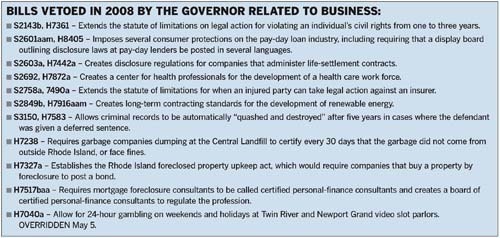
But earlier this month, Gov. Donald L. Carcieri vetoed the bills (S 2692a and H 7872a), citing in his message to legislators his concerns that the new regulations might restrict consumers’ abilities to purchase other life insurance products. Of the 49 bills vetoed this legislative session, Kennedy’s measure was one of at least a dozen business-related pieces of legislation that didn’t make it past Carcieri.
The veto shocked Kennedy, who called it a “huge setback” in protecting consumers from “unsavory practices of the life industry.”
While the governor’s veto of the popular renewable energy bill has attracted the most attention, other legislation with ties to business that have fallen victim to vetoes range from one that would create a group to coordinate efforts to develop a health care work force (S 2692 and H 7892a) to another requiring garbage-collection companies dumping at the Central Landfill to certify every month that their trash is not coming from outside Rhode Island (H 7238).
As of last week, legislative leaders hadn’t decided whether to reconvene for overriding votes. Larry Berman, spokesman for House Speaker William Murphy, said the top legislators will decide in the coming weeks.
“What they need to do is go over the inventory of what was vetoed,” Berman said.
Although the General Assembly has until January to override the governor, observers have said it’s possible that legislators will return in the fall, when more of them would be available. In order to override a veto, the legislature needs the approval of three-fifths of the legislators present at the time of the vote.
If the legislature were to reconvene, tops on the override agenda would likely be the renewable energy bill that encouraged private investment in large renewable energy projects by guaranteeing that National Grid will purchase the output. Carcieri’s veto drew protests from environmentalists and legislative leaders.
But not everyone wants the legislators to come back early.
David R. Carlin III, the lobbyist for a coalition of 13 chambers of commerce in Rhode Island, was jubilant last week about several vetoes, including one that rejected an attempt to set the statute of limitations on alleged violations of the Rhode Island Civil Rights Act at three years.
In his veto message for that measure (S 2143b and H 7361), Carcieri cited a 2007 R.I. Supreme Court decision in a gender bias case that found that the one-year limit for the Rhode Island Fair Employment Act should also be applied to the Civil Rights Act.
“The statute of limitations for similar employment actions under the two statutes should be consistent,” the governor wrote. “A three-year statute of limitations for this type of action is not reasonable for the business community…”
Carlin agreed, saying employment discrimination cases often turn on conversations that took place in the workplace and other memories.
“It’s important that a discrimination case be brought within a year, while those memories are fresh,” Carlin said.
According to Carlin, two other vetoes benefited business:
One targeted legislation that would extend the time limit for an injured party to sue a business’ or individual’s insurer (S 2758a and H 7490a), the other rejected the much-discussed measure that would have automatically “quashed and destroyed” criminal records after five years in cases where the defendant was given a deferred sentence (S 3150 and H 7583).
Carlin argued that expunging criminal records would make it more difficult to hire appropriate workers. “Particularly when it’s a job handling money, it’s extremely important to know the background of potential employees,” he said.
In several veto messages, Carcieri agreed with the intent of the legislation but found flaws with certain provisions.
With the legislation requiring garbage-collection companies using the Central Landfill to certify where the trash originated, the governor worried that costs to enforce such a regulation would exceed revenues from fines.
And a measure that would create a Center for Health Professions, under the sponsorship of the Health Partnership Council of Rhode Island, for coordinating statewide efforts to address the shortage of nurses brought this response from Carcieri:
“While I wholeheartedly support this goal, I am forced to voice my disapproval,” he wrote in his veto message. “Work force development is clearly an executive function, whose duties rest with the Director of the Department of Labor and Training … Ceding executive branch authority to a private institution does not serve the public good.”
Carcieri rejected legislation that imposed several consumer protections on the pay-day loan industry (S2601aam and H 8405) because it also required those businesses to display disclosure laws in more than one language.
“While I am supportive of increased measures to protect the public, I am vehemently opposed to a government mandate that requires a private business to conduct its operations in any language other than English,” the governor said in his veto message.
Carcieri also rejected a measure (H 7517b) that would require mortgage foreclosure consultants to be called “certified personal finance consultants” and would create a board of certified personal financial consultants to regulate the profession.
He said he saw no need for it.
“A new board means more government and more regulation, which means more red tape, more paperwork, and at some point in time, more fees,” the governor said in his veto message. •