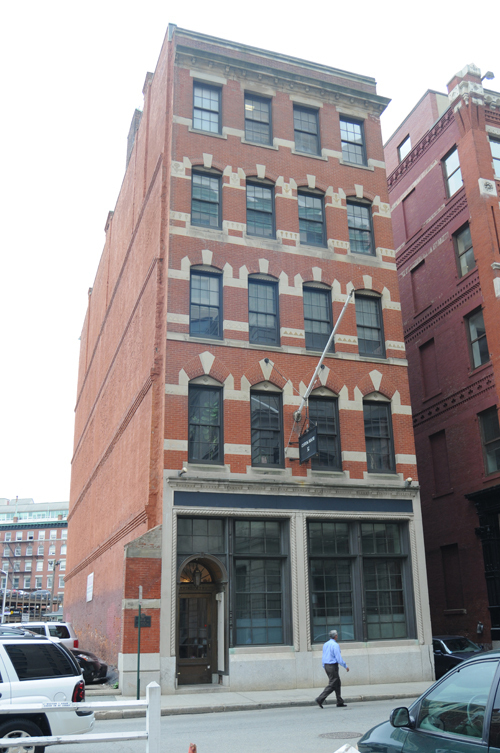
Last August, it seemed that the Equitable Building, prominent in Providence’s Financial District and one of only a few cast iron-fronted buildings in Rhode Island, wouldn’t be vacant for long.
David Corsetti, principal of Premier Development and Corsetti Properties LLC, was confident that he could turn the building around. He had bought it in 2003, paying just $750,000 for a property the city valued at $1.02 million. A sign for “Custom House Tavern,” which had closed, still hung outside, but scaffolding covered the building and a $2 million renovation was under way. Corsetti hoped the renovation would draw office tenants. He planned to open a new two-floor restaurant on the ground level.
Today, the 10,000-square-foot building is still vacant.
And, as of last month, municipal tax liens had been filed against Corsetti, although in the middle of last week, the documents were not available in the office of the Recorder of Deeds. The Equitable Building – along with Corsetti’s two other Financial District buildings and another on Plain Street – have entered the state’s receivership process. In addition, a message left for Corsetti last week was not returned, and Premier Development’s phones have been shut off.
On May 28, the court-appointed receiver, Richard L. Gemma, principal of Wieck, DeLuca & Gemma, announced that bids for each building – or all the buildings as a package – will be accepted until June 30. Gemma plans to award the properties in July. For the three buildings in the Financial District, which are appraised by the city for a total of $4.63 million, Corsetti paid $3.55 million in 2003 and 2004, according to public records.
Some of Providence’s commercial real estate professionals see Corsetti Properties’ receivership as a harbinger of future trouble in the Financial District. Hayes & Sherry Real Estate Services Partner Karl F. Sherry, who runs one of the state’s largest commercial brokerages, said last week that the district’s leasing activity has slowed to a crawl.
“You’ve got some buildings out there that have some vacancy, and they just haven’t been able to fill the space,” he said, adding, “I think a lot of people are trying to ride this economy out and instead of trying to find a new location, they’re just re-signing their lease for a short period, a year or two years, and waiting to see what happens.”
Although the value of commercial property is falling, most lenders are raising equity-to-lending ratios, MPM Property Management President and CEO John J. Macliver said. (His firm is managing the Corsetti properties while they are in receivership.) That means that when a building owner who bought in the last few years attempts to refinance, he will need more equity to do so – and without tenants, proving that they have equity in their property could be a challenge.
“The office market issues really haven’t hit yet,” Macliver added.
He and Jeffrey J. Miller, who co-owns Barrington Capital Partners, last month were part of a team that founded New Providence Group. NPG is designed to counsel lenders dealing with loans that have the potential for default because of tenant and cash flow problems. “Our role is to come in, hopefully early in the process, be able to evaluate a portfolio of loans – looking at cash flow and value on each asset,” Miller said last week. NPG will be recommending that lenders work out deals or foreclose – and their suggestions could depend on how many tenants a building has.
A “flurry” of overbuilding in the last few years has led to a glut of office space that hasn’t been absorbed. And, with job losses mounting, the immediate future of Rhode Island’s commercial market looks grim, Miller said.
Overall vacancy for Providence office space is about 15 percent, according to Hayes & Sherry. CB Richard Ellis-New England earlier this year put the Financial District’s vacancy at about 12.5 percent. Still, Sherry said he expects the vacancy rate to climb through the end of the year.
And the vacancy rate in Corsetti’s three Financial District buildings is worse off than much of the rest of the city.
While the Equitable Building is vacant, the 13,500-square-foot 32 Custom House St. property has only one tenant listed by the receiver: The law offices of M. McLaughlin occupies the 2,700-square-foot top floor.
But Hanson Curran LLP, the largest tenant, leasing the first two floors – or about 40 percent of the building – doesn’t plan to stay. Partner James T. Murphy said his firm has been in the building since 1990. Hanson Curran had owned it and sold to Corsetti in 2003. It will move this summer to the Turk’s Head building – they had notified Corsetti before the receivership, Murphy said. “I can tell you, this is a wonderful building,” he said of 146 Westminster St. “But it needs a little TLC.”
Even before Hanson Curran moves out of the building, there are 23,000 square feet of vacant space in the three Class B buildings. That’s about 53 percent of available space and about three times more than the 17 percent citywide vacancy average for all Class B buildings, according to Hayes & Sherry.
Sherry said buying a building now might be a solid investment because values are dropping, but vacancy rates likely won’t improve until the economy does.
“Somebody who has some cash and has been sitting on the sideline and sees one of these buildings coming up that’s maybe 50 percent vacant, they may get a pretty good deal,” he said.
Said Gemma: “It’s a wonderful opportunity for someone to come in and buy a prominent building in the heart of downtown.”
There are some long-term tenants in the Corsetti buildings. Friedrich St. Florian, the architect who designed the exterior of Providence Place and the World War II Memorial in Washington, D.C., early last February signed a six-year lease for 146 Westminster St.
“Fundamentally, what we were told as far as the tenants are concerned is that we shouldn’t worry too much” about the receivership process, St. Florian said last week. “Basically, whoever wants to buy the building will be delighted that there are tenants.” •