Environmental advocates are lamenting the General Assembly’s decision last month to slash a $35 million bond request by Gov. Donald L. Carcieri that would have provided funding for the state’s clean water and open-space protection efforts.
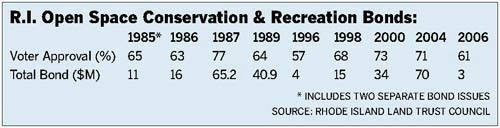
By the time lawmakers left Smith Hill, all that remained of the original proposal was a $2.5 million bond to buy development rights and conservation easements from farms around the state to keep them from being developed. Voters – who have backed similar proposals by wide margins in the past – will be asked to approve the measure on the November ballot.
“Even at a time when our state is strapped for cash, it makes sense to save farmland from development,” said Rep. Donna M. Walsh (D-Charlestown), who pushed the act through along with Sen. V. Susan Sosnowski (D-South Kingstown). A separate attempt by Rep. John J. Loughlin II (R-Tiverton) to boost the bond’s total to $5 million was defeated by just six votes.
The legislators’ efforts won praise from the director of the Rhode Island Land Trust, Rupert Friday, who said preserving farmland is a good investment because farming contributes $100 million to the state’s economy and is a key part of its culture. The land’s value will also appreciate in the decades to come without additional state investment, he said.
Since 1986, the farm preservation program has spent $4.1 million to preserve 19 farms totaling 1,279 acres, which are now valued at $10.1 million, according to the state. Foundations and other nonprofits have also contributed money. In addition, the farm bill passed last month by Congress roughly doubles the size of federal matching grants for farmland preservation.
However, in the absence of a larger bond, there will be no new money in the next two years for local open-space grants, state park property acquisitions, and projects to reduce water pollution. The next opportunity for new funding will be on the November 2010 ballot.
Supporters of the original $35 million proposal blamed its demise on Rep. Steven M. Costantino (D-Providence), chairman of the House Finance Committee, which killed the bond without discussion. But he defended the move as fiscally responsible.
“In an extremely challenging year, the Finance Committee was reluctant to add $35 million in debt to an already strained state budget,” Costantino said in an e-mail. “The $2.5 million bond issue that the General Assembly authorized to be placed on the ballot this November was all we could afford this year.”
He added, “There is still some open-space money in the pipeline, and we can revisit this issue in two years.” About $6.9 million remains from the 2004 bond for local open-space grants and state park property acquisitions, but only $70 was left for farmland acquisition.
Even if voters had approved the $35 million bond on the fall ballot, Friday said, lawmakers and the governor still would have had the final decision on when and whether to actually borrow the money.
Jane Austin, an advocate with Save The Bay, said the lack of new money to fund water pollution prevention and wastewater plant upgrades will result in higher borrowing costs for cities and towns, and also put the water quality of Narragansett Bay in jeopardy.
“I think it’s a rather shortsighted kind of economic analysis not to build this into the budget,” she said.
Save The Bay and other groups concerned with water resources now know they will need to step up their advocacy on behalf of these programs in 2010, Austin said.
“We probably should have pushed harder for these funds in this context,” she said. “The open- space folks did work very hard, and did have some success in the last minutes of the session.”
Austin added, “This is an investment that we cannot afford not to make, and we probably need to make that argument a lot more strongly and surely to the legislature.”
Without the larger bond, the loans available for municipal wastewater projects from the R.I. Clean Water Finance Agency will be reduced from $64 million to $38 million in 2009-2010, according to the agency’s executive director, Anthony B. Simeone.
Still, he said, “It doesn’t [eliminate funding for] us. We understand that there has to be some belt-tightening because the state has a huge gap that they needed to close. … We’re hopeful that in the future, during better economic times, maybe the state could see clear to send more money our way to build those capital projects.”
William Sequino Jr., the town manager in East Greenwich, said his community has used the clean water agency’s low-interest loans to finance a number of projects over the last decade, including the $20 million installation of new sewers west of Route 2 and the addition of a $6 million nitrogen removal system to the wastewater plant. The lower interest rates resulted in a lower cost to sewer ratepayers, he said. •