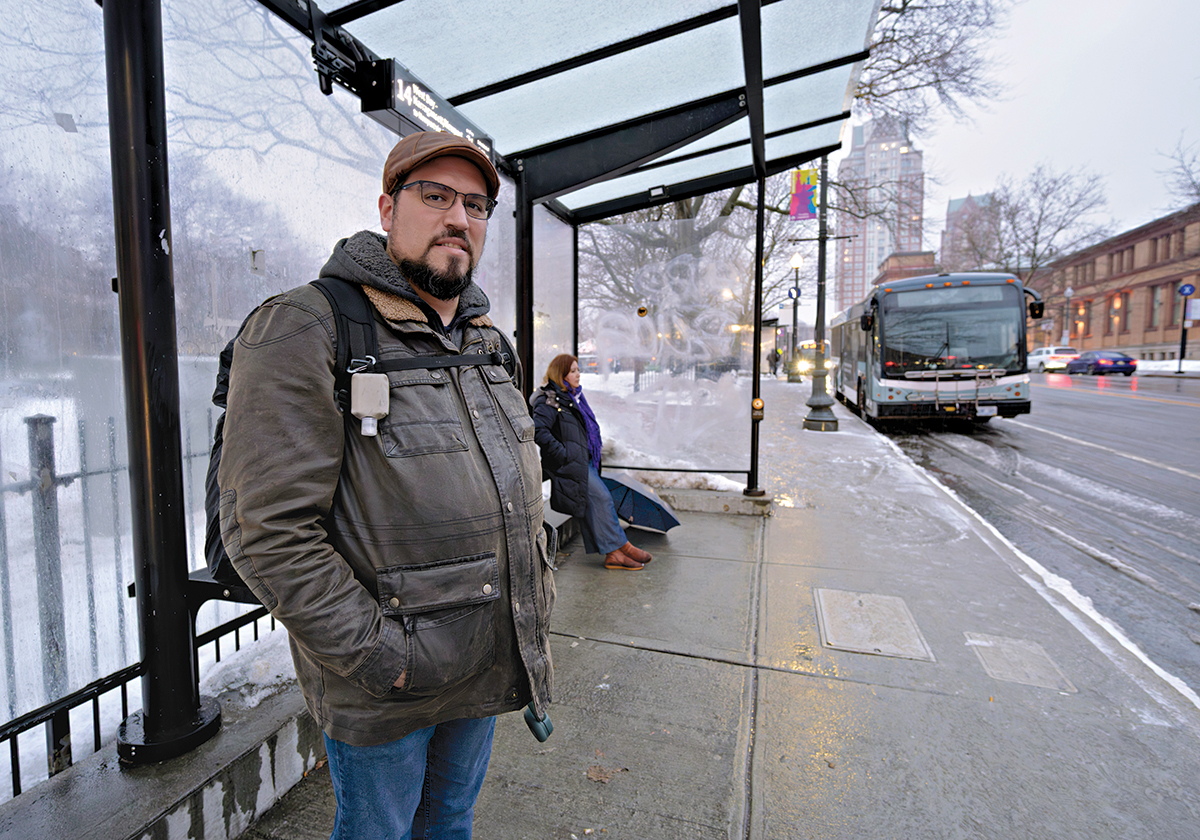
For years, East Providence resident Barry Dejasu’s commute to Warwick followed the same routine: Leave the house at around 7:30 a.m., walk to the R.I. Public Transit Authority bus stop at the end of his street, then transfer at Kennedy Plaza in Providence to a second bus that would drop him off about a 15-minute walk from his office.
The journey took about an hour, but Dejasu, who works at an accounting firm and doesn’t own a car, says it was affordable and felt relatively easy. That changed when sweeping RIPTA service cuts went into effect last September.
Now, buses don’t start running the route near Dejasu’s house until later in the morning – too late for Dejasu to make it to his job on time.
So he wakes up at 5:30 a.m. to leave his house half an hour earlier and walks to a more distant stop. If the buses are running on time, which is never a guarantee, the new arrangement adds another 30 minutes to his morning commute. Meanwhile, he has to arrive at the office earlier, as the bus he catches to get home now leaves about 15 minutes earlier than his schedule would typically end.
“It’s a lot of leaving early in every direction I go, basically,” Dejasu said.
There are financial consequences, too. When the RIPTA cuts first went into effect in the fall, Dejasu had to drop work shifts that the bus schedule no longer accommodated. And on occasions when the bus is late, he’s had to pay about $18 – enough money to cover 9 RIPTA fares, which run a flat $2 – for a one-way trip with the on-demand ridesharing service Lyft.
Dejasu is one of countless transit riders facing a longer, all-around more difficult commute due to reduced bus services. Still, he considers himself fortunate compared with some other Rhode Islanders who rely on RIPTA and have few alternatives to get to work and back home.
If the results of a survey conducted last fall by a public transit advocacy group are any indication, there are many people who fall into that category.
Save RIPTA, a subgroup of the nonprofit Providence Streets Coalition, released results of the survey and testimonials as part of its “2025 Service Cuts Impact Report” last month.
Of 249 people who commented on an online survey, 101 said they had experienced or feared job impacts; 72 said they had concerns that they would lose their jobs as a result of the cuts; and eight reported that they had lost their jobs due to the service cuts. Twenty-one respondents said they had to reduce their work hours.
Such effects have gotten the attention of some businesses, particularly those in sectors that rely on hourly workers and shift employees – such as retail, manufacturing and health care. Because workers may be late or absent, hiring pools shrink and employee turnover can rise.
Kevin Durfee, owner of George’s of Galilee restaurant in Narragansett, says he’s lost six employees because of bus route reductions. “RIPTA is just a critical tool for getting people to and from work,” he said.
Indeed, buses running less often and daily services starting later and ending earlier add up quickly in riders’ lives, says Dylan Giles, an organizer with the Providence Streets Coalition, which advocates for alternative transportation modes.
“If someone is working a night shift, they might have to Uber home instead of taking a bus that used to run until midnight and now runs until 8 p.m.,” Giles said.
[caption id="attachment_517171" align="aligncenter" width="1200"]

ON THE RUN: One of the buses on The Quonset Express – or Qx – route makes its way through the business park in North Kingstown on a February afternoon.
PBN PHOTO/ELIZABETH GRAHAM[/caption]
MONEY ISSUES
RIPTA has long struggled with recurring financial shortfalls, largely due to structural funding challenges as operating costs rise faster than dedicated revenue sources. Temporary federal COVID-19 pandemic aid masked the problem for several years, but once that money evaporated last year, the financial woes grew much worse.
Last year, estimates in planning documents showed RIPTA expenditures would total $159.1 million for fiscal 2026, eclipsing revenue by $31.5 million.
Through negotiations and funding changes, that projected shortfall was reduced, but RIPTA was still left with a gap of about $10 million that needed to be closed.
The RIPTA board in late August approved a series of service cuts that reduced the frequency of rides along 40 “lower-ridership” routes. RIPTA also enacted a multi-year schedule of fare increases for the first time in 15 years, eliminated or reassigned employees in administrative positions, and raised advertising revenue and federal reimbursements by $2.5 million.
The results could have been even more dire. A month earlier, the board was mulling a proposal that would have affected 58 of RIPTA’s 67 service routes, completely eliminating 16 routes. After intense public backlash, the board revised the proposal to emphasize route reductions over complete elimination.
Patrick Crowley, a RIPTA board member and president of the Rhode Island AFL-CIO, sees the reductions as “a layer of inconvenience for too many people who rely on RIPTA as their primary source of transportation.
“It’s been harder for people to get to work, to get to doctors’ appointments, and to just get around the state,” said Crowley, who voted in favor of the service changes.
What’s happening to RIPTA has certainly drawn the attention of the business community, including the Rhode Island Hospitality Association and Rhode Island Manufacturers Association.
“I’ve spoken to some restaurant operators that have literally said that if these cuts grow, they’ll have to shut down half of their restaurant [capacity],” said Farouk Rajab, RIHA president.
Melissa Travis, president of RIMA, says public transit is vital for workforce development. “Across industries, CEOs consistently identify employee transportation and mobility as meaningful barriers to recruitment and retention,” Travis said in a statement to PBN.
Ocean State Job Lot, which employs about 1,100 people at its corporate headquarters and a distribution center in North Kingstown’s Quonset Business Park, recognizes that robust public transportation means a wider pool of workers, said Kristen Gardella, the company’s director of human resources.
For a Rhode Islander living in Woonsocket, a job in Quonset Business Park is likely a tough sell.
Even for those living not quite as far as Woonsocket, it’s often a formidable commute without a car. In an attempt to close that barrier, state transportation and workforce leaders teamed up to launch an express bus route running from northern Rhode Island to several stops within Quonset.
“I think it does open up more potential for others to consider us as an employer when they might not have before,” Gardella said, “because they thought [Quonset] is just too far away.
“If they have access to safe, reliable transportation, then we become an employer of choice for them,” she said.
Transit advocates and the agency itself echo this idea. According to RIPTA data, 40% of the service’s nearly 17 million trips per year are work-related.
[caption id="attachment_517172" align="aligncenter" width="1200"]

DRIVING FORCE? CEO Christopher Durand has been lauded by RIPTA board members for the way he’s handled the authority’s financial problems.
PBN FILE PHOTO/TRACY JENKINS[/caption]
RIPTA CEO Christopher Durand says that strengthening workforce-specific programming will serve as a cornerstone in securing the agency’s stability, and eventually, growth.
“Coming out of the service changes, this is the key to success here,” Durand said. “Getting more people, but also tailoring [service] to businesses.”
Meanwhile, RIPTA has, in the past few years, broadened its workforce and commuter-specific initiatives. The agency launched its Quonset Business Park route, the Quonset Express, as a three-month pilot in 2019 and made the service permanent in 2021. The business park is home to one of the state’s largest employers, submarine maker General Dynamics Electric Boat.
The RIPTA schedule shows the Quonset Express – also known as Qx – makes as many as nine runs between Providence and Quonset each way on weekdays, making about a dozen stops in the business park. Some of those also connect to Woonsocket.
RIPTA said it was not immediately able to provide ridership data on the express program because of a recent change of personnel.
In 2022, RIPTA introduced Wave to Work, a program offering business owners the opportunity to partially or fully subsidize bus passes for employees. Eighteen companies have signed on so far, including Brown University Health, Amica Mutual Insurance Co., engineering firm Vanasse Hangen Brustlin Inc., and manufacturers Greystone Inc. and WaterRower Inc.
At The Miriam Hospital, the first Brown Health facility to participate in the program, about 50 employees actively use Wave to Work, according to spokesperson Jessica Wharton.
“We’re proud to work with RIPTA to pilot innovative solutions that support our workforce and local community, strengthen sustainability efforts, and provide employee satisfaction,” Wharton said in a statement.
WHO’S ON BOARD?
Lincoln-based Amica has just two employees who use the program, company spokesperson Brendan Dowding said. RIPTA currently makes just two stops at Amica per day.
But this low participation could be affected by a location – a corporate campus bordered by Routes 116, 146 and Interstate 295 – that is not especially conducive to bus travel in general, Dowding said, “so overall workforce impact from [RIPTA’s service changes] has been minimal.”
RIPTA and participating companies have had difficulty persuading employees to take advantage of public transit, Giles says, adding that the news about route reductions probably has not helped.
“Participation in Wave to Work is not great, and certainly the cuts to RIPTA don’t inspire confidence” in the service’s expansion, he said.
Durfee says that such programs don’t account for the reality of owning a small business. He hadn’t heard of the program, and he wants officials to focus on simpler solutions.
“They’re trying to get me to help people take the bus … [but] I have zero time to do these programs,” Durfee said. “They’re probably designed by legislators who have no concept of what it means to run a small business.”
But under RIPTA service reductions, Route 69, which connects the University of Rhode Island to the Galilee area of Narragansett, now runs every 90 minutes, down from every hour. It also starts later and ends earlier, and weekend buses were eliminated at first, but a limited Saturday service has resumed, according to RIPTA’s online schedule.
The buses are more critical in the summer, Durfee said, when there are few parking spaces during tourist season, and the restaurant relies on international students from URI, who often don’t have cars and rent apartments near bus routes, to fill out busy shifts.
“The best thing [RIPTA] can do is keep the bus lines open,” he said.
Durand says the Wave to Work program can serve small businesses, too. But it’s still on RIPTA to “get in there and show them the value to employees,” he said.
Beyond partnerships with specific businesses, RIPTA also offers express/commuter routes “tailored specifically to workplace-related transit,” the agency said in its 2019 Master Plan.
Most of those routes, such as ones to Amica, make just a couple of stops per day. The combined express routes make about 2,700 daily trips, according to RIPTA.
A route specific to Johnston’s Amazon distribution center – a massive warehouse that employs about 1,500 people – serves more than 30 passengers daily, Durand says. He considers the express route a significant success.
While many are frustrated with the service cuts, they don’t necessarily feel that RIPTA itself is to blame.
An independent efficiency study of RIPTA, commissioned by the state and conducted in August 2025 by national transportation planning first WSP USA and Foursquare ITP, noted that the transit authority makes good use of the financial resources that it has and provides an essential service throughout the state.
But efficiency can only go so far. The study found that RIPTA has limited remaining cost-cutting options and, without additional revenue, may need service reduction of up to 20%.
And advocates say that state leadership hasn’t truly acknowledged the vital economic role that the efficiency study describes, leading to chronic underfunding.
As state officials look ahead to fiscal 2027, RIPTA’S budget situation remains tenuous.
In December, the RIPTA board submitted a $158.9 million spending plan to Gov. Daniel J. McKee that had a $13.8 million funding gap. In turn, McKee’s $14.8 billion state budget proposal recommended that RIPTA receive a $9.3 million increase in the state’s Highway Maintenance Account base share revenue, as well as an additional $3.5 million in Rhode Island Capital Plan funds. Mckee’s proposal also estimates $1 million more will be generated from additional fees paid by the Newport-Providence cruise operator.
But the bus service can’t simply stay afloat, Crowley says – the board needs to find the resources to restore services.
[caption id="attachment_517173" align="aligncenter" width="1200"]

HOPING FOR HELP: Patrick Crowley, secretary of the R.I. Public Transit Authority board and a local union leader, says the General Assembly needs to provide additional funding for public transit to undo last year’s service cuts.
PBN FILE PHOTO/MICHAEL SALERNO[/caption]
Crowley says he’s “hopeful the General Assembly will provide additional funding,” which would need to amount to millions of dollars to reverse the damage done under the deficit.
Legislators also had to intervene in fiscal 2026, directing funding from a 2-cent per-gallon increase to the state’s gasoline tax to reduce RIPTA’s deficit by about $15 million.
Durand is also optimistic that the worst is behind RIPTA.
“We hit the bottom last year,” he said, “and I think we’re starting to climb out of that and think more about the future.”
Some observers are also encouraged by an upcoming leadership change at the R.I. Department of Transportation, namely the recent resignation of longtime RIDOT Director Peter Alviti Jr. He had served as RIPTA chairperson since 2023.
In the last few years of his tenure, Alviti faced criticism for his handling of RIPTA funding, as well as the emergency shutdown and yearslong replacement process of the westbound Washington Bridge.
The Providence Streets Coalition and Save RIPTA celebrated this development, sharing in a statement that “for over a decade, Rhode Island taxpayers have forked over billions of dollars to an unaccountable DOT that has not produced adequate results for drivers, failed to meet our emissions reductions goals, and consistently rejected dignity, safety, and convenience for people who cannot or do not drive.”
‛BAFFLING TO ME’
Along the Quonset Express route, which was spared in the recent round of service cuts, Gardella, of Ocean State Job Lot, hopes that working with RIPTA will reinforce a vision of how improved transit will impact the workforce.
The Quonset Express didn’t immediately take off with Job Lot associates, Gardella says, but the cause was easy to identify: Stops didn’t align with workers’ shifts. When brought to RIPTA’s attention, Gardella says, it was an easy problem to fix.
Changes went into effect in January, and Gardella is optimistic that more associates will begin to take advantage of the service, providing mutual benefits for the employer and employees.
Other changes to the Quonset routes have dramatically increased usage, Durand says. Last summer, RIPTA rearranged its system of northern Rhode Island stops and emphasized a direct bus from Kennedy Plaza to Quonset. Ridership increased by 300% following that change, Durand says.
RIPTA is also focusing on improving its ease of use. “If people haven’t taken transit every day, they haven’t taken it in a while, or they’ve never taken it, there’s a mental hurdle to getting on the bus,” Durand said. To that end, the agency is taking steps to add digital wallet payment.
But many riders continue to feel unheard.
Some harbor concerns that go beyond the bus schedule, such as ongoing talks about moving RIPTA’s Providence hub to a location less central than Kennedy Plaza.
“It was baffling to me that [the cuts] were even a consideration,” said Dejasu, who is also concerned about the bus hub relocation.
When he first heard about plans for service cuts, “my first thought was, how many people, myself included, won’t be able to get to their jobs?” he said. “This is going to affect so many lives, everything from housing and rental costs to the economy in general.
“The decision to do such things is coming from people who don’t ride the bus,” he said.