 click here. / " title="To view a full-sized chart, click here. /"/>
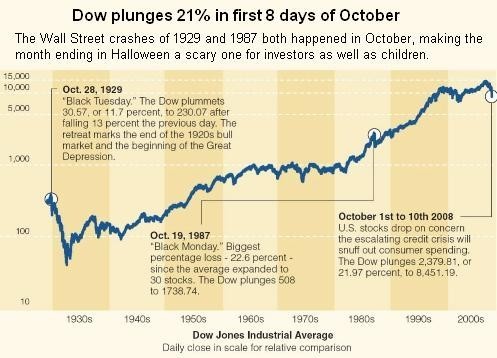
NEW YORK – U.S. stock markets ended the day down, after some of the wildest swings on record, amid fears the credit crunch will further slow consumer spending.
By the close of New York trading, the Standard & Poor’s 500 Index stood at 899.32 points, its lowest level in more than a year, after what Bloomberg News said was its worst week since 1933.
A modernized health plan: Supporting cost management and the employee experience.
The Surest health plan came from a group of innovators wondering: What if health care…
Learn More
The Dow, meanwhile, saw its widest intraday point swings ever. The index lost as much 697 points – dropping more than 500 points not once but twice: after the opening bell and again in mid-afternoon – then gained as much as much as 322 points in the final hour of trading, before retreating at the close. (Its rebound was credited to a forecast that the bankruptcy auction of Lehman Bros. Holdings debt won’t exacerbate credit-market losses, Bloomberg said. But meanwhile, the cost of credit-default protection on corporate bonds soared to a record high.)
For the day, the S&P was down 10.60 points, or 1.16 percent; the Dow Jones Industrial Average was down 128 points, or 1.49 percent, at 8,451.19; and the Nasdaq Composite Index was up 4.39 points, or 0.27 percent, to 1,649.51.
Yesterday – when only one stock rose for every 20 that fell on the New York Stock Exchange, compared with one gainer for every 11 losers today – the S&P 500 had fallen for a seventh straight day, dropping 7.6 percent, as the Dow lost 7.3 percent and the Nasdaq Composite 5.5 percent. (READ MORE)
European and Asian markets also extended their losses today, into what Bloomberg called “their worst retreats on record.” The Indonesian market remained closed for the third day in a row, while Russia and Ukraine both suspended trading. Europe’s Stoxx 600 fell 7.5 percent today, extending its decline to 22 percent for the week – the deepest slump since records began in January 1987 – and paring its market value to 8.5 times company earnings.
“The problem is, the rules of valuation no longer exist,” said Pierre-Yves Gauthier, founding partner of Alphavalue SAS in Paris, told Bloomberg News. “It’s best to remain cautious. The economic slowdown is here.”
Today’s wild swings boosted the Chicago Board Options Exchange (CBOE) Volatility Index (VIX), also known as the “fear” index, to its fifth consecutive record high.
The VIX – based on the cost of using index options for the S&P 500 to ensure against market declines – gained 6.03 points for the day, or 9.43 percent, to close at 69.95 points, triple its level at the beginning of last month, Yahoo! Finance data show. (The CBOE also has two similar indexes: the VXN, which tracks the Nasdaq 100; and VXD, which tracks the Dow.)
“What we have is a slow-motion crash,” Robert Arnott, founder of Pasadena, Calif.-based Research Affiliates LLC, had told Bloomberg earlier in the day. “In the space of 10 days, we’ve had a 25 percent drop – that’s a crash.”
Macy’s Inc. (NYSE: M), the nation’s second-largest department store company, helped fuel the selloff this morning, when the company said it now anticipates full-year earnings of $1.30 to $1.50 per share rather than the $1.70 to $1.85 of its previous predictions. Macy’s shares ended the day down 10 percent at $10.30.
Energy shares also fell, as the price of a barrel of crude dropped below $80 for the first time in more than a year. But regional banks bounced back somewhat from past losses, led by Wachovia Corp. (NYSE: WB). Wachovia shares rose 29 percent to close at $4.65, the second biggest percentage-point gain in the S&P 500, on news that the $12 billion acquisition bid from Wells Fargo & Co. (NYSE: WFC) had edged out rival Citigroup Inc. (NYSE: C), Bloomberg News said.
Among other financial industry companies with significant local operations, the day saw more winners than losers. Gaining ground were:
• Bank of America Corp. (NYSE: BAC) shares rose $1.24, or 6.32 percent, to end the day at $20.87.
• Bancorp Rhode Island Inc. (Nasdaq: BARI), the parent of Bank Rhode Island, saw its shares rise $2.17, or 8.40 percent to $28.
• Independent Bank Corp. (Nasdaq: INDB), Massachusetts-based parent of Rockland Trust Co., rose $1.67, or 7.29 percent, to $24.59.
• Sovereign Bancorp Inc. (NYSE: SOV) rose 55 cents, or 16.87 percent, to close at $3.81.
• Washington Trust Bancorp Inc. (Nasdaq: WASH), parent of The Washington Trust Co., rose $2.45 per share, or 12.25 percent, to $22.45.
• Webster Financial Corp. (NYSE: WBS), Connecticut-based parent of Webster Bank N.A., gained $1.28, or 7.52 percent, to close at $18.30.
• MetLife Inc. (NYSE: MET) – the nation’s largest insurer, whose home and auto division is based in Warwick – rose $2.25, or 8 percent, to end the day at $30.25.
• American International Group Inc. (NYSE: AIG) fell 19 percent today to close at $1.93, as the ailing insurer began spending down another cash infusion, having already run through the Federal Reserve’s first $70.3 billion.
Ending lower today in New York trading were:
• Citizens Financial Group Inc. parent Royal Bank of Scotland (London Stock Exchange: RBS.L; NYSE: RBS:US) fell 4 cents, or 2.68 percent, to close at $1.45 per share in New York trading.
• Newport Bancorp Inc. (Nasdaq: NFSB), the holding company for Newport Federal Savings Bank, fell 50 cents, or 4.17 percent, to $11.50.
A statement this morning by President George W. Bush, saying his administration will “aggressively” use a “wide range of tools” to stabilize the economy, passed with little effect – much like the multinational interest-rate cut earlier this week. (READ MORE)
The president’s comments came a day after U.S. Treasury Secretary Henry M. Paulson said he would consider buying equity in banks – as in the U.K. government’s bank bailout scheme – rather than simply buying up bad debt. Although a shift from his original plan, the move would be within the guidelines of the U.S. Emergency Economic Stabilization Act of 2008, the financial rescue package approved by Congress last week. (READ MORE)
“The Treasury is no longer looking for one silver bullet,” Steve Bartlett, president of the Financial Services Roundtable, which represents 100 of the biggest firms in the industry, told Bloomberg News. “They have to proceed on all fronts.”
Money from the bailout will begin reaching banks within weeks, Paulson has said. Meanwhile, Neel Kashkari, the Treasury official named the interim leader of the bailout effort, is slated to give a presentation on the U.S. rescue plan this Monday in Washington, D.C.
But concern is growing over the cost of the various bailout and stabilization efforts, which is now approaching $2 trillion in the U.S. alone, economists told Bloomberg News.
The additional spending could push the national debt “well past” 70 percent of gross domestic product, the highest since right after World War II. This year, the gross U.S. debt already had reached $9.6 trillion – or about 68 percent of GDP – even before crisis-related spending. The bailout legislation “creates a mask for all sorts of fiscal irresponsibility,” added Robert Bixby, executive director of the Concord Coalition, a nonpartisan watchdog group.
This evening, as the trading day ended, economic leaders of the Group of Seven nations were facing a crisis of their own, according to Bloomberg News, as the G-7 central bankers and finance ministers gathered in Washington struggled to reach consensus on a joint communiqué on the global economic turmoil. “You can’t apply the same method to different market situations,” French Finance Minister Christine Lagarde said in a statement, while Germany’s Peer Steinbrueck said “solutions may be different from country to country.”
Information about the U.S. Emergency Economic Stabilization Act of 2008, U.S. monetary policy and the administration’s latest efforts to stabilize the financial markets is available from the Federal Reserve System at www.FederalReserve.gov and the U.S. Treasury Department at www.treas.gov.