PAWTUCKET – Soccer scarves rose into the air from some attendees during Tuesday’s celebratory announcement that West Warwick-based
Centreville Bank will emblazon its name on Rhode Island FC’s new 10,500-seat stadium along the Seekonk River.
It marked another milestone achievement for the Ocean State in its quest to bring economic prosperity to a blighted area within Rhode Island’s fourth-largest city. Especially after a longtime professional sports organization
took its talents to the Bay State four years ago and McCoy Stadium is
now being demolished for
a new high school.
“[Centreville Bank] Stadium is an important piece to fill a void of what we lost [with the Pawtucket Red Sox] and [begin] a new era on the water,” Mayor Donald R. Grebian told Providence Business News. “This gives us opportunity with open access to the water.”
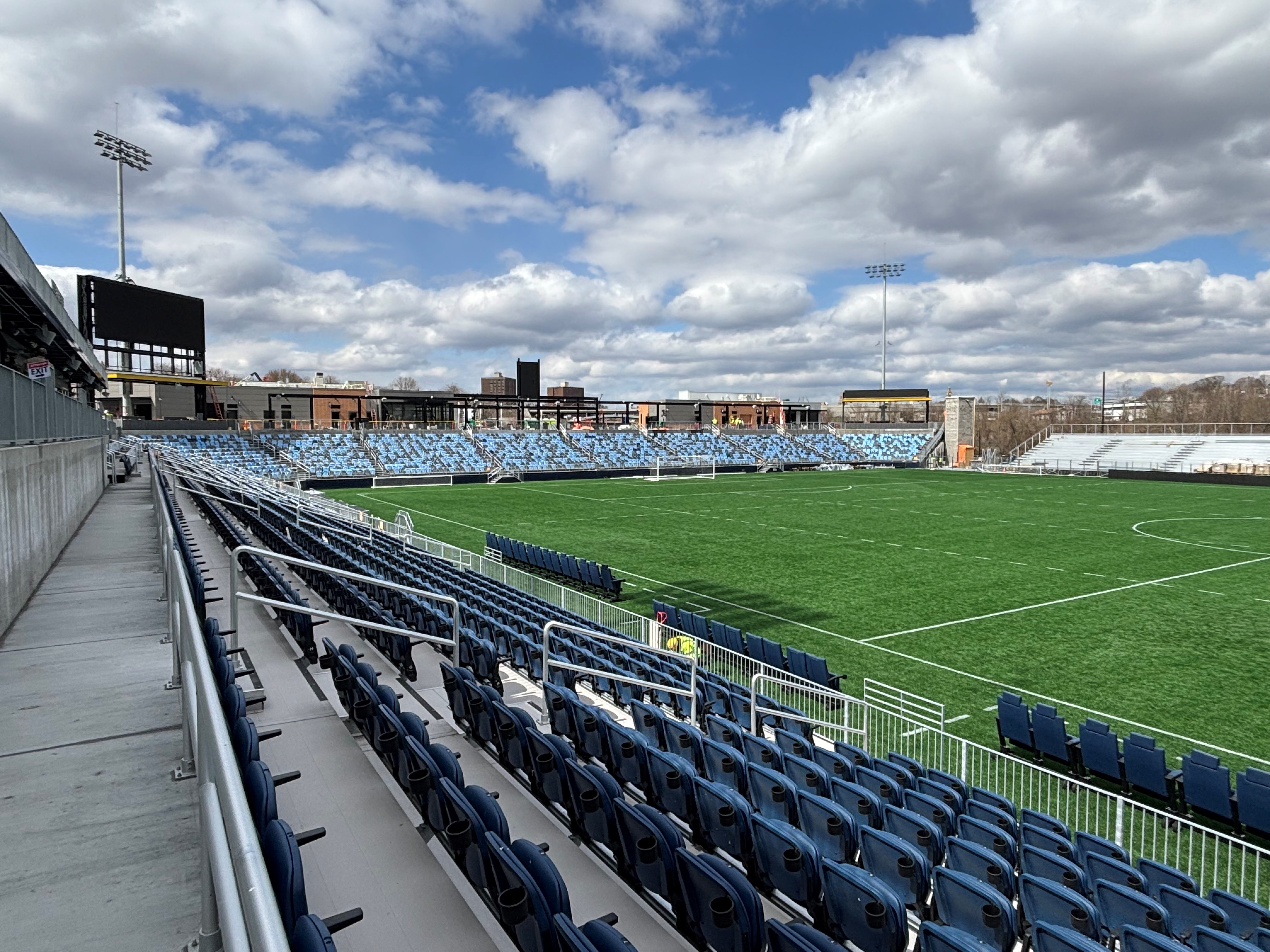
But as the finishing touches are put on Centreville Bank Stadium before
its grand opening on May 3, the state’s new sports and entertainment venue is just the first piece of a larger plan to make the riverside vibrant. Proverbial wheels are now in motion for the mixed-use element around the stadium, a major component needed for state leaders to approve the Tidewater Landing project, to come to life over time.
Plus, Centreville Bank Stadium and Rhode Island FC are also both positioned for future growth, both physically and competitively.
Back when
ground first broke on the Tidewater Landing project in 2022, Fortuitous Partners officials said that along with the stadium, the project also calls for more than 500 units of housing, plus retail, office and parking, and a pedestrian bridge connecting the two sides of the river. At that time, the project was pegged at $344 million, including $137 million for the stadium alone.
[caption id="attachment_492213" align="alignright" width="404"]

THE NAMING of Centreville Bank Stadium in Pawtucket on Tuesday marked another milestone achievement for the state to bring economic prosperity to a once-blighted area within Pawtucket. / PBN PHOTO/JAMES BESSETTE[/caption]
Dan Kroeber, Fortuitous’ managing partner and director of development, told PBN on Tuesday that the mixed-use portion is currently in the design phase and the developers are working on permitting for further construction. In all, Kroeber said the mixed-use project will be a “rolling process” to construct the three new buildings – two on the opposite side of the Seekonk River and one on the stadium’s north side.
“It will be staggered and phased as we go along,” Kroeber said.
Such permitting is needed from both the R.I. Department of Environmental Management and the R.I. Coastal Resources Management Council since construction is taking place near a waterfront, Grebian said.
Back in August, the city awarded Lincoln-based engineering firm BETA Group Inc.
a $1.4 million design contract to help design the riverwalk and pedestrian bridge adjacent to Centreville Bank Stadium. Grebien told PBN the bridge will be in operation next year.
Along with the riverwalk and the pedestrian bridge spanning the river, the city said this summer's project includes a stormwater park to address stormwater and recreation needs for both the stadium and the city. BETA Group will also design a proposed stairway from Pleasant Street to Taft Street to facilitate pedestrian movement to the development, city officials said.
“We’re working with our architects and engineers on designs of the buildings that fit and tie them into all that public infrastructure,” Kroeber said. “Then, there will be a whole lot of process to get those permits, final design and bid for the project.”
Housing, Kroeber said, will be a major element for the stadium’s mixed-use component. Fortuitous, he said, recognizes that housing is “really critical” both within the city and across Rhode Island as a whole. Kroeber declined on offering an exact amount of housing will be installed in the mixed-use buildings surrounding Centreville Bank Stadium but said it will be “a lot.”
Kroeber also said Fortuitous is collaborating with the state to build that public infrastructure around the stadium area, which will involve both private and public financing to pay for the project. While he didn’t offer a specific amount, Kroeber said the rest of the project will cost “hundreds of millions of dollars.”
Area businesses expressing interest in setting up shop in that mixed-use development is high, Kroeber said. “We’ve seen a lot of engagement from local businesses and other businesses coming into the city that want to expand on all the momentum that is happening here,” he said.
[caption id="attachment_492212" align="alignleft" width="405"]

RHODE ISLAND FC also will have an opportunity to both expand on Centreville Bank Stadium and also promote itself to the new United Soccer League Division One that will launch in the 2027-28 season. / COURTESY RHODE ISLAND FC[/caption]
There’s also room for both Rhode Island FC and their home pitch to grow, as well. Recently, the United Soccer League announced plans to launch for the 2027-28 season a new Division One – the organization’s highest level of play – and a promotion/relegation system. That system, similar to what’s established in European soccer, allows teams to either go up a division or drop down a position based on performance.
Fortuitous Chairman and Rhode Island FC Co-Founder Brett M. Johnson told PBN he’s proud the USL is implementing this promotion/relegation system in the U.S. and wants the local XI to be part of Division One’s inaugural class. He saw this system firsthand overseas with England-based Ipswich Town when the club went from League One to the Premier League in just two years.
“You’re fighting to go up or down. From a fan-engagement perspective, it’s a brilliant system,” Johnson said.
Some criteria needs to be met for Rhode Island FC if it wants to be in Division One. Performance is one metric, where Johnson said
the club making last year’s USL Championship Final would have qualified it for promotion.
The other promotion metric is stadium capacity. Currently, U.S. Soccer requires home stadiums of teams playing in top divisions to have at least 15,000 fixed seats.
Johnson said Centreville Bank Stadium can be expanded upon by adding more seats to each end zone and can be done “in a second phase.” He said any additional stadium construction would be privately funded.
Johnson also said it may be sooner than 2027-28 before Fortuitous considers increasing Centreville Bank Stadium's capacity.
“We feel this is one of the best mid-sized stadiums in all of America, certainly in New England,” Johnson said. “We have so much demand from our team, other teams in other sports, professional, collegiate is among the reasons we want to take the stadium up to 15,000 [seats]. We want the opportunity to grow this as it becomes the sports and entertainment capital for Rhode Island.”
James Bessette is the PBN special projects editor, and also covers the nonprofit and education sectors. You may reach him at Bessette@PBN.com. You may also follow him on X at @James_Bessette