
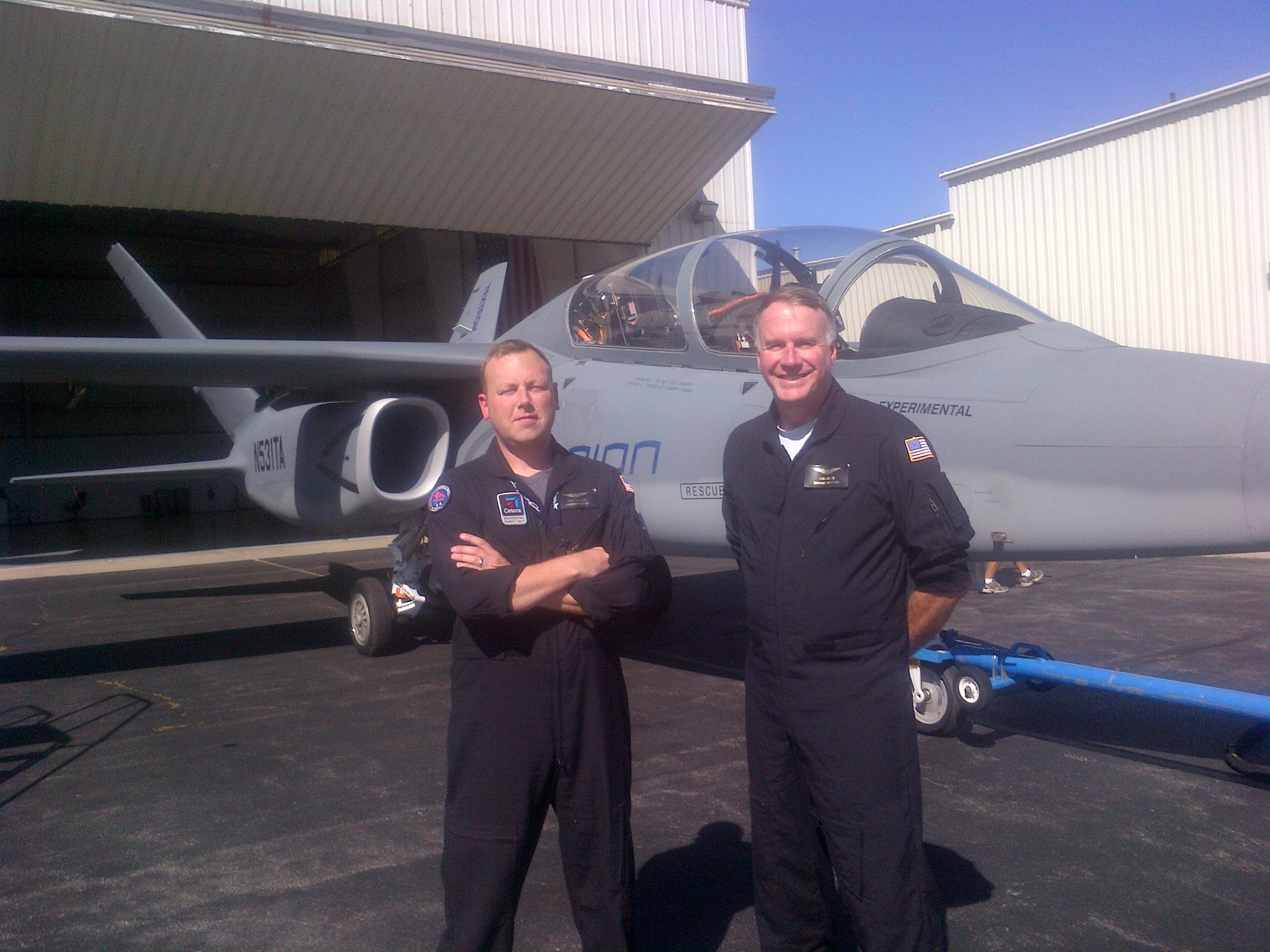
When the U.S. Air Force puts out an expected request for proposals next year for the next generation of jet trainers, Providence-based Textron Inc. hopes to join what is sure to be a crowded field. If it is in the mix, the new Textron AirLand Scorpion jet will be the reason why.
Developed as a low-cost alternative to planes now being used for “routine missions that are operational,” according to Textron spokesman Dave Sylvestre, the Scorpion in September made a stop at Warwick’s T.F. Green Airport on its way to a Washington, D.C., air show.
The Scorpion is being pitched as a bargain at an estimated $20 million each compared to the competition – F-16, F-18, or F-22 planes – that Sylvestre says can cost between $60 million and $100 million each. The lower price tag is because it was designed without the constraints of military-contract specifications and was able to incorporate cheaper commercial aviation technology.
“Economic constraints in [Washington, D.C.] in some ways play to our advantage,” Sylvestre said.
So far, though, most of the interest in the new jet, expected to go into production next year, has been from outside the U.S.
The aircraft is a “big deal to a lot of countries that aren’t as wealthy as the U.S.” because of its relatively cheap price tag, according to Sylvestre. He said Textron, through a subsidiary and its partner, AirLand Enterprises LLC, are in discussions with several U.S.-partner countries.
Though the Textron-AirLand collaboration is a joint venture, Textron provided all of the funding, Sylvestre said. The company put in “many millions of dollars in design and development.”
Wayne Plucker, an aerospace and defense-industry analyst at Frost & Sullivan, said in an email that the military-aircraft market is, generally, “in a decline,” adding that “the major buys of aircraft have ceased for the moment.”
According to the 2013 annual report by the Aerospace Industries Association, preliminary numbers show the sector did $220.1 billion in sales, with $56 billion of that coming from military aircraft sales. This was a slight decline from 2012, when the industry did $222 billion in sales, $59.7 billion of which were military aircraft sales.
However, the report projects that 2014 will be a better year than 2013, estimating total sales of $232.1 billion, of which $57.6 billion would be military aircraft sales.
Textron could benefit from the potential to upgrade parts of Scorpion jet based on customer needs, Plucker said.
“Textron has also included a number of other companies in their program who can ‘trick out the ride’ by adding sophisticated electronics, sensors and fire controls,” he said. “That suggests that they view those as great selling features.”
Sylvestre noted that while Textron can now “grow into another niche market,” military ventures are nothing new for the company. Textron currently makes helicopters and integrated aviation companies Cessna, Beechcraft and Hawker Aircraft into “Textron Aviation” in March, according to the company’s website.
Sylvestre said there could “possibly” be an employment expansion as a result of the Scorpion. Between 100 and 200 employees worked on the aircraft’s development, but those people largely came from Cessna. However, workers at a production facility would be needed to fill orders of the Scorpion jet, he said. •



