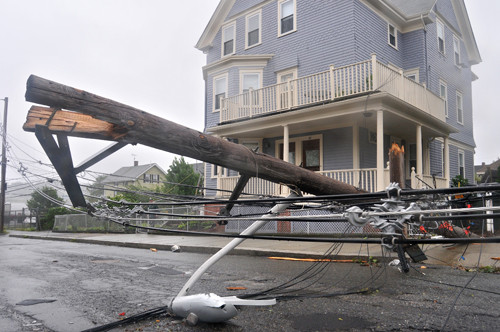
Natural disasters create some of the most critical challenges any business can face, and Mother Nature over the last two years has been challenging the region’s businesses to the max.
Rhode Island and many of its businesses were still overcoming the devastating effects of the March 2010 floods when 2011 came along – and with it, Tropical Storm Irene in the days leading up to Labor Day and a surprise Halloween snowstorm, along with other climate disruptions.
Although Irene created little physical damage to businesses, the storm downed power lines that left 65 percent of the state without electricity for at least a day, meaning thousands of dollars of lost revenue for businesses and an uncounted amount of spoiled food.
Local insurance agents were awash in claims, some employers were forced to lay off workers temporarily and the governor’s office estimated that at least $8.5 million in public costs were incurred in the Ocean State for cleanup and recovery. Private insurers and government-backed emergency loans helped business owners and municipalities recoup losses in some cases, but reaction after the fact is often too late to help an enterprise fully recover.
For that reason, the Cyber Disruption Team was created in July to protect Rhode Island’s cyber infrastructure, an effort led by R.I. State Police. It was developed by state emergency management officials, along with numerous public and private entities.
One outcome of the 2010 springtime floods was a positive one for James Silvestri, owner of Napa Auto Parts in Westerly, but it was balanced by another not so positive one.
In May, he was presented with the Phoenix Award by the U.S. Small Business Administration in Washington, D.C., for the work he did to restore his business after the floods. He also took on a 30-year $300,000 SBA loan to help cover increased costs the flood caused in rent, insurance, payroll and inventory, an obligation the company will see on its balance sheet for 30 years.
Not all of the news in the state’s business-services sector was disaster-related. Rhode Island felt the effect of an ongoing national trend when the prestigious Providence law firm of Edwards Angell Palmer & Dodge LLP – itself a union of two top New England firms – merged yet again.
As of Oct. 1, Edwards Angell became Edwards Wildman Palmer, merging with Chicago’s Wildman Harrold Allen & Dixon, resulting in a firm with 650 lawyers and offices across the nation, and in London and Hong Kong.
In a twist on the merger trend, the Providence law firm of Hinckley, Allen & Snyder LLP announced in October that it had formed a strategic alliance with a minority-owned boutique law firm in Hartford, Conn., Crumbie Law Group. Both firms will remain independent, but act together as co-counsel for certain transactions and cases.
A field that gained prominence in 2011, due in part to shortages and other inventory-related problems stemming from the Great Recession and the tsunami in Japan, is supply-chain management.
A summit on this topic in August, organized by Bryant University, drew about 200 people and saw discussion of a new form of supply-chain management, vested outsourcing, aimed at containing costs.
At Bryant, the new dean of the College of Business, Michael R. Cooper, said in October he intends to create a supply-chain management department, which would be only the fourth in New England. •