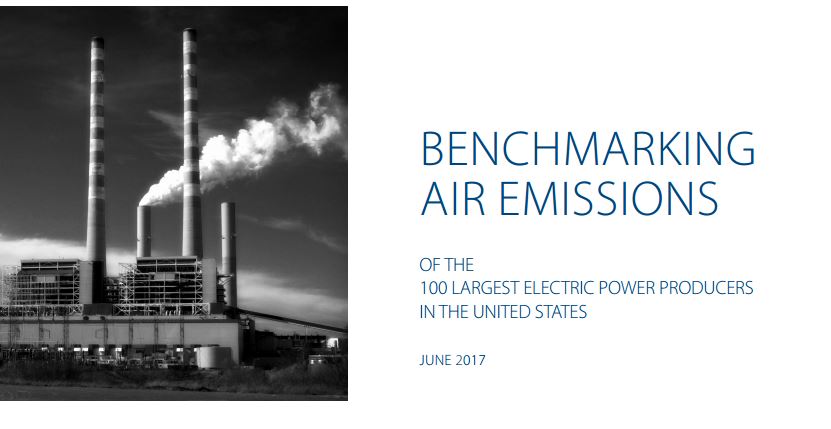
PROVIDENCE – Rhode Island had the highest carbon dioxide emission relative to electricity generation in New England, according to a new report called “Benchmarking Air Emissions.”
The report, commissioned by a coalition of energy companies, banks and nonprofits, was released this month. It focused on carbon emissions of the nation’s 100 largest electricity generators during 2015, taking into consideration emissions, emission rate and energy sourcing.
Seifert Systems Invests in Energy Efficiency to Strengthen Operations
For manufacturers, energy is more than just another operating expense. It plays a critical role…
Learn More
It also analyzed carbon emissions by state.
Overall, Rhode Island produced 3 million tons of CO2 emissions, the fifth least in the nation. Texas, which emitted the most, released 248.2 million tons. Massachusetts accounted for 12.7 million tons, while Vermont produced zero CO2 emissions in 2015.
But the study also considered emissions relative to electricity generation, a calculation called “carbon emissions rate.”
The emissions rate provides a proportionate calculation of how much carbon each state emits relative to its generation (pounds per megawatt hour). For instance, Rhode Island produced 895 pounds of carbon dioxide per megawatt hour, while Texas produced 1,112 pounds per megawatt hour.
Looking at emissions this way, Rhode Island ranked No. 33 in the nation and No. 1, the least efficient, in New England. Massachusetts, No. 2 in New England, recorded 781 pounds per megawatt hour and Vermont had the lowest emission rate in both New England and the nation with 5 pounds per megawatt hour.
The rest of New England ranked as follows:
Connecticut was No. 3 in New England (472 pounds per megawatt hour), New Hampshire was No. 4 in New England (457 pounds per megawatt hour) and Maine was No. 5 in New England (296 pounds per megawatt hour).
New England states, however, are largely better off than others. Wyoming, for instance, had the least efficient emissions rate in the country, releasing 2,039 pounds per megawatt hour. All six New England states were among the top 15 lowest total CO2 emission producers in the nation.
In 2015, Wyoming accounted for 49.9 million tons of CO2 emissions. The study said Wyoming’s poor emission rate was due to its reliance on coal energy. Wyoming also produced proportionally more energy than any other state in terms of in-state supply versus its in-state consumption electrical needs.
Vermont had the second-largest proportional energy surplus in the country.
A few companies operating power plants in Rhode Island made the top 100 electric power producers, ranked by net electric generation in the United States, including Dominion Energy – operator of the Manchester Street power plant in Providence – ranked No. 12; LS Power – operator of Ocean State Power in Burrillville – ranked No. 27; and The Carlyle Group – owner of Rhode Island State Energy Center – ranked No. 69.
The list also included Invenergy Thermal Development LLC (No. 62), which has proposed a controversial gas-fired power plant in Burrillville, and Dynegy Inc. (No. 11), which recently closed the Brayton Point power plant in Somerset.
The study was commissioned by the Bank of America Corp., Calpine Corp., Ceres, Entergy Corp., Exelon Corp., Tenaska Inc., and the Natural Resources Defense Council. The report was authored by M.J Bradley & Associates LLC. The report utilized information primarily from the U.S. Energy Information Administration, the Environmental Protection Agency and the Securities Exchange Commission.
Chris Bergenheim is the PBN web editor.