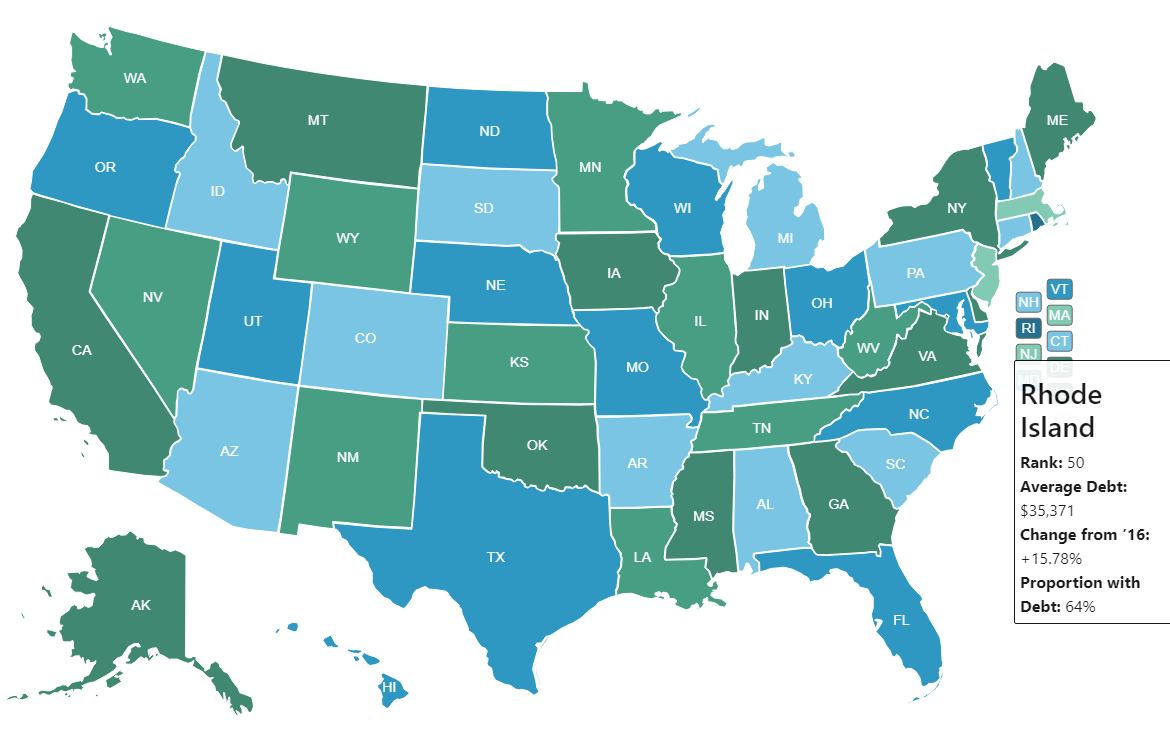
PROVIDENCE – In one year, average student debt among Rhode Islanders has jumped 15.78 percent for an average $35,371 per Class of 2017 borrower – the second-worst figure in the nation – per Wednesday’s Student Loan Debt by School & State report by online student lending tool LendEDU.
More than half of Rhode Island higher education graduates in the Class of 2017 – 64 percent – are burdened by student loan debt according to the report.
A modernized health plan: Supporting cost management and the employee experience.
The Surest health plan came from a group of innovators wondering: What if health care…
Learn More
Findings in this most recent report show Rhode Island has returned to the second-worst average student debt per borrower position, a ranking it also held in the 2016 report.
Wednesday marks the third publication of the the Student Loan Debt by School & State report by LendEDU. The 2017 findings, which ranked Rhode Island the top 10 states with the most student debt, can be read in the Providence Business New archive.
LendEDU results also ranked individual schools based on the amount of debt per borrower. Among the Overall Top 250 Highest Debt schools were:
- Bryant University: No. 8 ($52,949)
- Roger Williams University: No. 31 ($44,225)
- Providence College: No. 63 ($41,383)
- Salve Regina University: No. 143 ($37,464)
- Stonehill College: No. 179 ($36,502)
- Wheaton College: No. 244 ($35,058)
Among the top 200 private schools with the highest debt rankings were:
- Bryant University: No. 8 ($52,949)
- Roger Williams University: 28 ($44,225)
- Providence College: No. 55 ($41,383)
- Salve Regina University: 121 ($37,464)
- Stonehill College: 146 ($36,502)
- Wheaton College: No. 244 ($35,058)
Rhode Island- and Bristol County Massachusetts-based schools listed on the top 200 public highest debt schools were:
- University of Rhode Island: No. 66 ($33,335)
- University of Massachusetts Dartmouth: No. 84 ($31,992)
- Rhode Island College: No. 162 ($25,791)
Brown University was ranked No. 115 among the top 200 private schools with the least debt at an average $25,471 per borrower.
Regionally, Rhode Island had the worst score among New England states.
Massachusetts was ranked No. 43 with an average $31,319 debt per borrower reflecting a 2.4 percent increase from 2016. At No. 46 with an average $31,643 in debt per borrower, a decrease of 2.11 percent since 2016, Connecticut similarly scored better than the Ocean State
Vermont ranked No. 34, Maine No. 39 and New Hampshire No. 48.
Utah, according to the 2018 report, saw the least average student debt per borrower, $18,425, in the Class of 2017. The Beehive State saw a 2.05 percent decline in average student debt over the past two years with 39 percent of graduates having debt.
Since Washington, D.C. is included in the rankings, there were 51 results with Pennsylvania coming in last place. Average student debt in the Keystone State among Class of 2017 graduates was $36,193 – a 2.87 percent increase from the prior grade. Sixty-seven percent of Pennsylvanian graduates carry student loan debt.
Second to mortgages, per the Wednesday report, LendEDU found student loan debt is the next highest form of debt in the United States. The lending company reported $1.52 trillion in outstanding student loan debt owed by 45 million borrowers as of the Wednesday findings.
The report’s methodology is based on Peterson financial aid data regarding the Class of 2017. State-level data was compiled from 1,080 colleges and universities across the country.
Average debt per graduate was calculated by adding the total debt at each school and divided by the number of bachelor degree recipients.
Emily Gowdey-Backus is a staff writer for PBN. You can follow her on Twitter @FlashGowdey or contact her via email, gowdey-backus@pbn.com.