PROVIDENCE – Rhode Island has made great strides toward cleaner and greener transportation, but significant investments in electric vehicles, public and alternate transportations and design and infrastructure are needed to meet the state’s ambitious renewable energy goals, according to a report released by the R.I. Department of Environmental Management Thursday.
The 169-page document represents the culmination of a five-month study by a Mobility Innovation Working Group, which included representatives from relevant state agencies as well as business and community representatives with industry expertise. Providence-based engineering consultant AECOM also offered services in the review and report.
Building a Strong Data Foundation in the Age of AI
Artificial intelligence (AI) has become a key priority in the boardroom and across management —…
Learn More
As the state’s top producer of greenhouse gas emissions – comprising 36% of total emissions – transportation plays a key role in achieving the state’s ambitious renewable energy goals.
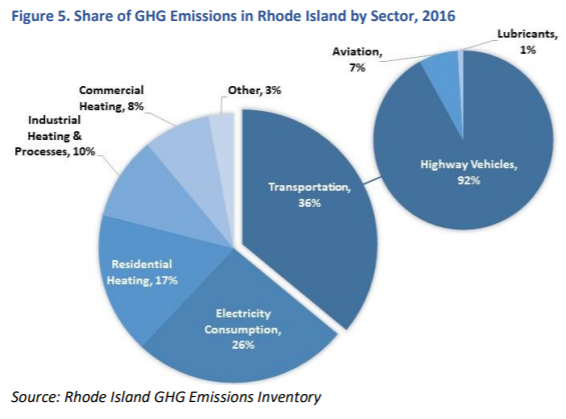
“It is impossible to meet the state’s greenhouse gas reduction goals of an 80% reduction by 2050 without aggressively transforming the transportation sector,” the report stated, naming “bold initiatives” such as electric vehicles, expanded public transportation options and community design that encourages it as necessities.
Still, heavy reliance on fossil fuels for electricity means increasing the supply of zero-emissions vehicles, which topped 3,000 as of June, is “insufficient” to meet state goals, including a 43,000-vehicle zero-emissions fleet by 2025, the report stated.
The cost of electric vehicles – $31,600 for a zero-emissions Nissan Leaf- is out of reach for many low-income households, too, creating equity problems for a green transportation plan solely reliant on electrification.
“Creating a system with more efficient travel options and patterns (e.g., shared rides, walking, biking, using transit) is an important element of the Strategy for reducing emissions,” the report stated.
The report also noted the impact of the pandemic, both in its consequences for reduced ridership through R.I. Public Transit Authority, as well as the potential that green transportation initiatives hold for job creation and economic recovery.
“This economic disruption underscores the importance of tying economic development opportunities to decarbonizing the transportation sector,” the report stated. “While the electrification of the transportation system represents a substantial cost, it also holds significant job creation potential as new charging stations, electric grid improvements, and job training will all be needed to realize this transition.”
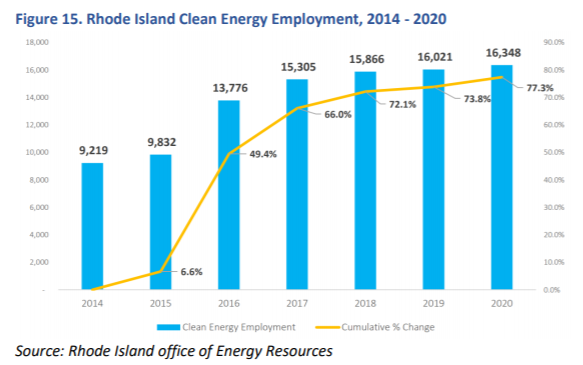
Already, the state has seen a 77% increase in clean energy jobs – from 9,200 in 2014 to 16,300 in 2020. Exactly how many more jobs the state could gain through increased electrification initiatives was not clear, but national estimates suggest a net gain of 51,500 to 108,400 jobs from 2015 to 2040, the report stated.
The report considered three ways in which the state could invest the anticipated $2.2M annual funding through the state’s participation in the Transportation and Climate Initiative Program. An electrification-focused portfolio, with 75% of funds spent on electric and alternative fuel strategies- was most effective in cutting greenhouse gases and reducing air pollution, while a “mobility” focused portfolio that concentrated spending in areas such as bus services, pedestrian and cycling access memorandum into electric vehicle investments – offered better benefits on job creation, equity and health thanks to increased physical activity. A third option examined the impact of a “blended” investment strategy that fell in-between the two prior models.
The report stopped short of recommending one of the three portfolios, instead describing them as a tool for policymakers to use in their decision-making. However, the report issued a slew of other recommendations – 24 in total, coupled with 37 “action steps” – aimed at helping the state achieve its sustainability goals, including allocating at least 35% of TCI funding to “overburdened and underserved” communities; committing to a goal that all new cars, light-duty trucks and buses sold in Rhode Island will be electric or “technology neutral” by 2040; and enact or advance a host of already-signed policies and goals such as TCI, the 20-year Transit Forward RI long-term transit plan, ongoing electrification of school and transit buses; and a 2020 regional agreement to sell only zero-emission heavy-duty buses and trucks by 2050.
Nancy Lavin is a PBN staff writer. You may reach her at Lavin@PBN.com.