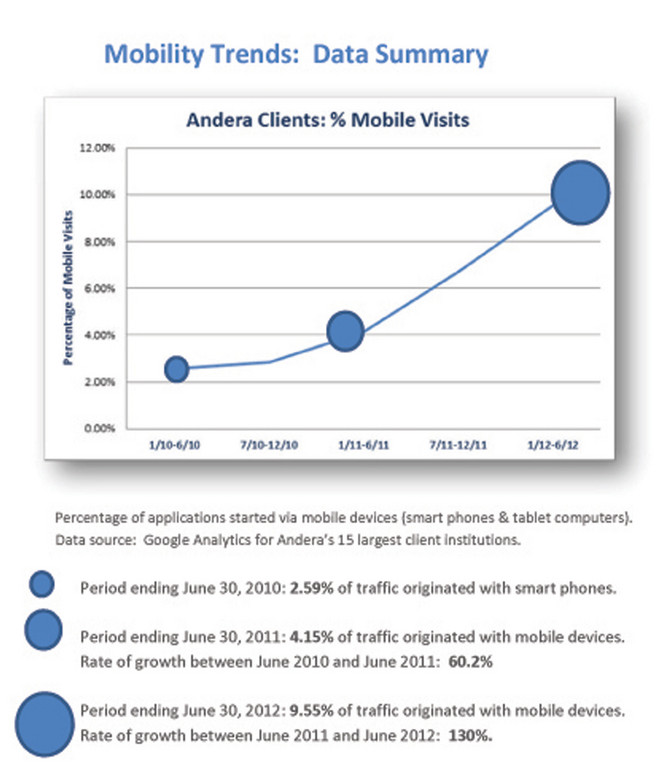
 HERE. / COURTESY ANDERA" title="THE NUMBER OF U.S. CONSUMERS performing banking actions on mobile devices grew 130 percent between June 2011 and June 2012, according to a new report from Andera. For a larger version of this image, click HERE. / COURTESY ANDERA"/>
PROVIDENCE – American consumers are becoming more comfortable conducting banking business on mobile devices, according to a new report from financial software company Andera Inc.
The 30-month study of application traffic sources showed that consumers in the U.S. are becoming more comfortable conducting more complex banking functions and transactions on smartphones and tablets.
Beyond Cash Donations: How New Forms of Giving Are Transforming Not-for-Profit Accounting
Evolving Funding Landscape for Not-for-Profits Not-for-profit organizations are being asked to do more with less,…
Learn More
“Up to now, what we’ve called ‘mobile banking’ has largely meant using mobile phones to check account balances and transfer funds between accounts. That’s changing,” Charles Kroll, president of Andera, said in prepared remarks.
According to a study released by the Federal Reserve Bank in March, roughly 90 percent of consumers engaging in mobile banking use the technology to check account balances or recent transactions. Transferring money between accounts was the second most common use as 42 percent.
“In the two years since we began tracking and analyzing the sources of visits to our company’s platforms, we have seen a 70.3 percent growth in total number of online visits,” said Kroll. “But within that total number of online visits, the portion that comes from mobile phones and tablet devices has grown dramatically – by 269 percent.”
In the study, which began on Jan. 1, 2010, and ended on June 30, Andera used Google Analytics to track applicant device types for the company’s 15 largest client institutions.
During the initial six-month period, only 2.59 percent of applicants used smartphones or tablets, compared with 9.55 percent in the six months ended June 30.
Kroll said that the results hinted at two things, “First, more and more consumers are getting used to dealing with their financial institutions online. But more importantly, they are feeling confident about establishing new banking relationships or expanding existing ones on a mobile, paperless platform. They are no longer using their smart phones or tablets solely to check balances or move funds.”