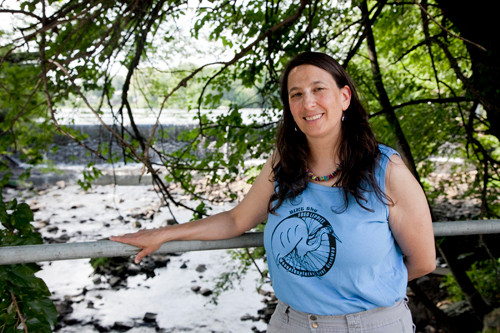
The U.S. Environmental Protection Agency in 2000 officially declared cleaning up the polluted Woonasquatucket River near Centredale Manor a national priority. This October, after 10 years of study, the agency will unveil a final report detailing the options for the North Providence site.
The alternatives are expected to range from containing contaminants with barriers to removing all or part of the polluted soil. A decision is expected in late 2011, after a 60-day comment period.
The agency’s selection of a plan will represent a major turning point for the site so badly contaminated that the government erected fences to keep the public out of the polluted Allendale Mill Pond.
“This has been a hugely long process but we definitely are getting somewhere,” said Alicia Lehrer, executive director of the Woonasquatucket River Watershed Council.
Officially known as the Centredale Manor Restoration Project Superfund site, the polluted area is approximately nine acres and home to the Brook Village and Centredale Manor apartment complexes.
Long an industrial site, it was home to Centredale Worsted Mills prior to 1936 and then Atlantic Chemical Co. – later Metro-Atlantic – from 1943 to the early 1970s. In addition, New England Container Co. Inc. operated an incinerator-based, drum-reconditioning facility in the area from 1952 until 1971. In 1972, a fire destroyed most of the industrial facilities.
The Brook Village apartments opened in 1977. And the Centredale Manor apartments opened in 1983; a year before the R.I. Department of Environmental Management ordered the removal of about 400 drums of hazardous waste and 6,000 cubic yards of contaminated soil.
In 1996, the EPA found dioxin – a possible carcinogen – in fish collected from the Woonasquatucket River. Since that time, EPA has documented elevated levels of contaminants, including dioxin, polychlorinated biphenyls (PCBs), volatile organic compounds (VOCs) and other pollutants at the site.
Pollution remains, however, and finds its way into plants growing along ponds in the area and in nearby wetlands. The government warns not to eat fish caught downstream from the site and swimming is out of the question.
For Lehrer, the pollution is frustrating. The river and Allendale Mill Pond represent some of the only waterfront in North Providence. There are residents nearby unable to set canoes in the river or take a swim on a hot day. And the water serves not as a tourist attraction but as a caged-off area with not-so-discreet signs warning visitors to keep out.
The Centredale site “is the scariest threat on the Woonasquatucket,” Lehrer said.
That’s partly because the industrial pollution is essentially stuck in the soil. Unlike some pollution that washes away or breaks down over time, dioxin stays around for years.
And removing it can be pricey. In its interim report, the EPA said most options would come with price tags in the millions of dollars.
In 2005, the owners of Brook Village and Centredale Manor agreed to contribute at least $3.6 million to the cleanup. Although they did not cause the contamination under federal law, they share responsibility for cleanup costs. The EPA has put that money aside for future cleanup operations, said Eve Vaudo, a lawyer with the EPA handling the Centredale case.
Once completed, the cleanup should represent the last major remediation project at the site, said Stacy Greendlinger, a Community Involvement Coordinator at EPA. Other than monitoring activities, the EPA will then consider the project closed.
“This is very significant and it’s going to be a huge milestone in terms of advancing hazardous waste and hazardous-contamination cleanup in the Woonasquatucket River, but there are remaining issues for the river,” said Stacy Greendlinger, a Community Involvement Coordinator at EPA.
Any cleanup would come as the Narragansett Bay Commission progresses on a $300 million project to separate sewer lines from pipes that carry runoff from the streets. The combined system overwhelms the capacity of the pipes and leads to raw sewage spilling into the Woonasquatucket River during heavy rainstorms.
But Lehrer says the latest project – and impending EPA plan – gives her optimism.
“Every time we do something else it just gives me a little bit more hope that we’re going to take this back to a river we can use freely and without fear,” she said. •