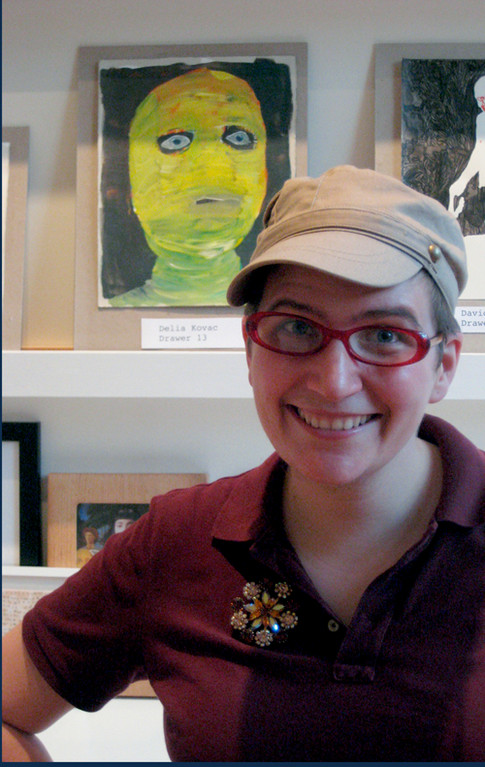
Five years ago, Delia Kovac envisioned building a website to help promote her fledging career as a multimedia artist, so she took the first step of purchasing the domain name, deliakovac.com.
Today, however, Kovac’s site remains unfinished. Unstarted, really. Visitors to deliakovac.com are greeted by a blank screen, save for the request “Please visit my blog” and a link to another address at blogspot.com.
The problem: Kovac wanted to design her site so it looked professional, not slapped together. But she didn’t have the time, expertise or the money. “It’s representing me out to the globe,” she said recently. “I want to make sure it’s something I’m comfortable with.”
Now Kovac, a Providence resident, is poised to capitalize on the power of the Internet to sell her artistic ability, and maybe even some of her artwork. She was one of two dozen Rhode Island artists who recently participated in a nationally renowned, professional-development program that isn’t focused on artistic techniques and theories, but on the nitty-gritty of running a creative-economy business.
More specifically, the artists learned from a lineup of experts some of the more productive and efficient ways to market and promote their work online.
The three-day program, which ran from April 8 to April 10, was presented by Creative Capital Foundation, a New York-based nonprofit that focuses on providing artists with “sustainable” career-development services.
Kovac and the other artists were immersed in sessions on technical matters such as Web-content management systems and email, but the program included group talks about building communities on the Web, designing “sticky” websites and generating revenue online.
The program was intended to give artists who don’t have the time or interest in handling the marketing and promotion “the tools and strategies to become more self-sufficient as business people,” said Caitlin Strokosch, executive director of Providence-based nonprofit Alliance of Artists Communities.
Creative Capital presenters made their inaugural trip to Rhode Island after the alliance was awarded a $10,000 subsidy to finance some of the cost of hosting the program.
Several groups – including the city’s department of art, culture and tourism, The Rhode Island Foundation, the R.I. State Council on the Arts and the Office of Career Services at the Rhode Island School of Design – collaborated to foot the remaining costs.
Kareem Roustom, a Providence-based TV and film music composer, said he realizes the importance of maintaining a presence on the Web, even though he is established in the industry.
Roustom, whose work ranges from pop, to jazz and Arabic music, has a website and is registered on Facebook, which he uses mostly to keep in contact with friends and family. And Twitter? “It seems inane to me,” he said.
Yet there are reminders of the global reach of the Internet. For instance, Roustom said he received a call recently from a musician overseas seeking to use one of Roustom’s compositions that had been posted on YouTube. That call will likely lead to royalty payments in the future.
At the same time, however, Roustom said he has little time to do the research necessary to get the most of the online opportunities. “It’s a lot of ground to cover and a lot of effort for what could be a little payoff here and there,” he said.
Strokosch said many artists are looking for guidance. “So far they’ve been cautiously involved with social media,” she said. “But they don’t want to get on [social sites to promote their work] if they don’t know what the strategy should be.”
Now Strokosch said the alliance is hopeful that there will be a “multiplier effect” from the workshop – that participants will pass the knowledge along to other artists.
Kovac, a RISD graduate who works at a library at the Rhode Island Historical Society, also has little time to invest in developing the expertise to build a website. In addition, she has made a foray into graphic design as well.
Right now, she maintains a blog that keeps followers up to date on exhibits she is involved with, but she doesn’t like the format.
She is hoping the workshop will serve as a spark for her to assemble a website for her portfolio. Kovac knows it could be crucial for her artistic career, particularly because it allows her to reach into much larger markets.
“Providence is a great place to be an artist,” she said. “It’s not that great of a place to sell your art.” •