
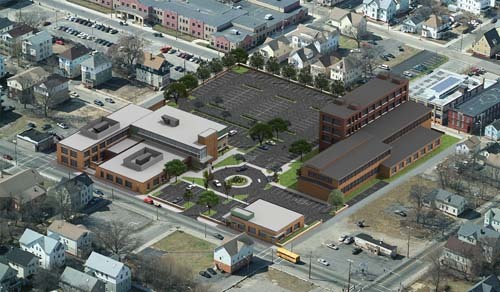
Lifespan, one of southern New England’s largest hospital networks, has joined an effort to rebuild South Providence by promising to locate new offices on a four-acre block now occupied by the long-vacant Federated Lithographers complex.
Lifespan’s commitment is expected to help attract financing for Providence Community Health Centers’ move to the same site, and could bring hundreds of employees to the neighborhood, building an economic base for shops, restaurants and other businesses.
“What we want to create here is an economic engine that will reconnect this community to the mainstream economy,” said Darrell A. Lee, a private developer working as an adviser to Providence Community Health Centers. “This project is about more than bricks and mortar. It’s about rebuilding the neighborhood and rebuilding families.”
Those possibilities helped persuade Lifespan executives to commit to the project, which is slated to include a 40,000-square-foot medical facility with a cardio center, an asthma diagnosis and treatment clinic, a diabetes prevention and management clinic, a dentistry center and other services. The new Lifespan offices could be ready sometime in early 2011, though there’s no firm date as yet.
“We haven’t decided specifically what we’ll have located there, but it will be something synergistic with the work done by the community health center,” said George A. Vecchione, Lifespan president and CEO. “The community health center really needed an anchor tenant, and Lifespan – representing our hospitals – felt this was the type of project that warranted our support.”
Mark Montella, Lifespan’s senior vice president of external affairs, said Lifespan’s commitment will “make it easier for Providence Community Health Centers to find tenants to take on the commercial side of the project. It’s going to help develop a critical mass of people in that area that will attract a mix of business and residential development.”
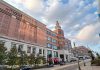
The sprawling collection of brick factory buildings at 369 Prairie Ave. rose up in the 1880s, the city’s industrial heyday. Federated Lithographers moved to the site in the 1940s. The company was a major employer, and for a long time the surrounding neighborhood thrived. By the mid-1980s, however, the buildings were vacant and the area went downhill. Empty shops and boarded-up buildings now line the nearby streets.
In 2003, Providence Community Health Centers purchased the Federated Lithographers property for $1 million. The health center was then outgrowing its clinic in the Urban League of Rhode Island building three blocks away.
Financing the project, however, proved to be a daunting task. And that’s where Lee stepped in. A graduate of the Massachusetts Institute of Technology’s business school, he had previously worked with health centers in Massachusetts, and he had helped Providence Community Health Centers build the John Chaffee House Center on Allens Avenue. To reflect his view of the possibilities in redevelopment projects, he named his company BCOG Planning and Development, with the acronym standing for “building cities on God.” (Lee says that name BCOG reflects “the principles of faith, charity, and love which create the strongest foundation for building communities and improving society.” BCOG is not a religious organization.)
Lee looked around South Providence and saw a stagnant neighborhood mired in poverty. In the Federated Lithographers project, he saw an opportunity for positive change.
In 2005, Lee began meeting with elected officials and others from the neighborhood. There were focus groups with neighborhood residents and business owners, who were encouraged to form a steering committee.
In 2006, the Prairie Avenue Revitalization Initiative was unveiled, a plan that presented the Federated Lithographers project as the first step toward a new direction for South Providence.
The estimate for the Federal Lithographers project alone came to $38 million, a sum that seemed beyond the reach of Providence Community Health Centers. Lee took on the financing task. He worked to get the main building at the site, the former Veaman & Smith tool-manufacturing plant, named to the National Register of Historic Places. That meant the renovation project would qualify for state and federal tax credits. He brought in $1 million in private donations. He pushed for federal stimulus dollars.
“There will be 350 people working there every day. That brings in restaurants. That brings in services,” he said.
“We’re still working on financing, but Lifespan’s move … makes the whole project viable,” added Merrill Thomas, CEO of Providence Community Health Centers.
The $300 million price tag for the Prairie Avenue Revitalization Initiative looks well beyond the Federated Lithographers project, of course. Once the latter is under way, the planners envision other projects throughout the neighborhood, including a home-ownership program, and an education center with classroom space for local colleges and community groups.
Construction at the Federated Lithographers site is scheduled to begin this fall, and the renovated buildings could open by late 2011 or early 2012. Workers have already demolished some smaller buildings at the site.
The master plan calls for three buildings:
• A 50,000-square-foot office building, with Lifespan leasing 27,000 square feet.
• A 5,000-square-foot retail building.
• A new health center that will meet standards for energy efficiency set by the U.S. Green Building Council, and will be wired for Internet access, cable, and security.
There’s also new name proposed for the old mill site, one that reflects the planners’ dreams – Revival Square. •








WHY? Another Medical facility – is this ‘good business’ – aren’t they making a bad business decision? Can’t the patients that would be seen here – be seen down on Eddy Street?? WoW – a MAJOR investment in rennovations (unless this is another sweet deal with the ‘restoration’ of historic buildings deals) and spreading short the critical staff that’s needed to man the facility ! Oh, who thinks of these deals?