
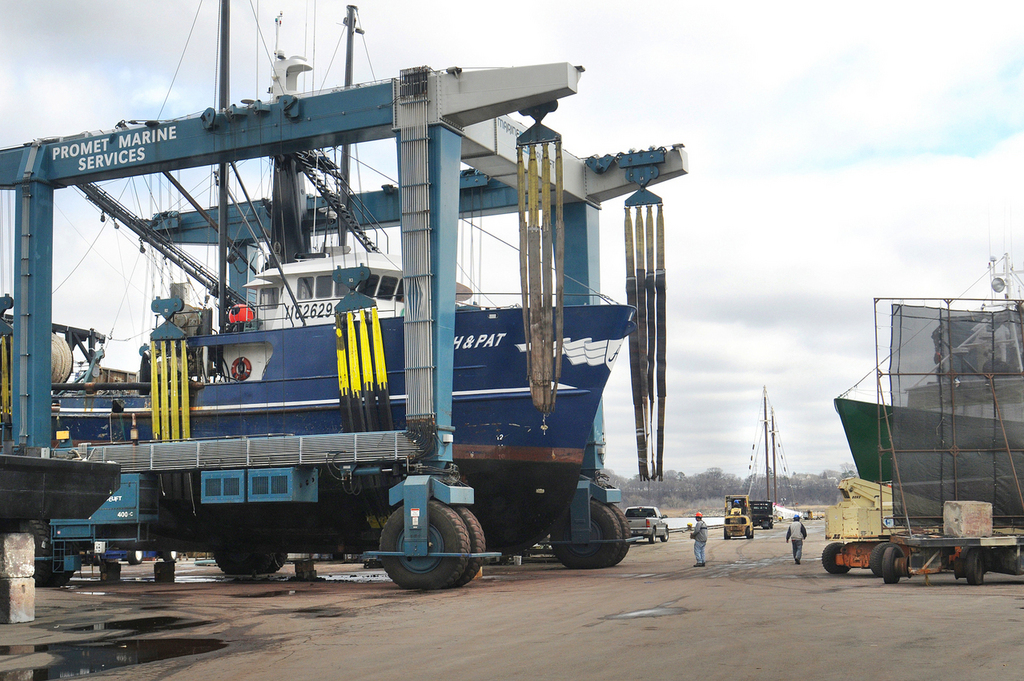
PROVIDENCE – The Providence City Plan Commission voted Tuesday night to recommend that City Council adopt a significantly smaller redevelopment area along Allens Avenue than initially proposed. The commission also urged the council to prevent residences in the areas. But, over the objections of local business owners, the commission stopped short of suggesting that the city ban hotels from the area dominated by heavy marine industries.
The decision came after the commission heard three-and-a-half hours of public comment, spent an additional nearly two hours discussing proposals among itself and then voted down a series of at least half-a-dozen motions.
Seifert Systems Invests in Energy Efficiency to Strengthen Operations
For manufacturers, energy is more than just another operating expense. It plays a critical role…
Learn More
Ultimately, commissioners said they recognized the cloud that would hang over businesses if their land were included in the Providence Redevelopment Plan project area. Businesses owners contended putting the properties in the area was the first step toward taking them by eminent domain. That fear would jeopardize investments in the businesses and threaten badly needed blue-collar jobs, business owners said.
“To label this area blighted and substandard would effectively, in our opinion, put the Providence Redevelopment Agency on third base to get these properties by eminent domain,” said Sean Coffey, a lawyer for the Providence Working Waterfront Alliance, a group of businesses.
Coffey said taking a property by eminent domain was a two-step process. First the City Council must find an area blighted and put it within a redevelopment area. Then it must identify specific parcels it wishes to acquire. And although the city had only identified two parcels in the current plan it wants, Coffey said the blighted label and the inclusion of businesses in the redevelopment area would have a “chilling effect” on owners who feared their property could be next.
Commission Chairman Stephen Durkee agreed.
“I think chilling is probably a pretty good word for that,” he said. “If you’re a business owner and a property owner I think it could wreak havoc.”
City Councilman John Lombardi cautioned the commission that lumping businesses in a redevelopment area under a plan that could last as long as 40 years would almost assuredly lead to a court battle if the city ever moved to add properties to a list of ones it wished to acquire.
To belay fears, the commission accepted a suggestion from Planning Department staff and moved the northern boundary south to Thurbers Avenue from the initially proposed hurricane barrier. The commission also removed the Johnson & Wales University property from the zone.
Commissioners and Planning Department staff said the tighter area more accurately reflected what the city was trying to accomplish with the plan, which is to acquire two parcels near the Port of Providence and expand the city-owned port.
The commission, again at the suggestion of staff, also included language that expressly said the city could only take parcels by eminent domain that were specifically identified in the plan after an approvals process by the City Council.
In the end, the commission approved the redevelopment plan 6-1, with Harrison Bilodeau opposed.
Separately, the commission also suggested that the City Council remove language in a proposed ordinance that would label the northern part of the Allens Avenue corridor “blighted.” Some business owners had taken exception to the label and said it cast their viable businesses in a negative light.
Business owners also urged the commission to move away from encouraging mixed use in the area, saying that uses like hotels did not mesh with loud and smelly industrial uses along the road.
“Mixed zoning in my mind sets us up for failure,” said Burt Russell, vice president for operations at Sprague Energy. “It’s death by a thousand cuts.”
He was joined in opposition by representatives from the Northeast Marine Pilots, Walco – a company that supports electrical components in motors – and others.
But Director of Planning Tom Deller said the city wanted to keep the window open for a possible hotel to serve the cruise ship industry, if it decides to utilize the area as a port. And he disputed that a hotel would not work in the area.
“People stay at hotels at airports and they’re noisy,” he said. “I think it is a fair plan. I think it is a good plan.”
The concept of a hotel also drew support from Unite Here! Local 217, a union that represents hotel workers. About a dozen members wearing red T-shirts and holding signs with “support middle class jobs” turned out to encourage mixed use.
“We see this as a positive step forward for the hospitality industry,” union coordinator Francis Engler told Providence Business News before telling the commission that a new hotel with unionized employees could create an “upward pressure” on hospitality wages throughout the city.
Mixed use was supported by City Councilman Luis Aponte and City Councilwoman Balbina Young, as well as state Sen. Harold Metts and state Rep. Joseph Almeida, who said the city needed to take every step possible to grow the economy.
Durkee spoke for many commissioners when he said he could see both sides.
“I’m not sure I exactly share the opinions of mixed use as a bad idea,” he said. “I think in this climate if there is a research building that wants to go up would that be a horribly bad idea?”
He added that the port area has seen limited development and he was torn between whether prohibiting mixed use would hamstring the existing industry or other potential growth.
Deller and Director of Long-Range Planning Bonnie Nickerson said mixed use encompasses more than just a hotel, saying it could also be offices, diners or health care centers. But mixed use would not, they said, include traditional residences or apartment buildings or condos. Although live-work, a concept in which artists live in buildings that house their gallery or studio space, would remain permitted under the Waterfront Plan ultimately adopted in a 6-2 vote, with Bryan Principe and Bilodeau opposed. Principe motioned twice, both times without success, to exclude hotels from the Allens Avenue corridor.
An approved plan came only after the commission removed the Shooters nightclub property from the plan. A few weeks ago the commission approved a neighborhood plan that recommended no change in the current zoning, which would allow a residential complex to be built there.
But neighbors – then and again Tuesday – complained bitterly that the city needed to rezone the area to encourage a public use. They envisioned a low-lying public building with docks for ferries, a shoreline diner and space for nonprofit organizations on the land that overlooks Narragansett Bay and sits next to India Point Park.
But commissioners could not come to an agreement whether to essentially reverse their earlier decision. After at least five failed motions, the group decided to jettison the lot altogether from the plan. Durkee, the chair, left open the possibility that the commission may revisit its recommendations for the area.












Mr. Deller uses the example of hotels next to airports as justification for placing them in a 24-hour operating industrial port, but most airports, including T. F. Green are closed from midnight to 6am. So much for that reasoning! Hotels can go anywhere, marine terminals and water-dependent businesses cannot.
Why would it be “so horribly bad” for a research building to be built in this neighborhood? Because a research building can go anywhere, but the city of Providence has finite, and rapidly shrinking, areas zoned for maritime and heavy industrial use. The city needs industry and a functioning waterfront.