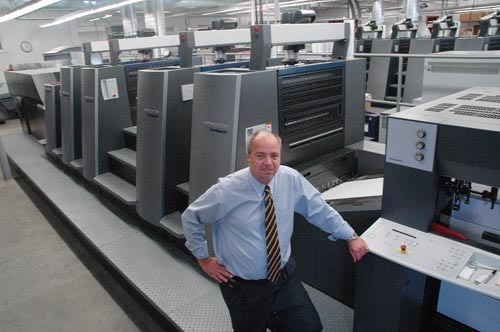
Ask John Nickson, president of OmniColor Printing, how his company is going “green,” and he will show you a plastic menu that will last longer than the prices listed on it.
“In the past a restaurant might have ordered 500 menus, because they have to toss them when they’re beat up,” he said. “Now they only need 100. And a menu printed on plastic can be washed. I put one through my dishwasher 10 times so I could show it to our customers. You can’t do that with a laminated menu.”
Printing on plastic sheets (made from recycled milk jugs) is just one of the ways the East Providence company is striving to be eco-friendly. And other Rhode Island print shops are moving in the same direction.
No one ever called Johannes Gutenberg a tree hugger. The printing press he invented back in 1439 relied on paper, ink and lead type, and for centuries after there was little concern as to how those materials were produced or where they were dumped. But today the print industry is seeking to erase that image by saving energy, recycling materials, reducing waste and seeking alternatives to harmful chemicals.
“We’ve been on the same ride as many others in the industry,” said Keith Couto, co-owner of Barrington Printing in Cranston. “We do a good amount of recycling, both paper and metal plates, and that’s been going on for years. We use soy-based inks whenever we can. We even had a company come into our facility to install energy-efficient lights throughout the building.”
A healthier planet is one motivation; another is economics. Eliminating waste, recycling and equipment efficiencies all mean cost savings. And an eco-effort can be a marketing boost as well.
“The trend is being mandated by our customers,” said Nicholas Carafa, president Packaging Graphics Corp. of Pawtucket, which produces folding cartons, blister cards and thermo-formed plastic. “They’re looking for environment-friendly printers.”
Even neighborhood copy shops are making an effort. “Nobody throws paper out with the trash,” said Peter Adams, owner of Ocean State Printers in Pawtucket.
One of the top green innovations is the UV press, like the new large-scale Heidelberg at OmniColor, or the one that’s been in use at Packaging Graphics for the past decade. The machines use ultraviolet light to rapidly dry ink.
“UV inks are different from conventional inks because they have zero Volatile Organic Compounds (VOCs),” said Nickson, whose company focuses on marketing materials. “These materials – VOCs – get into the air and deplete the ozone layer. And the material can harm groundwater or soil if it’s buried. For years the big talk in printing was soy-based inks, because they have fewer VOCs, but they still have some.”
OmniColor’s machine can handle projects that would be impossible with the company’s older presses, which still use soy-based ink. “We can now print on nonporous substrates,” said Nickson. “We can print menus on a paper made from limestone. We can print on materials that are weather resistant, for items that are used outdoors or on boats. We’re printing on a plastic material that’s 100 percent recycled, and because it’s plastic, it can be recycled again.”
For Nickson, the UV press also has meant less waste and more energy savings. With every press, the first pages coming off the machine must be scrapped, but at OmniColor the number has dropped significantly.
“With the computer technology of this press, we can set up and be running in as little as 100 sheets,” he said. “With older machines, that would be impossible. It would be 500 to 1,000 sheets.”
Computer technology has been an eco-boon for printers everywhere. A decade ago many shops relied on a photographic system to transfer images to the metal plates used in presses. Today the image is stored digitally, and goes from the computer directly to the plate. “With film, there was a lot of chemistry involved,” Couto recalled. “That meant the state had to send people in to look around, to make sure nothing was going down the drain and everything was disposed of properly. That’s no longer an issue.”
Printers are also doing their part to conserve timberlands, the source of the wood pulp used in paper. Many larger print shops – including Barrington, OmniColor and Packaging Graphics – boast that they are certified by the nonprofit Forestry Stewardship Council.
“The FSC goes out to forests to ensure trees are being replanted,” said Couto. “When we put the FSC mark on a piece, that tells the customer that our materials come from forests that are properly managed.”
What’s more, some print shops will cite the number of trees they believed they have saved through paper recycling efforts, a figure calculated by the outfits that pick up the material. “They told us we saved 5,600 cubic feet of landfill space last year,” Nickson said. “And that’s the equivalent of 2,000 trees.”
Other materials recycled by printers include containers, metal plates and wood pallets.
More green innovations are on the way, according to Nickson. “We’re constantly experimenting with green products,” he said. “The new plastic we’re using is 100 percent biodegradable. And we’re trying out a new paper that’s 100 percent tree-free. It’s made from plant wastes, leaves and cotton.” •