What if you could build your own iPhone?
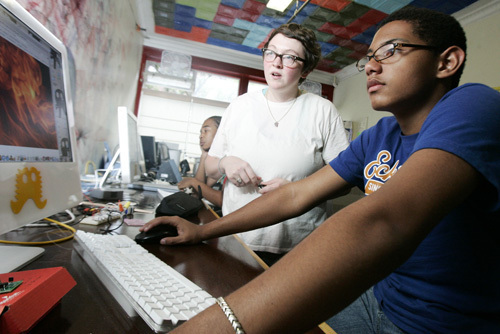
That, in a nutshell, is the idea behind the Fab Lab, a workshop where both experts and novices are given the tools and guidance to do their own hands-on technology projects.
Rhode Island is now set to get its own Fab Lab. The nonprofit community arts organization AS220 recently unveiled its plan to launch one in downtown Providence, in partnership with the Massachusetts Institute of Technology.
The idea for the Fab Lab – which is short for “fabrication laboratory” – was developed by researchers at MIT’s Center for Bits and Atoms, part of the school’s famed Media Lab. They were exploring the idea of a home “fabrication center” – a single machine that people could use to create other machines – a bit like the fictional Replicator machine on “Star Trek.” Fab Lab creator Neil Gershenfeld, director of the Center for Bits and Atoms, has predicted that fabrication centers will eventually be as ubiquitous as personal computers are today.
MIT provides each Fab Lab with computer-controlled fabrication tools, open-source design and manufacturing software, and electronic components and test equipment. Besides the original Fab Lab in Boston, more than two dozen labs are currently up and running in the United States and overseas in Norway, Spain, Costa Rica, India, Ghana and South Africa.
The labs, which are open to the public, focus on underserved populations. “It’s democratizing technology,” said David Ortiz, AS220’s new development director.
Umberto Crenca, AS220’s artistic director, spoke about the Fab Lab in visionary terms, putting it at the forefront of an approaching movement toward small-scale, localized, sustainable economies.
In addition, Crenca said the Fab Lab harkens to an era when fewer people found technology mystifying and felt confident enough even as an amateur to work on a car, for example. The Fab Lab, he said, will let people “get back under the hood.”
AS220 is planning a major fundraising push to secure the $250,000 that will be needed to cover the Fab Lab’s startup costs, after which Ortiz said they expect it to become self-sustaining. However, the group does not need to have all the money in hand to start the lab. Ortiz said they expect to buy the lab’s equipment by the end of the year. Shawn Wallace, the former AS220 managing director who will head the Fab Lab, is also seeking volunteers and in-kind contributions.
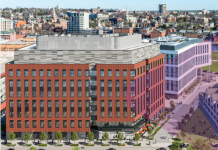
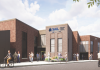
In addition, last month AS220 purchased Mercantile Block, a 50,000-square-foot building on Washington Street next to AS220’s recently refurbished Dreyfus Hotel building and the restaurant Local 121, for $1.6 million. The AS220 Fab Lab would eventually be housed in a planned $12 million, mixed-use development project there that the group hopes to complete by mid-2010.
Ortiz said the AS220 Fab Lab will be useful to a wide range of people. At one end, local information-technology entrepreneurs can use the expensive fabrication tools it makes available to develop their projects affordably, he said. “This project is how we build the creative economy, the innovation economy,” he added.
At the other end of the spectrum, young people can get their first hands-on experience working with technology.
Brian Jepson, an editor at Make magazine and an AS220 board member, said the Fab Lab fits AS220’s mission. “AS220 has a tradition of providing access to tools for creating things,” he said in an e-mail, pointing to the group’s darkroom and print shop, both of which are open to the public.
“The Fab Lab is a great next step because it provides tools to make a wide array of objects – furniture, art, toys, jewelry, electronics – the list goes on, because a Fab Lab lets you start with materials and ingenuity and out comes something amazing and unique,” Jepson said. •