This year’s most important auction won’t be held at Christie’s or Sotheby’s. In fact, it won’t take place in one physical location at all, but rather on dozens – perhaps thousands – of computers scattered around the world.
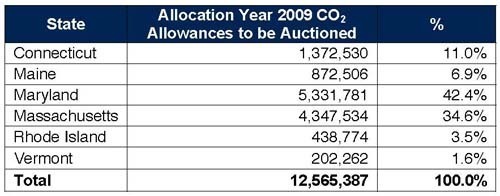
On Sept. 25, a group of six states, including Rhode Island and Massachusetts, will auction off more than 12 million carbon-emission permits to power companies, brokerage firms and other parties in an online bidding process. It will mark a major step forward in the Regional Greenhouse Gas Initiative (RGGI), a much-heralded consortium of 10 Northeast states which has pledged to reduce carbon emissions by a combined 10 percent over the next 10 years.
RGGI (pronounced “Reggie”) is the United States’ first attempt to place a mandatory curb on carbon dioxide emissions, a leading cause of climate change. RGGI’s first auction thus is being watched closely by policymakers as debate continues over creating a federal cap-and-trade system to cut down on the nation’s greenhouse gas pollution.
For a long time, it looked unlikely that Rhode Island would take part in the first auction. Although the state took part in the negotiations that led to RGGI, Gov. Donald L. Carcieri, citing concerns about the possible impact on energy prices, waited a year to sign the final agreement.
Carcieri reversed course in January 2007, and the R.I. Department of Environmental Management then began crafting a complicated set of rules to govern the state’s carbon cap-and-trade regime. Those regulations were completed last month, allowing the auction to go forward with Rhode Island’s participation.
“It’s very exciting that the RGGI process is finally moving toward getting the carbon reductions we’ve been talking about for years,” said Cynthia Giles, director of the Conservation Law Foundation’s Rhode Island office. It took a major effort by the department’s employees to finish the regulations in time, she said.
During the cap-and-trade system’s first five years, from 2009 to 2014, RGGI caps its 10 states’ carbon emissions at 188 million tons a year. During that five-year freeze, power companies will need to stabilize their emissions at the 2009 level. That will prepare them for the next five years, from 2015 to 2019, during which RGGI calls for the region to cut its total annual emissions by 10 percent, down to 169 million tons of carbon in 2019.
Each state is receiving roughly enough carbon-emission allowance permits to match up with its historic level of carbon pollution.
Starting in September, RGGI will sell the states’ permits together in quarterly auctions. In order to continue emitting carbon, polluters will need to buy permits from RGGI or from traders in the secondary market that allow them to do so. Proceeds from the auctions will go back to the states to be invested in renewable energy and efficiency programs.
Each permit will entitle its holder to emit one ton of carbon dioxide, and polluters have until March 2012 to accumulate enough permits to cover all their emissions over the prior three years.
RGGI permits also will be interchangeable. For example, Dominion Energy, which owns the Bradford Street power plant in Providence, does not need to pay for that plant’s emissions with Rhode Island permits – any RGGI permit will do, so Dominion can pay for its emissions with permits that originated in New York, Maryland or some other state.
The permits on auction next month will be for carbon emitted in 2009. The big questions that remain unanswered are how many bidders the auction will attract and how much one ton of carbon will cost – or, technically, how much a permit to emit one ton of carbon will cost.
An analysis by the consultancy ICF International pegged the price at $2.32 for each ton of carbon in the 10 RGGI states. Based on that estimate, RGGI has set a floor price of $1.86 per ton for the first auction. However, officials and bidders estimate that the price could fall anywhere between $2 and more than $6.
The financial impact of the new emissions permitting system on businesses will be small for most Rhode Island businesses, according to a 2005 report by Marc Breslow, director of the Massachusetts Climate Action Network, and Eban Goodstein, an economics professor at Lewis and Clark College. •