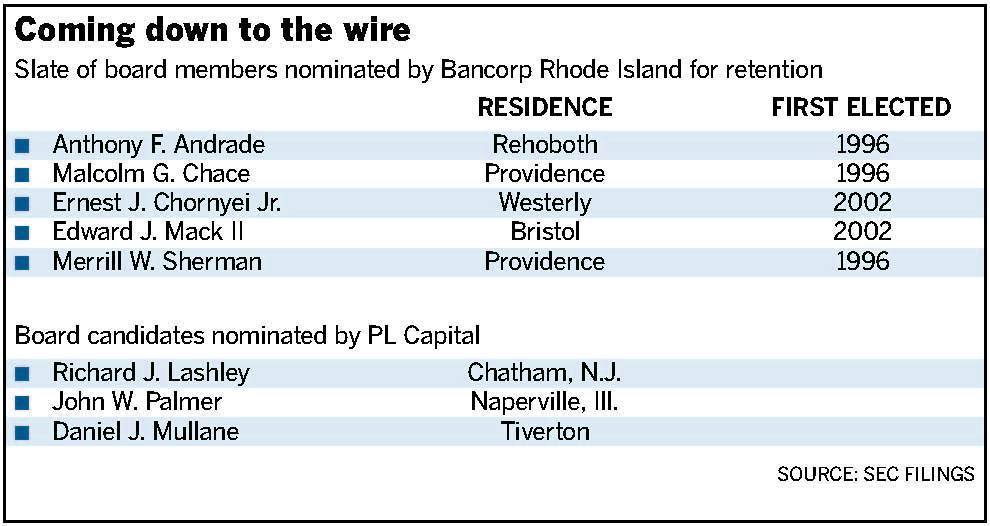
Armed with pie charts, line graphs and tables, Bancorp Rhode Island Inc. and a dissident shareholder are making a final push in their contentious battle to win over shareholders.
It’s part of the proxy campaign in which activist shareholder PL Capital LLC, an Illinois investment firm, is again seeking seats on the board of directors of BancorpRI, the parent of Providence-based Bank Rhode Island.
In recent weeks, presentations and letters to shareholders from both sides have painted vastly different pictures of how the bank is doing:
BankRI leadership has defended its performance in a difficult economic environment, touting the 14.58-percent average annual return for shareholders over the last decade and 17.3-percent year-over-year earnings growth last year.
“We are a solid success story,” Merrill W. Sherman, BankRI’s president and CEO, said in a recent interview with Providence Business News.
Then there’s PL Capital LLC, which has told shareholders that BankRI’s performance has lagged behind its peers in recent years. The firm points to the bank’s return on equity, which had fallen from 11.53 percent in 2004 to 7.22 percent in 2006, before improving to 7.87 percent last year. According to PL Capital, similar-sized banks had a ROE of about 9 percent last year.
“It’s a problem with management,” PL Capital principal Richard J. Lashley said in an interview with PBN last week. “I think it starts at the top, and [Sherman] is concerned – and rightfully so – because we’re highly critical of her being the CEO.”
With whom will shareholders side? They have until May 21 – the date of BankRI’s annual shareholders meeting – to decide.
At stake: Three seats on the 15-member board, and the future of Rhode Island’s second-largest independent bank.
PL Capital – which controls 8.55 percent of the bank’s shares, making it the largest institutional shareholder – has made no secret of its desire to push for change, either improving the bank’s performance through changes in management or seeking the sale of the 12-year-old institution.
“I’ll be the first to admit that their results are not horrible – they’re making money; credit has not been an issue,” Lashley said. “But they’ve hit the wall. They’ve reached the level of what they can do with the franchise.”
BankRI’s proxy efforts received a boost last week when Glass Lewis & Co., a San Francisco-based independent proxy advisory firm, issued a report endorsing the entire slate of company nominees instead of Lashley and other PL Capital principals John W. Palmer and Daniel J. Mullane, a Tiverton resident.
“While certain aspects of the company’s operational performance continue to lag behind its peers, we see improvements on multiple fronts,” the report said. “We believe that these improvements, while modest, suggest that the removal of the company’s current directors is unwarranted at this time.”
Another influential proxy advisory firm, RiskMetrics Group, is expected to release its report on Bancorp Rhode Island this week.
The proxy campaign has proved costly for both sides, according to filings with the Securities and Exchange Commission.
PL Capital estimated it would spend about $150,000 in trying to win votes, including paying $75,000 to a proxy solicitation firm. BankRI, meanwhile, said its expenses would be about $195,000, including $80,000 to hire its own solicitation firm.
There could be another cost: In an interview with PBN, BankRI executives expressed concern about the effect the proxy battle might have on the bank’s image among clients in the business community.
“Some of the numbers that have come out are distorted,” said James DeRentis, BankRI’s chief business officer. “If you’re a customer, or even an employee who’s reading it, you may not understand that it’s distorted.”
BankRI has been through this before – it’s the second time in as many years PL Capital has sought spots on the board. Last year, tensions between PL Capital and the bank’s leadership steadily increased ahead of the annual shareholders meeting.
When the votes were tabulated following that meeting, it was a shutout: Shareholders elected the entire slate nominated by the bank’s leadership. (READ MORE)
This time around, Sherman has some improved numbers to bolster her argument that BankRI is a well-run company with a sound strategic plan of focusing on small-business customers with a “feel-good, high-touch” relationship.
In addition to the 17.3-percent earning increase for 2007, the commercial loan portfolio increased from $520 million to $574 million, a 10-percent rise. (READ MORE)
“We’re still young and our reputation continues to grow,” Sherman said. “We’ve had double-digit commercial growth almost every year.”
Bank executives insist that flat earnings and declining return on equity were due in part to BankRI being in an “investment stage” between 2003 and 2006. That included opening four new branches since 2004, which have been a drag on earnings while they edge toward profitability. But although the East Greenwich and Pawtucket branches are not yet profitable, the bank said a branch in Lincoln has reached the break-even point and one in North Kingstown is approaching it.
In 2005, the bank also issued about 628,418 new shares to raise capital — lowering earnings per share – and acquired Marcolease, a New York fitness-equipment leasing company that has $40 million in revenue annually.
“People say it’s a tough environment out there, but if you look at where we stand we’re well-capitalized,” Sherman said. “We’re in solid shape; we’re growing and other people are now peeling off parts of their portfolio – including equipment leasing – and it may present some opportunities for us.”
While crediting BankRI for avoiding the credit mess that has hurt the banking industry recently, Lashley said he’s been unimpressed with the bank’s earnings figures.
Excluding a one-time charge of $558,000 in 2006, and a $165,000 gain on the sale of securities, Lashley said profits rose only about 7 percent last year.
Considering that the bank has opened new branches, raised capital in 2005 and bought back some stock, he expects better results. “Those are all thing that should have had a payoff already,” he said. “They claim that the payoff is coming in the future, but we don’t see it.”
Lashley said if PL Capital were to get representation on the board, he’d spend up to six months attempting to improve the bank’s performance, first seeking to lower the efficiency ratio to below 60 percent. It’s in the mid-70s now.
“I’m telling you there’s got to be a way to do it,” Lashley said. “I don’t know whether it’s on the expense side only or the revenue side. But there is a way with the right people and the right focus and the right business model.”
Lashley said he would like to do away with the universal banker model used by BankRI, in which all staff members at a branch are able to provide full service and sales support to customers.
“It’s a high-touch, high-cost model,” Lashley said. “You spend the money but you’re supposed to get the growth. As a director, I’d say universal banker is not working here. I don’t know why it’s not working. Maybe it’s not the right model for this market. Or we don’t have the right people or we’re not training them right or something. Shut it down, modify it or fix it.”
In a letter to the Bancorp Rhode Island board of directors in March, PL Capital chided the directors for allowing a few opportunities to sell the bank slip by.
“The Board of Directors should immediately engage outside advisors with a mandate to pursue a strategic transaction that maximizes shareholder value before additional opportunities are lost,” PL Capital said.
BankRI executives have criticized PL Capital for not having a “substantive plan” for the future, other than forcing a sale.
“Their agenda is not secret,” Sherman said. “Their interests are different from many of our shareholders … And I don’t think we can let ourselves be governed by what’s going to happen next week, or next month. We have a take a longer view.” •
Bancorp Rhode Island Inc. (Nasdaq: BARI), based in Providence, is the parent of Bank Rhode Island, a state-chartered, FDIC-insured institution with 16 branches in Providence, Kent and Washington counties. Additional information about BankRI and its parent company is available at bankri.com.
Seifert Systems Invests in Energy Efficiency to Strengthen Operations
For manufacturers, energy is more than just another operating expense. It plays a critical role…
Learn More