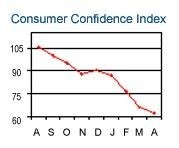
NEW YORK – Confidence among U.S. consumers this month hit a five-year low, though it slowed its decline after falling sharply in March and February, according to a report today from The Conference Board. But the board’s index of inflation fears matched its all-time high, set after Hurricane Katrina.
The board’s Consumer Confidence Index fell 5.5 percent to a preliminary April level of 62.3 points (1985 = 100) from March’s revised 65.9 points.
Analysts had expected the index to hit 61 points – down from the 64.5 points of the original March report (READ MORE) – based on the median forecast from a Bloomberg News survey of 67 economists. Their estimates ranged from 57 to 70 points.
“This month’s decline in Consumer Confidence was the result of yet another sharp decline in the Present Situation Index,” Lynn Franco, director of the board’s Consumer Research Center, said in a statement today. “This continued weakening suggests that not only has the feeble level of growth in the first quarter spilled over into the second quarter, but that economic conditions may have slowed even further. And, not only are lackluster business and job conditions eroding confidence, but rising gasoline prices” – now at record highs READ MORE – “are undoubtedly heightening concerns.
“Consumers’ inflation expectations continue to rise, and this measure now matches the all-time high reached in the aftermath of Hurricane Katrina,” Franco said. “The percentage of respondents intending to take a vacation over the next six months has fallen to a 30-year low, another sign of consumers turning more cost-conscious.
“Looking ahead, consumers’ outlook for the economy, the job market and their income prospects remains quite pessimistic and little changed from last month. Or, in other words, the glass remains half empty.”
Current business conditions were seen as good by 15.3 percent of respondents, “virtually unchanged” from last month’s revised 15.6 percent, the board said. The share saying business conditions are bad rose to 26.7 percent from last month’s 25.5. The share seeing jobs as plentiful fell to 16.6 percent from last month’s revised 19.2 percent, while the share seeing them as difficult to find rose to 27.9 percent from March’s 24.5 percent.
The Expectations Index – a gauge of expectations for the economy in the next six months – “remained quite grim,” the board said, although it improved slightly to 50.1 points from March’s upwardly revised 49.4 points.
The share of respondents expecting business conditions to worsen over the next six months increased to to 27.0 percent from March’s revised 26.0 percent, but the share anticipating business conditions to improve rose to 10.1 percent from the previous 8.6 percent. The share expecting jobs to become scarcer rose to 32.8 percent from last month’s 29.3 percent, while the share expecting jobs to become more plentiful rose to 9.0 percent from March’s 8.0 percent. The share expecting their incomes to rise over the next half year fell to 15.1 percent from last month’s 16.1 percent.
The indexes are based on a monthly survey conducted for the Conference Board by custom research firm TNS. The cutoff date for this month’s preliminary results was April 22.
“We have seen clear correlation between declines in confidence and concentrated increases in gasoline prices,” James O’Sullivan, a senior economist at UBS Securities LLC in Stamford, Conn., told Bloomberg Television. “The numbers are certainly consistent with an economy in recession.”
The Conference Board is a nonpartisan, nonprofit business membership and research organization with offices in New York City, Chicago and abroad. Additional information is available at www.Conference-Board.org.