Tax season has once again arrived. In light of many changes to the federal income tax and estate and gift tax laws in recent years, it may be wise to revisit how some of the most recent changes in the federal income, estate and gift tax laws may affect you.
• Economic Stimulus Package
On February 13, President George Bush signed the Economic Stimulus Act of 2008 (the “Stimulus Act”) into law. The Stimulus Act represents Congress’ efforts to stimulate the U.S. economy.
Under the Stimulus Act, many Americans will receive a rebate check from the federal government. Recovery rebates and incentives for business investments were included in this law as well. The idea behind the rebates is to motivate people to spend the money that they receive in the rebate check, thereby stimulating the economy.
Who will receive a rebate check and for how much? The maximum rebate amount for qualifying individuals is $600, $1,200 for married couples filing jointly and an additional $300 for each qualifying child no matter how many qualifying children you have. A child is considered “qualifying” if the child is a dependent child under the age of 17.
Non-resident aliens, estates, trusts or individuals claimed as dependents on another’s tax return are not eligible to receive a rebate check under the Stimulus Act.
Despite this maximum amount, there are phase-out provisions embedded in this law based mainly on income levels and income tax liability. The rebate amount will begin to phase out for individuals with gross income over $75,000. The rebate amount will be reduced by 5 percent of an individual’s adjusted gross income which exceeds $75,000. In effect, if an individual taxpayer’s income is $87,000 or above and such taxpayer has no children, then no rebate check will be issued to such taxpayer.
Similarly, for married couples filing jointly, the same phase-out begins at income levels of $150,000 and higher. In addition, certain low-income taxpayers with little or no tax liability will be issued a rebate check of $300 (for individuals) or $600 (for married couples filing jointly).
To qualify, taxpayers must satisfy one of the following. The taxpayer must have either qualifying income of at least $3,000, which includes earned income, social security benefits or veteran disability benefits, or the taxpayer must have net income tax liability of at least $1 and have gross income greater than the sum of his or her basic standard deduction amount and personal exemption. Twice the exemption amount is needed for married couples filing jointly.
Regardless of the amount of the rebate, a taxpayer must file a 2007 income tax return to be eligible to receive any rebate check. Additionally, the social security numbers of the taxpayer, taxpayer’s spouse and children must be included on the return.
• Estate and Gift Taxes
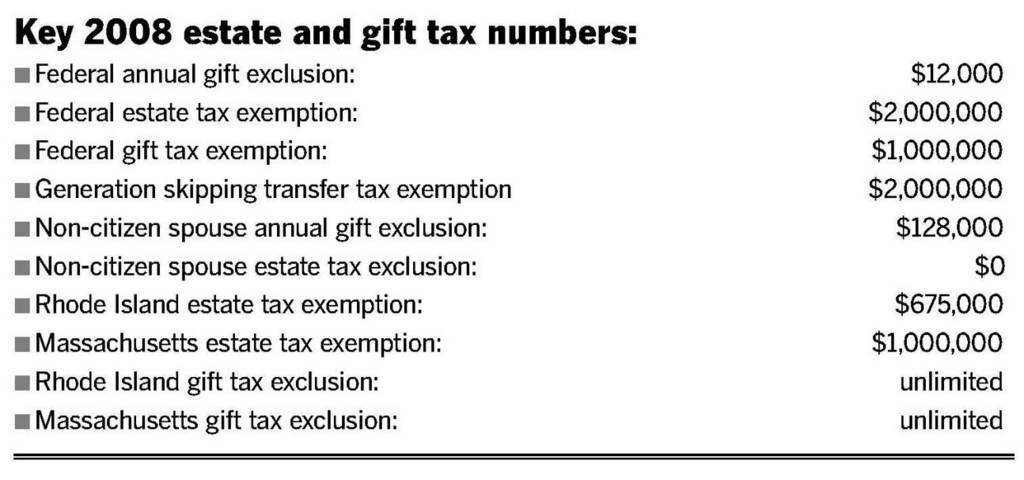
From a federal estate and gift tax perspective, with the exception of the annual gift tax exclusion for gifts made to a non-citizen spouse, the federal estate and gift tax exclusion amounts have not changed since 2007.
The current federal estate tax exclusion for an individual who dies in the year 2008 is $2,000,000. The current lifetime federal gift tax exclusion for an individual is $1,000,000.
This means that for federal estate and gift tax purposes an individual is entitled to transfer up to $1,000,000 during his or her life without incurring a gift tax. However, any use by a taxpayer of the federal lifetime gift tax exclusion will proportionately reduce his or her federal estate tax exemption at death.
Additionally, each individual may transfer $12,000 per year, per person (not including any payments made for tuition and medical expenses) without consuming a portion of his or her $1,000,000 lifetime gift tax exclusion (referred to as the “annual exclusion”).
There are certain requirements necessary for gifts to qualify for the annual exclusion. As discussed above, any gift that does not qualify for this annual exclusion will reduce this taxpayer’s lifetime gift tax exemption by the amount of each gift. •
Lawrence D. Hunt and Megan C.M. Andrews are members of the probate, trust and personal planning practice group at Partridge Snow & Hahn.