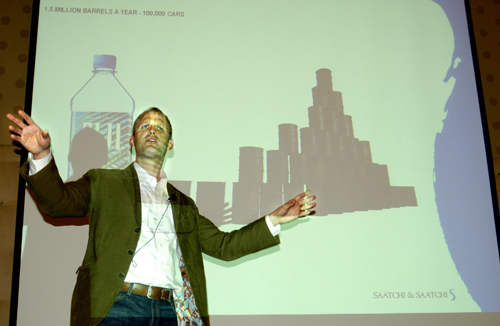
To Robert Hildreth, the corporate sustainability movement has to move beyond just the environment in order to maintain its momentum. It has to become personal.
The “green” marketing expert was one of the keynote speakers at the Brown Forum for Enterprise’s daylong 2008 Green Technology Conference on Feb. 28. Other sessions focused on sustainable design and architecture, the greening of polluted brownfields sites and the possible effects of nanotechnology on the environment.
Hildreth – vice president of global strategy at consulting firm Saatchi & Saatchi S, which works in part with corporations interested in making a move toward sustainability – told the gathering at the R.I. Convention Center that the key is making the sustainability movement “irresistible.”
That hasn’t been the case so far.
“Almost every chart that you can look at shows a decline in the world’s resources,” Hildreth said. “And this is largely why the dominant theme of the movement has been doom – scaring you into changing. But we’ve learned quite a bit over the last 20, 30 years about how ineffective that is as an approach.”
An innovative approach is what’s needed, Hildreth said.
“It’s not fear that motivates, it’s hope for a better tomorrow,” he said. “And we can innovate our way out of here.”
How? He recalled how Wal-Mart had contacted his firm, seeking ways of making the mammoth retailer and its employees more mindful of sustainability.
Instead of giving Wal-Mart executives a list of actions to take, Hildreth’s company developed the Personal Sustainability Project, in which Wal-Mart’s 1.3 million employees were asked to tackle a small problem that was important to them but would also have at least a minor impact on the world – quitting smoking, losing weight, recycling more, walking to work one day a week.
“This was based on a lot of different things that we learned don’t work in the environmental movement,” Hildreth said. “What doesn’t work: Working on a big problem that you don’t really care about.”
For instance, “green teams” at some other companies lack enthusiasm, he said. “Nobody really cares about it; they’re just sort of doing it.”
But so far, the Personal Sustainability Project has enlisted about 700,000 Wal-Mart employees – and that spirit of sustainability is spreading, Hildreth said.
According to Hildreth, 19,000 employees have quit smoking, leading to an estimated saving in health care costs of $34 million; project participants have lost a combined 184,000 pounds and have walked, swam or biked 1.1-million miles; and more than 3-million pounds of materials have been recycled.
He said one Wal-Mart employee looking to save energy noticed that the lights of the soda machine in the snack room were always on. He convinced the store manager to turn off the lights. “Within three days, every single store turned off the lights on the back-room soda machines,” Hildreth said. Savings for the company: $2 million annually.
“One of the powers of this exercise is you start making connections to the world – ‘My actions are connected to global consequences’,” he said. “People start to realize that sustainability isn’t something that’s out there; it’s not in the environment somewhere. We’re totally surrounded by it all the time. It’s in the choices we make at the store or in the house.”
“And it’s this personal revelation that creates the conditions for something I might do toward sustainability at my job or as a leader of my business,” Hildreth said.
Hildreth said the ultimate goal of Saatchi & Saatchi S is to inspire a billion people worldwide to participate in a similar personal sustainability program.
“Think about the changes that could happen,” he said. “This force would be so much more powerful than anything a government could do or any mega-business could do.” •