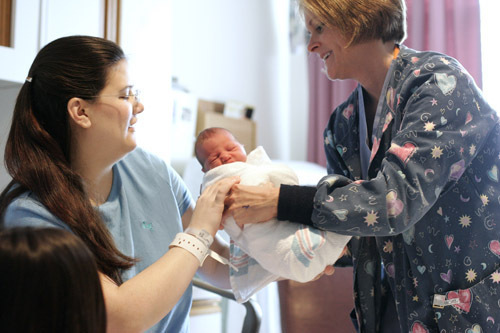
When a new mother leaves the hospital, she might not be confident of her maternal instincts. She might not know how often to breast-feed or why her newborn is being so fussy. After only 48 hours of postpartum care, few first-time mothers would consider themselves experts.
That’s where Memorial Hospital of Rhode Island’s “We Baby our Mothers” program lends a hand – a new mother can just pick up the phone and call a 24-hour hotline, said Kathy Jarvis, nurse manager of Memorial’s birthing center.
“If it’s simply a question that a new mom might have and doesn’t know where to go with it, we’re more than happy to go over what we’ve said in the hospital and offer any other ideas that we might have,” Jarvis said.
But the phone service is only the last piece of the hospital’s individualized “We Baby our Mothers” maternity care, said Dr. Michael Pepi, who took over as chief obstetrician and gynecologist a little more than a year ago.
Under Pepi’s guidance, the hospital has begun promoting itself as a family-friendly birthing center – a focus made easier by its small annual birthing volume of about 400, much fewer than Women & Infants Hospital’s.
Because of that, Memorial Hospital is able to offer a level of care that Women & Infants might not offer, Pepi said – unless the baby needs to visit the Neonatal Intensive Care Unit. Women & Infants is the state’s premier hospital for that care.
At Memorial, nurses are paired with patients and work them through the birthing process. Even pre-birth outpatient testing is done at the hospital, “so they’re seeing the same nurses who are going to be taking care of them during labor, and they get to know the nurses,” Jarvis said.
At a larger hospital, many nurses work with each mother, but a community hospital setting allows the same nurse who welcomes a patient into the hospital to work with them until they are discharged.
“From that perspective, it gives both the nurse and the patient an opportunity to get to know each other,” said Jarvis.
The small staff – Jarvis manages about 35 nurses – and intimate quarters make birthing a “special” time, Jarvis said. “We encourage the dads to stay overnight. We encourage that the baby stay in the room – that they’re not separated from their mothers at any time.”
At Memorial, patients are able to bypass the emergency room. “That’s what this ‘We Baby our Moms’ initiative is all about,” said Pepi, who worked for 18 years at Women & Infants. “Here if a patient comes in and thinks she’s in labor, she’s taken right upstairs to the labor floor to be examined – not even stopping in the emergency room.”
Memorial isn’t the only community hospital in the state, though. Among the others are Newport Hospital and South County Healthcare System – both UNICEF and World Health Organization-certified as “Baby Friendly” – which offer similar birthing programs. Both have nurse-patient ratios and inclusive rooms comparable to Memorial’s.
At Newport Hospital about 700 babies are born each year. There, mothers are set up in one room – most of which are on the seventh floor, overlooking Newport Harbor – that are meant to mimic at-home settings, said Denise Dorato, Director of Maternal Care. And they stay in the same room throughout the birthing process – labor, delivery, recovery and postpartum.
Newport’s 10 birthing rooms are discrete about their purposes. They’re equipped with in-room Jacuzzi tubs, which many mothers find ease their pre-birth pain, and all the medical equipment is hidden in the closets.
When it’s time for the birth, all the gear comes out, but “once the delivery is done, all the high-tech goes away and we close the closets,” Dorato said. “It looks just like a room with a beautiful, spectacular view of Newport.”
Being on an island, too, adds to the community atmosphere for the Newport nurses, leading to an average tenure with the hospital of 15 years for the roughly 30 professionals. Outside the hospital, they see the women they help through labor. “They might even see them in the grocery store,” Dorato said.
At South County’s Maternity Services & Birthing Center, where about 420 babies are born each year, continuity of care is important, said Deborah Lee, one of 16 staff nurses.
South County offers eight inclusive rooms, where, like Newport and Memorial, husbands are encouraged to sleep over. At South County, any number of family members can sleep over and be part of the postpartum process, Lee said. “Pretty much the size of the room controls how many people can stay in there,” she joked.
At Newport, South County and Memorial’s birthing centers, there is a common purpose: the whole point of individualized care is to increase the comfort and quality of health care during birth.
“When a woman comes into the hospital to have a baby, this is a life-altering experience,” Dorato said. •