Last year, according to the National Alliance to End Homelessness, 6,866 Rhode Islanders were homeless at some point – about 1 in 150 state residents, giving the Ocean State one of the 10 highest per capita homelessness rates in the nation.
Most of those people were only temporarily homeless. But some are homeless because they are deeply troubled, and every year, they require extensive social, medical and other services, at a steep cost to the government.
Advocates for the homeless have pushed for an alternative: investing in supportive housing that provides rapid access to services that help chronically homeless people lead independent, stable and productive lives. And a new study supports their argument.
The study, conducted by Eric Hirsch, a Providence College sociologist, and Irene Glasser, a Roger Williams University anthropologist, and released Nov. 1 by the HousingWorks RI coalition, evaluates the first year of the Housing First program, a pilot initiative that provided supportive services and permanent housing to 48 chronically homeless people in the state.
The program was run and funded by the state and the United Way of Rhode Island, with support from the Rhode Island Coalition for the Homeless and placements at House of Hope’s Fran Conway House or in the Riverwood Mental Health Services Center.
When it wraps up later this year, the pilot will have cost $475,000 for two years – including $175,000 from the United Way. Supporters are seeking to raise the state’s contribution to $475,000 per year, which would allow the program to serve 160 people, said Karen Jeffreys, associate director of the Coalition for the Homeless.
The study indicates it would be a good investment, Hirsch said: $15,143 per person in supportive services produced a “dramatic decline” in hospitalizations, emergency room visits, use of residential rehab programs, nights in emergency shelters, and jail time.
The program works by targeting the 10 percent of Rhode Island’s homeless who use more than half the available services, he said. By his calculations, in 2005, before entering the program, the 48 homeless people used an average of $31,617 in services, for a total of $1,517,626. During the pilot the same individuals cost the state $1,093,344, he said – for net savings of $424,282.
At a State House event to release the study, Armeather Gibbs, chief operating officer of the United Way, noted that some homeless Rhode Islanders cost the system even more. She detailed expenses of “Million Dollar Rhody,” a disabled, mentally ill man.
“From December 2006 to April 2007, Million Dollar Rhody was transported, by ambulance, to the hospital a total of 98 times in a 96-day period,” Gibbs said. “Medicare was charged $37,096 for those particular trips.”
During the same period, the man racked up 65 hospital bills and 164 bills for tests, X-rays and doctor’s visits. All told, he cost the federal and state governments $134,877 in four months.
At that rate, “it would take less than three years for one individual to rack up $1 million worth of medical bills. $1 million, one person, 36 months. These are powerful, overwhelming numbers,” Gibbs said.
Even with expanded funding, the Housing First program wouldn’t cover the total population of Rhode Island’s chronically homeless, which Hirsch estimated to be about 650 people. But not only would it save money, supporters said – it would make a real human impact.
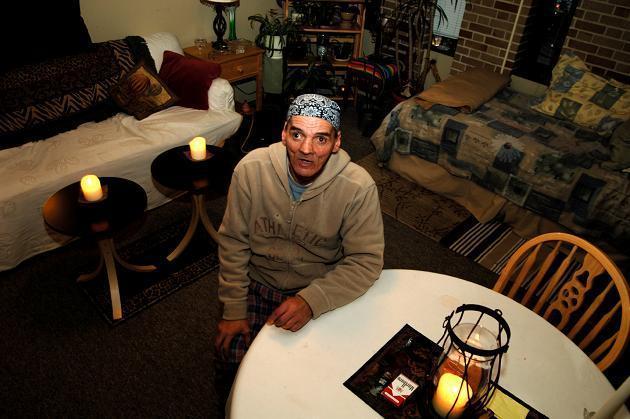
At the State House event, one of the people who participated in the pilot, identified only as Robert from Providence, made that point.
He’s been living at the Fran Conway House, and “it changed my life dramatically,” he said. “It restored my dignity, gave me a safe, clean place to live, and the staff and support you see here is just overwhelming.” •