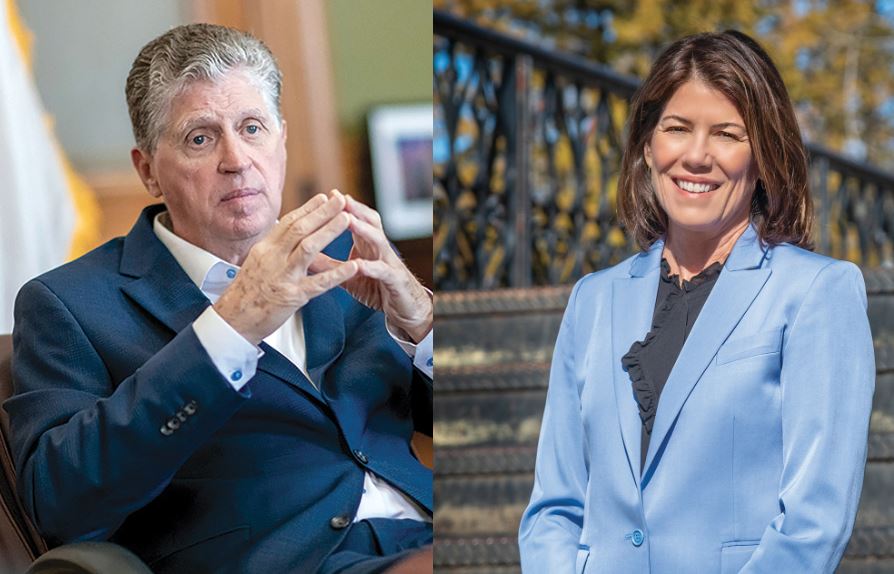
Among Gov. Daniel J. McKee’s favorite statistics: the 37,000 jobs “created” under his administration.
But his recent boast drew a strong rebuke from his Democratic primary challenger, Helena Buonanno Foulkes.
Seifert Systems Invests in Energy Efficiency to Strengthen Operations
For manufacturers, energy is more than just another operating expense. It plays a critical role…
Learn More
“This is a lie he’s telling all of you, and I really want to clarify that,” Foulkes said in response to McKee during an Aug. 12 televised debate hosted by WJAR-TV NBC 10 and Coastal ABC. “Most of those jobs were coming out of COVID, which every state in this country did.”
Unlike other moments of disagreement between the two rivals, this dispute can be easily fact-checked using federal labor market information.
So who’s right?
Technically, both of them.
As of June 2026, the most recent data available through the U.S. Bureau of Labor Statistics, Rhode Island’s seasonally adjusted nonfarm payroll – a.k.a., jobs count – stood at 514,200. That’s 39,700 more jobs in the state than when McKee took office in March 2021.
But, as noted by Foulkes, the Ocean State was still climbing out from the pandemic, which almost instantly slashed 108,700 jobs – more than one in five positions.
As mask requirements and social distancing rules lifted, businesses reopened, and seasonal tourism rebounded, so jobs increased. Slowly.
It took almost three years, until December 2023, for Rhode Island to reach its pre-COVID jobs level – the first New England state to do so, according to the R.I. Department of Labor and Training.
Yet, the comeback became a comedown a year ago. After reaching a record 517,800 jobs in May 2025, Rhode Island, like much of the nation, began to see employers pull back amid economic uncertainty posed by Trump tariffs, and later, the war in Iran.
The state’s current job count stands at 0.06% higher than in January 2020. In other words, there are 7,200 more jobs in Rhode Island now versus before the pandemic took hold.
Foulkes suggests the much smaller employment gains are evidence of McKee’s economic failure, and that any post-COVID rebound would have happened anyway.
She has hammered McKee over the loss of Hasbro, which is in the process of moving its headquarters to Boston. More recently, Foulkes accused McKee of attacking CVS Health Corp., another major employer, because of his campaign critiques of her role as former head of its retail pharmacy division.
McKee, in turn, points to major employment expansions by Fidelity and Anduril Industries, along with the successful ploy to secure a long sought-after Amazon warehouse in Johnston, as proof of his leadership success.
To Edi Tebaldi, economics professor at Bryant University, the best way to measure Rhode Island’s record is not in any single statistic, but its performance relative to neighboring states and the rest of the country.
“How did we do compared to other states like Massachusetts and Connecticut?” Tebaldi said. “I think that’s more meaningful than anything else.”
On the jobs front, Rhode Island surpassed at least one of its New England neighbors, up 1.4% in total jobs compared with January 2020. Connecticut also saw jobs rise 1.4%, while Massachusetts lost 0.4% of its jobs during that time frame. Massachusetts and Vermont have yet to regain all their pandemic job losses.
Nationwide, jobs are up 4.5% since January 2020.
“Rhode Island is doing very well representing New England,” said Kate Greenwell, assistant director of labor market information for the Rhode Island Department of Labor and Training.
Yet, Rhode Island lost a greater share of its jobs than any other New England state in the last year, down 0.4% from June 2025 to June 2026. Maine was the only other regional state to report year-over-year job losses (down 0.1%) while Massachusetts and Connecticut grew by half a percentage point each. And labor force participation – the number of people employed or looking for work – is down, another troubling sign to economists like Tebaldi.
“Our population is getting older, and all the data suggests that is not going to be changing any time soon,” he said.
No single governor or leadership team can be held responsible for demographic realities.
But state policies can help, specifically taxes.
“We know states with tax-friendly environments tend to do better with population, tend to be better with the labor force,” Tebaldi said.
Infrastructure, including access to private and public transportation, is also a well-documented method to boost business growth. Hasbro CEO Chris Cocks cited Boston’s public transportation system and proximity to other major employers and talent as reasons for the move. The global gaming company is also receiving $14 million in tax credits through a Massachusetts economic development program.
“When we lose jobs, you’re going to blame the governor and the leadership,” Tebaldi. “When we gain jobs, it’s somewhat fair to give credit to whoever is in power.”
Rhode Island voters are looking for a candidate who they think can ease the affordability crisis gripping the state, and nation, said Joe Fleming, a political analyst for WPRI-TV 12.
But they don’t put much weight on specific labor force statistics.
“In this election, I don’t think it’s going to have a great impact,” Fleming said of McKee’s 37,000 jobs claim. “Most people, by this point, have opinions of both candidates already and who they think will do a better job.”
Yet 22% of Democratic voters remain undecided in the gubernatorial primary, according to the latest public polling via The Pell Center at Salve Regina University. McKee, down 20 points to Foulkes among survey respondents, continues to put his economic record at the center of his appeal to voters. Foulkes, meanwhile, frames her campaign around a shift from a status quo that is not working, pledging to increase efficiency and eliminate cronyism in government.
Asked by debate moderator Gene Valicenti how she would improve Rhode Island’s lackluster business climate, Foulkes suggested a “one-stop shop” modeled after Worcester, Massachusetts, to ease the regulatory burdens associated with business creation and development.
Foulkes was unavailable for additional comment.
Sophie Mestas, a McKee campaign spokesperson, shifted focus back to Foulkes’ record, including as CEO of Hudson Bay Company from 2018 to 2020. Foulkes was charged with stabilizing the struggling Canadian retail company in a restructuring that included laying off 2,000 workers.
“McKee has spent his career fighting for Rhode Island workers,” Mestas said in a response sent via text message. “That’s not changing.”
Nancy Lavin is a senior staff writer for the Rhode Island Current.