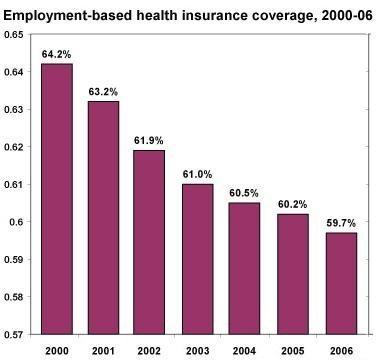
Nationally, the news was bad: From 2005 to 2006, the U.S. Census Bureau said, the number of people without health insurance rose from 44.8 million, or 15.3 percent of the population, to 47 million, or 15.8 percent. About 700,000 of the new uninsured were children.
But Rhode Island, which long has taken pride in covering children, but had been seeing that coverage erode in the last several years, actually saw a small improvement, from 6.5 percent uninsured, to 6.4 percent – compared with 11.7 percent nationwide.
And adults’ coverage in the Ocean State also held steady, bucking national trends: Between 2004 and 2006, the Census Bureau said, an average of 10.2 percent of Rhode Islanders were uninsured (all figures are three-year rolling averages); for people under 65, the figure was 11.5 percent.
In Texas, meanwhile, 24.1 percent of the population is now uninsured. Only six states do better than Rhode Island; the best is Minnesota, with an uninsured rate of 8.5 percent.
Poverty figures released in the same report, “Income, Poverty, and Health Insurance Coverage in the United States: 2006,” also offered good news for Rhode Island, with the share of children under 18 living in poverty dropping from 19.5 percent to 15.1 percent.
The poverty rate also declined nationally, but by less – from 18.5 percent to 18.3 percent for children, and from 12.6 percent to 12.3 percent for the population as a whole.
So what does this information mean?
The figures are based on two Census Bureau surveys: the Current Population Survey, which compiles mostly national-level statistics, and the American Community Survey, which gathers data at the state and metropolitan area levels.
Neither is viewed as so authoritative that a single year’s data can be taken as gospel; that’s why three-year rolling averages are used instead, to provide a bigger-picture perspective. And as with all statistics that use relatively small samples to estimate the actual results for large populations, there is a “confidence interval,” a range where researchers estimate the correct number lies. For example, the percentage of Rhode Islanders who were uninsured – 10.2 percent for 2004-06 – carries with it a 90-percent confidence interval of 0.9 percent. That means that 90 percent of the time such an estimate is made, the actual number of uninsured ranges from 9.3 percent to 11.1 percent.
Asked about the Rhode Island figures in particular, Elizabeth Burke Bryant, executive director of Rhode Island Kids Count, which compiles statistics on children’s well-being in the state and is widely regarded as authoritative, said she and her staff had looked at the data and deemed it to be credible. And it also fits with what they have observed.
The Census Bureau’s definition of poverty, for example, is pretty conservative: It’s based on the federal poverty line, which for last year was an income of $16,242 a year for a family of three. A small increase in income would push many families just over that threshold, even if they were still struggling financially, research analyst Elaine Farber noted, and thus decrease the poverty rate. And in fact, Rhode Island’s minimum wage rose in March 2006, from $6.75 to $7.10 (it’s now $7.40).
Similarly, with the insurance rates, Rhode Island has managed to protect children’s coverage under the widely praised RIte Care program, Bryant noted, and it has made efforts to preserve employer-based coverage, so things could actually have held steady.
The figures for 2007, however, may look different, Bryant and others warned. This year, the state adopted tough new federal rules on eligibility verification for Medicaid beneficiaries, and Mark E. Reynolds, CEO of Neighborhood Health Plan of Rhode Island, the state’s largest RIte Care coverage provider, said the program’s rolls have declined by about 4,000 due to those rules alone.
“And that’s not people who failed the standard – it’s largely people who were not able to complete the process of providing the documentation needed,” Reynolds said. As the state begins to apply the tougher rules not only to new enrollees, but to current program participants, he added, “we’ll have another large impact on enrollment.”
Reynolds also pointed out that the Census figures don’t reflect the growing number of Americans – and Rhode Islanders in particular – who go without insurance for at least part of the year; the statistics include only those who have been uninsured for at least a year.
It’s becoming more and more common for people to lose coverage, then get it back, then fall off the insurance rolls again, Reynolds said. At Neighborhood, “about two-thirds of the people we serve fall off during the year and come back.”
This is particularly common among Medicaid beneficiaries because of rules about co-payments and such, Reynolds noted. Some just don’t pay what they should, he acknowledged, but sometimes it’s “because of what’s happening in their lives – they have a hard time meeting the timeline requirements to submit paperwork, and those problems will only increase with the new documentation requirements.”
Asked whether he expects the number of uninsured to keep growing nationwide, Reynolds said he’s still hopeful that state-based initiatives will make a positive impact. Despite some setbacks, Massachusetts is doing pretty well with its effort, he said, and California, which is currently stuck in a political stalemate, could have a very positive influence on the nation if it manages to reach a compromise and move forward with its universal-care plan.
“If California does achieve a compromise, it will encourage other states to continue to move in that direction as well as put pressure on the federal government,” he said.
In Rhode Island, meanwhile, both Bryant and Reynolds said they hope the glimmer of good news will encourage state leaders to aim higher and try to cover more of the uninsured.
About 60 percent of the roughly 15,700 uninsured children in the state, Reynolds noted, already appear to be eligible for RIte Care based on their families’ income – some for free, some with co-payments. The same holds true for about 25 percent of uninsured adults.
“So a huge portion of the uninsured in Rhode Island could be solved not by new programs, but simply by making sure that the programs are more accessible,” Reynolds said. •