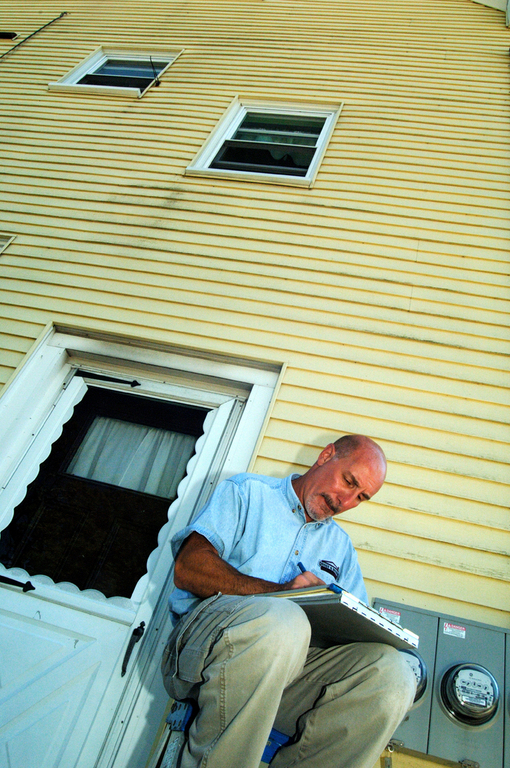
Paul Brunetti of Griggs & Browne has been inspecting homes in Rhode Island for 25 years. But starting next January, he may have to prove he’s qualified to do his job before he’s allowed to practice in the state. And as he sees it, that is a good thing.
The General Assembly passed a law in 2000 that required home inspectors to be licensed in the state, but it’s only now being implemented. About 200 inspectors are affected by the new rules.
The regulations governing licensure are being developed with input from the R.I. Department of Business Regulation, the Rhode Island Association of Realtors and the Rhode Island Builders Association, among others.
“It’s a good thing for all the players involved, especially the consumers. It’s very pro-consumer, because right now, anybody can be a home inspector,” said Brunetti, president of the Rhode Island Association of Home Inspectors. “Anybody right now can hang out a shingle and be a home inspector. And with the licensing, there’s going to be continuing-education requirements.”
Since the mandate – R.I. General Laws Chapter 5-65.1 – was passed, funding hasn’t been available for the two necessary employees and license-making equipment, so state-regulated testing, licensing and continued education have never taken root.
Now, pending public hearings in November, the regulations should go into effect by January 2008, said George Whalen, executive director of the R.I. Contractors’ Registration and Licensing Board. And employees will be hired to implement them.
“Our first step is to get some staff. There are two FTEs in the budget for clerical and investigative staff, which hopefully we’ll get passed and get here in a while. Even though the budget came into effect July 1, we’ll be lucky to have those people in place by the end of the year,” said Whalen.
The law requires contractors currently operating in the state to go through testing similar to the type that’s currently required in Connecticut and Massachusetts – both of which adopted similar legislation in 2001 – and 29 other states, according to a 2006 study by the American Society of Home Inspectors. (According to the same study, Rhode Island’s unfunded regulations ranked at 10th-best nationally, tied with those in West Virginia.)
To get a license in Massachusetts, contractors are required to inspect at least 25 homes in the presence of a licensed home inspector, while in Connecticut they’re required to inspect 100. In Rhode Island, the 2001 legislation calls for 50 home inspections to be an associate inspector, then 50 inspections to be an inspector. Also, a grandfather clause allows contractors who have ben licensed for at least five years in another state to be approved for a Rhode Island license.
Along with the licensing come penalties for those who break the rules. For Rhode Island, each violation will be punishable by a fine up to $1,000.
For some home inspectors, such as Don Lariviere, owner of House Doctors in North Smithfield, the licensing won’t bring about many changes to his practice. For example, he already carries the errors and emissions insurance policy that will be required at a minimum of $250,000 coverage.
“Inspectors that have a conscience already have insurance, but on their own, even though there’s no enforcement to do it,” said Lariviere.
Stephen Antoni of RE/MAX Professionals in East Greenwich, and president of the Kent Washington Association of Realtors, said that inspectors who help consumers with such major purchases should be licensed just as Realtors, of whom there are about 5,000 in the state.
“I suppose the only person who would be against this, if anybody has a negative opinion on this, would be an unlicensed home inspector who didn’t know what they were doing,” Antoni said. •