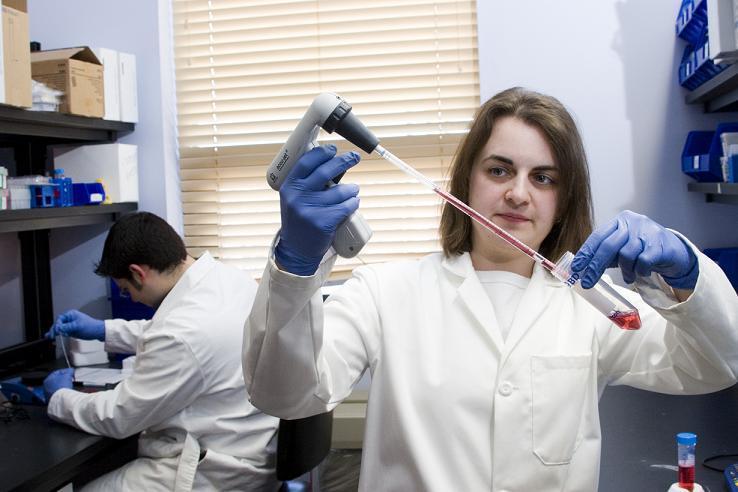
Having spent the first part of its history developing a closely guarded technology platform that drives its work, a Providence company is working to develop vaccines for HIV, smallpox, tularemia, and other infectious diseases and potential bioterrorist weapons.
EpiVax Inc. was founded in 1998 by Dr. Anne S. De Groot, an associate professor of community health and medicine at Brown University and director of Brown Medical School’s TB/HIV Research Laboratory. De Groot devotes about two-thirds of her time to running the company while continuing her teaching and research at Brown.
At the core of all EpiVax’s work is the EpiMatrix System, a vaccine design technology that De Groot developed in the 1980s and 1990s while working at Brown and previously at the National Institutes of Health. The computer program uses algorithms and coefficient sets to predict which parts of a gene sequence will activate T-cells, which direct all other cells in the immune system.
“Annie came up with a … program which could predict which pieces of a virus or bacteria will actually stimulate the T-cells to turn on,” said Daniel S. Rivera, EpiVax’s director of molecular and cellular biology. “That’s the EpiMatrix platform. You can take any gene sequence from any virus or bacteria and throw them into the program and, voilà, it comes out and says, ‘There’s a signal right here, there’s another one down there.’ ” After spending years doing mostly basic-stage research that proved the EpiMatrix program worked, in recent years EpiVax has begun developing several vaccines and preparing for the company’s growth.
Two years ago, the company moved into its current headquarters on Clifford Street in the Jewelry District, which has 2,000 square feet of lab space and about 3,000 square feet of office space. EpiVax now has about 12 employees and is expecting that number to grow in the coming months and years as it moves its vaccines to market, Rivera said.
“We would like to start the first clinical trial on a vaccine – whichever the lead candidate is at that time – in about two years,” he said.
About 33 percent of funding that EpiVax receives is federal bio-shield defense funding for its work to develop vaccines against smallpox and tularemia, and the company’s two-year-old program, in partnership with Lifespan, to develop a tularemia vaccine is the closest to clinical trial, Rivera said.
Also known as rabbit fever, tularemia is a relatively rare tick-borne disease that causes high fever and can be fatal. About 200 people in the United States get the disease each year through tick bites – including about six cases each year on Martha’s Vineyard, which is a hot spot for the disease.
But tularemia would pose a serious threat as a bioterrorist weapon, because the pathogen is almost always fatal if inhaled, Rivera said.
“National Institutes of Health put this on Category A for bioterrorist possibilities,” he said. “Smallpox is on there, tularemia is on there, all the bad things you can think of that a bioterrorist may want to play with … and the idea is that they would take tularemia, grind it up and then use crop dusters over New York City.”
In experiments, EpiVax has protected about 70 percent of mice against a lethal exposure to tularemia, and the National Institutes of Health soon will test the company’s vaccine against more potent tularemia strains at one of its secret labs, he said.
EpiVax also has gotten promising results from early work to develop a smallpox vaccine, and probably will start experiments in the next few months aimed at showing it can protect mice from a lethal smallpox infection, Rivera said.
The company is also working in partnership with the University of St. Louis to develop a vaccine against HIV. It has identified epitopes, or gene sequences, that activate T-cells, on every one of the thousands of known strains of the virus.
Eventually, those microscopic pieces of DNA could be used as a vaccine against all strains of HIV, Rivera said. “Your body will generate an immune response to the conserved regions that are in every single HIV virus,” he explained.
EpiVax is also working to re-engineer botulism toxin for use in treating people with muscular diseases. Botulism, which is one of the most toxic chemicals known, relaxes muscles when injected in minute quantities.
The chemical is already marketed as Botox in the cosmetics industry to smooth facial wrinkles, but the body stimulates an immune response if the chemical is injected in larger doses, as it would need to be if used to battle muscular diseases, Rivera said. EpiVax is trying to re-engineer the epitopes of botulism that stimulate T-cells, so that they no longer cause an immune reaction, he said.
EpiVax also runs an epitope screening service for major pharmaceutical companies, using its technology to predict which proteins that the companies are trying to develop into drugs will fail by generating an immune response, meaning the body will reject them, Rivera said.
While EpiVax very closely guards its technology platform, the company has decided not to patent it, which would require disclosing the program. That would make it too easy for competitors to design a knock-off technology, Rivera said.
“We think that there are too many clever people out there, and if we patent this and throw it out there, we’d have exclusivity on this, but somebody would design a modification,” he said.