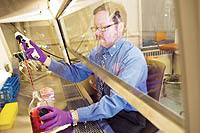
Tom Webster of Brown University feeds cells, a process that involves taking off old culture medium and adding new medium.
Research was done at Brown, Purdue
After six years at two universities, and about $10 million in grants, Thomas J. Webster’s research to use microscopic structures to simulate human tissue is nearing commercialization.
Beyond Cash Donations: How New Forms of Giving Are Transforming Not-for-Profit Accounting
Evolving Funding Landscape for Not-for-Profits Not-for-profit organizations are being asked to do more with less,…
Learn More
The Brown University professor said last week that a deal is in the works with a private investor from Indiana to form a company that licenses his research, which he started at Purdue University in 2000.
Because the deal is pending – the closing is expected this week – the name of the Fort Wayne, Ind., investor and the details of the transaction were not disclosed.
Webster, an associate professor of engineering at Brown, left Purdue to join the Ivy League school’s faculty in January. Because most of his research took place at the other university, in West Lafayette, Ind., Brown will receive less money than Purdue in the deal.
The professor believes that the arrangement’s involving two universities, rather than one, makes it unique. “Faculty move around all the time,” he said, “but I’ve never heard of a situation where two universities get together in this way for the sake of technology. … It’s really happened seamlessly.”
Officials from Purdue, Brown Technology Partnerships and the unnamed private investor plan to meet this week in Providence to set terms for the deal, Webster said. And, though he believes the future company probably would base its operations in Fort Wayne, Webster said he wants the continuing research and development to take place at Brown.
At present, Webster leads a staff of 16 researchers and students. The researchers, six of whom came with him from Purdue, have developed several “nanomaterials” – structures ranging in size from 1 to 100 billionths of a meter, or “nanometers” – for medical use.
Webster said the aim is to make nanomaterials that simulate tissue in five human organs: bones, cartilage, blood, the bladder and the brain. Thus far, the most promising aspect for commercial use has been the group’s material for bone implants, he said.
Webster has patented a bone-simulating nanomaterial derived from a common ceramic used in orthopedic implants, called titanium oxide. At a nano level, the new material has a rougher surface, increasing the total area on which bone cells can grow and making it stronger. It also is more difficult for harmful bacteria to infect the new implant.
With titanium oxide already approved by the U.S. Food and Drug Administration, the professor believes his rendition of the material could win the agency’s approval for commercial use within five years. (That’s about half the time typically needed to clear a new drug or product with the FDA.)
Demand could be huge for this bone-like material, Webster said. More than 275,000 Americans had surgery to replace a broken hip, knee or shoulder in 2002, according to the American Academy of Orthopedic Surgeons. An estimated 1 to 2 percent of those surgeries resulted in bacterial infections that required further surgery.
Webster said his materials, when tested in laboratory animals, promoted the growth of new bone cells at four times the rate of implants used today. Another benefit, which hasn’t yet been tested, he said, is that his materials are likely to make the new implants more durable than today’s implants, which last only 10 to 15 years.
The market for bone implants has been growing at 15 to 20 percent per year with the aging of the baby boomers, Webster noted. “So it’s definitely happy times for the orthopedic implant industry.”