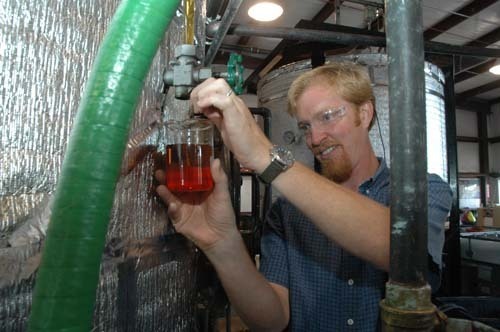
You may crave deep-fried chicken wings, but the owners of Newport Biodiesel are hungry for the vegetable oil it was cooked in. The company collects used vegetable oil from restaurants by the truckload and turns it into biodiesel capable of fueling a vehicle or heating a home.
At a small manufacturing plant in Newport, the owners are going “toe-to-toe” with some of the biggest energy suppliers in the country, if not the world. Biodiesel competes against traditional diesel, which is refined from crude oil from sources all over the world, including the Organization of Petroleum Exporting Countries, or OPEC. But to compete, Newport Biodiesel, led by five managing partners, needs thousands of gallons of the greasy stuff.
Collecting it falls to one of those partners, Chris Benzak, who travels the state with a simple pitch to restaurants – Newport Biodiesel will collect your used vegetable oil for free. Period.
“We’re not interested in your output. We’re interested in serving your restaurant. We need every Fry-O-Lator in the state to give us oil,” Benzak said.
A bouncy, energetic man never at a loss for words, Benzak calls biodiesel made from spent vegetable oil a chance to reclaim something that would normally land in the sewer, and in turn use it to produce a fuel cleaner than traditional diesel. The company estimates it already collects 40 percent of the vegetable oil used in Rhode Island restaurants, including 99 percent of the oil used in Newport and 50 percent of Providence oil. It has its sights set on collecting 100 percent of the roughly 2 million gallons used each year by restaurants in Rhode Island and southeastern Massachusetts.
“We’re trying to get people to think different about … grease,” Benzak said.
It was a much less grand dream that started Newport Biodiesel. About four years ago, now-managing partner Nat Harris was growing frustrated with volatile fuel prices. A Newport resident, he looked around and it struck him that Newport hosts lots of restaurants in close proximity that generate heaps of vegetable oil. One thing led to another and soon Harris was brewing his own biodiesel in 50-gallon batches in his basement. Then he talked with his neighbors and a business was born in 2006.
Once the group of neighbors had the process down, Benzak said they “took a long shot” and starting building a plant in 2007. On Jan. 3, 2008, the plant produced the first batch of biodiesel, and since then it has sold about 400,000 gallons.
The plant, tucked off Connell Highway near Naval Station Newport, resembles something like the New Jersey skyline, with tanks and pipes crisscrossing the metal building, one local fire official told the partners.
Five days a week the company’s fleet of five trucks travels through Rhode Island and southeastern Massachusetts collecting oil from about 500 restaurants. The company even takes in oil from a contractor that collects it from Martha’s Vineyard.
Once at the plant, the oil is pumped through a network of pipes and insulated vats that heat and screen the oil to remove food waste and water. Then a 2,000-gallon reactor mixes the oil with methoxide to produce a burnable fuel. Once water, waste and glycerin are removed, the plant produces about 40 gallons of fuel for every 100 gallons of spent oil it collects. The waste is composted and the glycerin shipped to Michigan.
Four of the five managing partners work full time at the plant, doing everything from homemade science experiments to testing the process to building oil storage drums for restaurants. They also search resellers of industrial equipment that they can reclaim and add to their plant.
The plant has drawn the attention of U.S. Sen. Sheldon Whitehouse, R.I. Senate President M. Teresa Paiva-Weed and Gov. Donald L. Carcieri, who was scheduled to meet with them in September.
The partners hope they can persuade the state to list Newport Biodiesel as the preferred – or even required – collector of restaurant cooking oil, much like the state mandates that recyclable municipal waste goes to the state landfill in Johnston. Such a designation could provide a welcome boom to the company that has yet to turn a profit. But Benzak said the company is about more than just the money.
“We’re five guys who are out to divert the entire waste stream of Rhode Island into sustainable fuel,” he said. •
COMPANY PROFILE
Newport Biodiesel
OWNERS: Chris Benzak, Ed Booth, Nat Harris, Bob Morton and Myles Standish
TYPE OF BUSINESS: Converter of used vegetable oil into biodiesel
LOCATION: 312 Connell Hwy., Newport
EMPLOYEES: 5
YEAR ESTABLISHED: 2006
ANNUAL SALES: WND
Rhode Island's Market Has Changed. Developers, Builders, Investors and Sellers Must Change With It.
By Emilio DiSpirito IV License Partner | Engel & Völkers Oceanside Leader | The DiSpirito…
Learn More