Lighthouse Computer Services Inc. is putting the finishing touches on a new high-tech criminal tracking system that company and state officials say could revolutionize the way law enforcement authorities monitor pedophiles and parolees.
After two and a half years of research and development, the Lincoln-based firm and a partner, location-device manufacturer OmniLink Systems Inc., have created a unified R.I. Criminal Offender Tracking System that executives say is far more advanced than current technology and fully integrated with state and local departments’ existing systems.
“The timing of this is perfect, because the technology has matured,” said Tom Mrva, Lighthouse’s CEO.
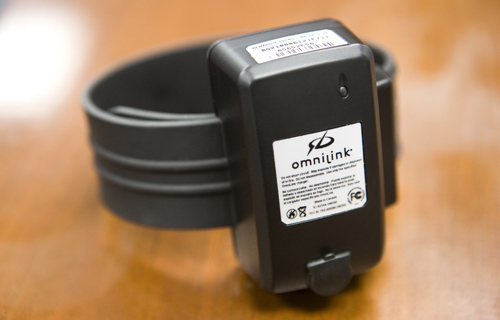
The system tracks offenders using a one-piece ankle bracelet slightly larger than a cell phone, which transmits its whereabouts with a five-second delay. Law enforcement officials can track the devices using a Web application, FocalPoint, that stores information on offsite servers.
Probation officers can access and manage their caseloads on FocalPoint. They can set up alerts to warn them if a parolee has not arrived at work or a treatment center at a court-ordered time when he or she was supposed to be there. They can also set up inclusion and exclusion zones and receive alerts if those zones are violated – for example, if a sex offender travels too close to a school.
“The system is designed to manage by exception,” said Jim Berard, who is leading the project at Lighthouse.
The original push for the project was from Jonathan Huston, executive director of Justice Assistance, the quasi-public agency that supports the state’s criminal justice system by connecting parolees with employers, working with inmates’ families and providing other services. He said Rhode Island and other states are desperate for a cheap, safe alternative to incarcerating hundreds of criminals for minor offenses.
“The Department of Corrections is sucking the state dry,” he said, though he emphasized the agency should not be blamed. “This is a solution for them.”
Each prisoner serving time in jail costs the state $108 a day, according to Huston. By comparison, electronic monitoring costs an average of $18 to $22 a day per parolee, according to a national study by the U.S. Department of Justice’s research institute.
Tracking parolees and sex offenders has always been a problem for law enforcement, and current tracking technology, which relies on telephone landlines and only works when a parolee is at home, is not adequate, according to Huston. “We need a better way that will cost less money and give [the] public confidence,” he said.
That led Huston to approach Lighthouse, which specializes in dealing with high-risk computer problems for businesses. “I couldn’t think of a more complicated problem than the one we were facing here: How do you provide a sense of public safety at a reduced cost?” he said.
Although Lighthouse does not usually develop new systems, Mrva agreed right away because he liked the challenge it presented. “When John Huston approached me, I said, ‘Wow – this is big,’ ” Mrva recalled. “The goal wasn’t to engineer a new ankle bracelet, it was to integrate what’s out there. Our strength is integration.”
Lighthouse conducted over two years of research, interviewing state and local law enforcement employees. “We asked, what would be the ideal solution?” Mrva said. The major requests they got were for continuous monitoring, immediate information and alerts when an offender trespasses in or out of a restricted area.
Lighthouse settled on Omnilink’s device and software because of its long battery life, durability and advanced locating ability.
Daniel Graff-Radford, vice president of judicial solutions at Omnilink, a four-year-old firm based outside Atlanta, said the company’s technology is unique because it triangulates between GPS satellites and cell phone towers to pinpoint a device’s location. The company says it can do so to an accuracy of within 3 meters, in urban areas and indoors as well as outside.
Omnilink’s device can also maintain a zone around someone who is traveling, such as a victim of domestic violence with a restraining order. “It’s the first proactive alerting mechanism in electronic monitoring,” Graff-Radford said.
An additional challenge for Lighthouse was integrating the various agencies’ legacy computer systems with OmniLink’s new technology, and Graff-Radford praised the Lincoln engineers’ efforts. “Lighthouse has done a fantastic job,” he said.
Lighthouse has invested more than half a million dollars in research and development for the tracking system, although U.S. Rep. Patrick Kennedy recently secured $200,000 in federal money for Justice Assistance that will be used to partly offset the costs.
After five months of development and extensive testing across the state, the new tracking system is now ready to be deployed. It is already winning praise from law enforcement, although Lighthouse is still waiting for the state to formally request the system. Meanwhile, the company is also getting inquiries about the new system in other parts of the country, and the project’s backers say they also see an economic boost for the state.
“Once we establish a beachhead here in Rhode Island, everybody’s going to want to mimic what we have here,” Mrva said.
R.I. Attorney General Patrick Lynch said in an interview the new system could address his major concern about the implications of letting offenders out of jail based on budget considerations rather than public safety ones. “I’m concerned about the quality of life of Rhode Islanders, and if you’re one that’s going to relieve the burden of prisons, you need something in place to monitor people being let out, so we don’t suffer on the streets,” he said.
Lincoln Police Sgt. Philip Gould, who is in charge of training for his department and has tested out the system in his cruiser, said he sees promise in it, particularly because of the retrospective information it will provide investigators. “I think it’s going to be huge,” he said.
Lynch also said the companies will need to make sure it is affordable for cash-strapped state and local agencies. Graff-Radford said that will depend on how much information the agencies want and how many offenders are tracked.
Huston said he is particularly pleased by the way the system makes information available across different agencies and systems. Mrva also said it could enhance productivity because it would reduce the amount of time police and parole officers need to spend checking on offenders.
Gould said he could see other uses for the technology, as well, such as keeping tabs on Alzheimer’s patients and monitoring restraining orders.
However, those same implications are what concerns Steven Brown, executive director of the American Civil Liberties Union’s Rhode Island affiliate.
“It raises concerns for what it promises to do in the future,” he said. “There’s little question in my mind that within a very short period of time it will be used on more and more individuals for more and more minor offenses, and there’s definitely something very 1984-ish about tracking somebody 24 hours a day, wherever they are.”
Brown also said there could be pressure on victims of domestic violence to keep tracking devices with them to enforce restraining orders, and that the cost savings could divert attention from reforming the criminal code for minor offenses.
Brown called on officials to create strict rules for who can access information and how long it will be retained, and said legislators should consider new laws to protect against abuses. •