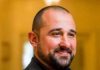
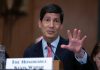
Name: Larry Liebenow
Position: President, CEO and director of Quaker Fabric Corp. in Fall River. Chairman of the U.S. Chamber of Commerce’s board of directors.
Background: Started career as an analyst at a steel company in Argentina. He later helped start a textile business in Mexico and a specialty yarn company, Nortex International, in the Untied States. With a group of investors, Liebenow bought Quaker Fabric Corp. in 1989.
Education: Bachelor’s degree from Willamette University in Salem, Oregon and master’s in business administration from Cornell University
Age: 58
Residence: Providence
Since taking over Fall River-based Quaker Fabric Corp. in 1989, Liebenow has helped triple the number of employees at the company to 3,000, and the company’s annual revenue has jumped from $90 million to $330 million. The 57-year-old, publicly traded company sells its fabric in more than 45 countries. It is the largest producer of Jacquard upholstery fabric in the world.
Your Business Has Gone Global. Has Your Insurance?
A decade ago, “doing business internationally” was mostly a large-company concern. Today, a manufacturer in…
Learn More
PBN: What are some of the keys of success for Quaker? What has your company done that most failed textile companies in Fall River didn’t do?
LIEBENOW: There are three major areas that I think that are very important to touch on. One is we offer a significantly differentiated product. We’re not making commodity product. We are producing a broad range of products for the home furnishings industry, with a high amount of technological and design input in the product. It’s not a commodity product. It’s not just based on where is the cheapest labor available. Secondly, we have continuously reinvested substantially in the company in terms of manufacturing, the technology and the people. Third, we have gone international. Even though we are doing all the manufacturing here in the Fall River area, an important part of our business is selling fabric outside the United States. That has helped us to both be able to compete on an international basis as well as providing additional revenues to the company.
How different is the product Quaker is producing today than it was 20 years ago?
There’s hardly any resemblance to what we were doing originally. When I got here Quaker was basically focused on more commodity product oriented to the low-end of the market in terms of price point. We reorganized that and focused the company primarily on differentiated product, high degree of styling content and more focused to the middle and upper end of the market. And we have a product range that appeals to the international market.
How vital is it to constantly review your technology needs?
We live in a world that is changing very rapidly, the nature of competition is changing significantly, the demands of the marketplace are changing …To be successful you have to have access to capital and you have to be willing to participate in the international market.
As your operation gets more technologically advanced, do you find you have a good work force to meet your needs?
We have been successful in terms of continuing to expand in the Fall River area. We have grown from about 1,000 employees from 1989 to about 3,000 employees, so over the years we have been able to attract a lot of terrific people. We do an extensive amount of in-house training. There are very few jobs left in any company, certainly at Quaker, which don’t require a significant degree of skill. All of the equipment is basically sophisticated electronic equipment that requires a substantial amount of training. We do a lot of in-house training, both in terms of picking up where the public education system has perhaps left off – providing foundation skills like reading and math. We also do the specific training for the kinds of positions that people are entering. In the design area, we have about 150 people in total that work in the design area. Access to (the Rhode Island School of Design) and the University of Massachusetts Dartmouth are assets to us.
Many of your employees are Portuguese. How do you address the language issue?
Quaker is a bilingual company. Everything that we do at Quaker is done in both English and in Portuguese. As part of our ongoing education program in-house, we provide English as a second language and Portuguese language training for our supervisors.
What makes the company function?
It’s the people. Therefore, the skills the people have to do both their specific job and to work effectively together makes all the difference. We want to give people a place to grow and be the very best they can be.
You were recently named the chairman of the board for the U.S. Chamber of Commerce. What are some of your goals for that position?
There are a number of critical issues, but underlying all of those issues is the fundamental importance of making sure that our political leadership understands what the private sector needs to continue to be successful and continue to provide opportunities to employees. Some of the issues that are currently very important, both at Quaker and to the private sector in general, include the overall trade agenda. It’s really kind of simple, and it always amazes me how irresponsible Congress in particular has been in dealing with trade issues. We live in a global market that’s not going to change. The United States is an open market and that’s not going to change. It’s to a great benefit to Americans that we live in an open market. I’ve lived in other markets, and it’s not where you want to be. At the same time, the rest of the world has varying trade regimes and restrictions and so forth. The major participants in the rest of the world are regularly negotiating among themselves. For example, the European Union is negotiating with most of the countries in this hemisphere for preferential trade agreements.
How does the U.S. fit in?
In our political system the only way the president can effectively defend the interests of the United States with respect to the trade agenda and to negotiate along with other countries these bilateral and multilateral agreements is by having what we called fast track trade agreement authority, now called trade promotion authority. The president has not had this for eight years, so for eight years other countries are setting the trade agenda, making the rules. Meanwhile, the U.S. is on the sidelines. In my opinion, Congress has been irresponsible in not providing trade promotion authority to the President.
What other issues do you want to address through the chamber?
Another issue is with tort reform. Businesses today face frivolous lawsuits that become extraordinarily costly for companies to manage. Everyone wants people in this country to be adequately protected by our legal system, but we have clearly seen a massive distortion in the use of our legal system by the class-action situation.
Tax policy is also very important in terms of making sure we have the right incentives in place that enable people to save and to reinvest, which allows companies to have access to capital.
Immigration policy is very important, particularly in light of concern with security issues. We need to balance that together with the need to normalize in an appropriate manner all of the people who have been working for a long time in various ways in the United States without proper documentation. We need to find a way to bring them into our system. We need an immigration policy that allows for an ongoing flow of immigration.
What do you think Fall River, New Bedford and the rest of Southeastern Massachusetts should do to attract businesses to the region?
I think in the case of Fall River, we have found a city administration that has been very helpful in terms of working with us to sort through the various issues when we have expanded extensively in the community. I think there are certainly infrastructure issues in terms of transportation. There are issues in respect to tax policy in Massachusetts and Rhode Island. We need to look to see if we are providing the right incentives to companies, so they can reinvest aggressively in their businesses.
What do you think is the biggest mistake Quaker could make?
I think the biggest mistake Quaker or any company can make is we are in an environment where there is an adequate amount of economic uncertainty…so the worst thing a company could do is to say let’s wait and see how things get sorted out. The best approach is to on a consistent basis reinvest in the company, in manufacturing, in people and in product. There is no time to sit back and pause to wait for things to be clear, because things are never clear in terms of the way the economy of this country or international economy is going.
Does the CEO of a manufacturing company need different qualities than does a CEO of a software company or an insurance company?
I’m not so sure that it is fundamentally different. It goes back to what makes a company? It’s not the buildings, it’s not the equipment, it’s not the product you make, or the market you’re selling to. What makes a difference is the people who work at the company. All the people, their skills, their passion, their ability to work together…those are the things that make a company. So, there’s no difference when it comes to that whether you are a manufacturer, a service company, software company, high-tech or any other type of company. It really is based on people.