Cool Polymers Inc. sees itself as a world-changing creator of “disruptive technologies.”
“Disruptive” does not sound like a good thing on the surface, but wait. In the parlance used by Cool Polymers General Manager Kevin McCullough, disruptive means a technology that totally changes the way a task is done.
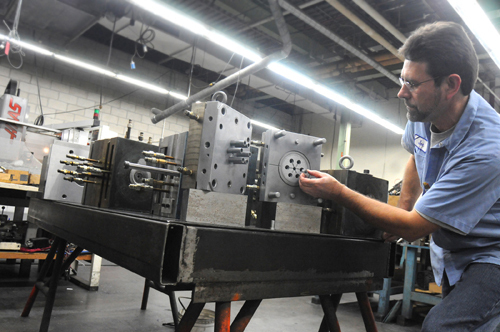
In 2008, Cool Polymers released into the market a new alloy that, for the first time, can be used to manufacture metal parts in conventional-injection molding machines built and used – until now – exclusively for plastic. The product, called Xyloy Injection Moldable Metal Alloys, solves a stubborn technical problem in millions of manufacturing operations around the world.
Further, this ingenious compound has been a big factor in keeping the Warwick-based company’s growth between 10 and 25 percent in each of the past three years, at a time when similar businesses are shrinking or failing.
“It is huge,” McCullough says of the potential use of the new alloy. People in the industry have been trying for 20 years, McCullough says, to develop a method for using metal in plastic-injection molding machines. “Multibillion-dollar companies have spent a lot of money trying to do it.”
Cool Polymers, in business for approximately 50 years, produces thermoplastic resins and specialty metallic hardware for electronics, the military and other industries. The company’s star of the moment is Xyloy alloys, which has a patent pending. The product rolled out in May 2008, and it is being used by a handful of select customers of Cool Polymers, under close observation by the materials scientists who developed it. The company plans to introduce Xyloy to the world market in January 2010.
Officials at Cool Polymers said reactions from customers and engineers to the new alloys included, “Sounds too good to be true,” and, “If I hadn’t seen it with my own eyes I wouldn’t have believed it.”
Jim Miller, product manager at Cool Polymers, said Xyloy was created after three years of research and development. It can be used in plastic-injection molding machines, after a limited and fairly inexpensive amount of adjustment to the existing machines. These machines, Miller said, are producing billions of parts all around the world, for a huge range of products like medical, electrical, and lighting equipment, sports equipment, consumer appliances and even the cap on your soda bottle.
He said that Cool Polymers’ Xyloy alloy is the only existing product that solves the problem in the method that it uses. The unique formula for Xyloy allows the alloys to be processed in a much wider temperature window than most metals can handle. Miller, said, though, that other companies are developing processes with the same goal – using metal in plastic-molding machines – by using more expensive specialty equipment.
How, then, does a company come up with a new and effective idea to solve a widely recognized dilemma? First, Miller says, Cool Polymers employs a fairly unusual combination of experts with extensive background in the fields of metal processing, plastic and thermal management. “That combination resulted in an understanding [of] the nature of the need for this material. Very few companies would have those three types of disciplines within them.”
Speaking of the Cool Polymers staff generally, Miller says, “We have a number of very creative people” under the direction of McCullough, who “is always thinking ahead and doing ahead.”
“All the people here are instrumental in having helped develop it,” Miller says of Xyloy. “Everybody makes a contribution. That is how we get to something that no one could get to on their own.”
Crucially, the engineers at Cool Polymers “look for places where the market is not being served and we find needs that have not been fulfilled,” Miller says. “We looked at the infrastructure of injection molding worldwide. There was a whole successful and diverse industry – plastic-injection molding – that was limited to using plastics. We offer people who process plastics another whole platform – to work in metal.”
The process of invention, McCullough says, relies on two qualities: open-mindedness and – above all – persistence. “I cannot tell you how many failures we had and how much money we spent” to develop Xyloy, McCullough says. “It has taken a lot of personal sacrifice” to the tune of seven-day, 100-hour workweeks during R&D and preproduction.
Another crucial part of the planning is the market value of the new product. Who wants to turn out a great product that no one wants to buy?
A project like the creation of Xyloy “needs to be driven by business opportunity,” Miller said. “Without that it would not have the push behind it to generate revenue. The driver is real-world necessity,” he says. “Once the product was ready to commercialize, we knew there would be customers who would want to use it.”
McCullough adds, “We have a couple of hundred customers waiting to get going with Xyloy.”
“Entrepreneurship happens as a combination of creative people working in an environment that allows creativeness to come to fruition,” Miller says.
McCullough is not considering allowing the company to sit on its laurels and let profits roll in. “We are a technology company and we have a whole list of projects ahead,” he said. He noted that Cool Polymers has 60 patents issued and 100 patents pending.
Furthermore, the material scientists and technologists at Cool Polymers get a charge out of this work.
“We would all be doing this even if we did not get paid for it,” McCullough says. “This is what we do on the weekends.” •