PROVIDENCE – On a busy stretch of 8th Avenue in Harlem, the green Citizens Bank signage stands out against the New York City rush: a little piece of Rhode Island embedded right into the hustle and bustle of Manhattan.
It’s just one small outpost of Citizens Financial Group Inc., a bank that now operates more than 1,000 branches across 14 states and Washington, D.C. However, its reach carries the weight of something far older – a lineage stretching back nearly two centuries.
Their story begins in 1828, when what is now Citizens opened in Providence as High Street Bank. Back then the city was emerging as a seaport and early industrial hub powered by shipping, mills and trade.
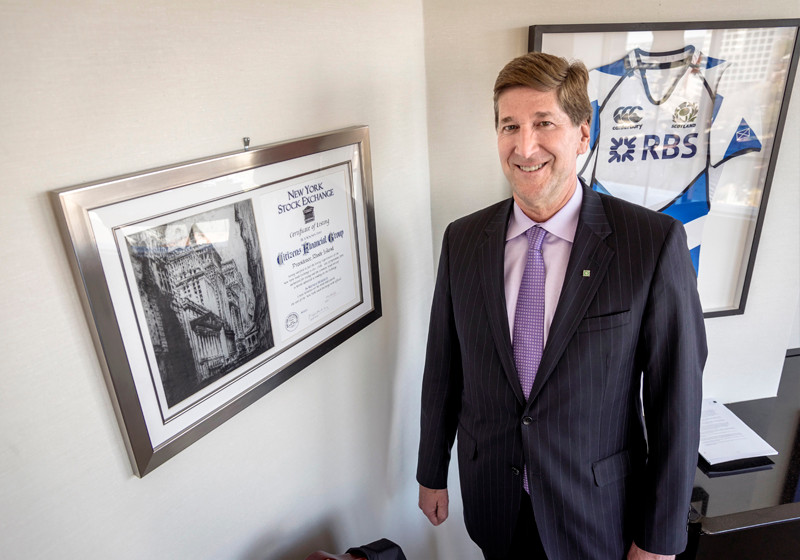
For current Citizens CEO and President Bruce Van Saun, the bank’s founding purpose remains remarkably familiar, even in 2026.
“The bank really was there to be a long-term investor in the state’s economic future,” Van Saun said. “At the heart of us, we still consider ourselves a strong community bank."
Today, Citizens ranks among the country’s largest banks, with roughly $230 billion in assets.
But the bank's path has been anything but linear, shaped by decades of mergers, acquisitions and ownership changes.
It even spent a long stretch under Royal Bank of Scotland ownership before regaining independence in 2015 in one of the largest bank IPOs in U.S. history.
That era, Van Saun said, reshaped the institution.
“To actually go through a long period of independence, then become part of a larger conglomerate, and then be set free again - it’s been an incredible journey,” he said.
Since returning to public ownership, Citizens has invested heavily in rebuilding its foundation, including technology, wealth management expansion and filling geographic gaps across its footprint, particularly in New York through acquisitions of Investors Bank and HSBC’s East Coast branch network.
Even in New York, Van Saun said, the bank leaned into the same local model first shaped in Providence.
“You think of New York as this gigantic metropolis,” he said. “But actually, it’s a series of smaller neighborhoods.”
That hyper-local approach still drives Citizens today, from workforce development and financial literacy programs to housing investments and veteran hiring initiatives.
“We try to put our time and treasure behind the things that matter locally,” Van Saun said.
It is also central to how Citizens has maintained its Rhode Island identity through decades of consolidation and disruption.
“We’re very grounded in our mission and values,” he said. “That ethos runs very deep in the company.”
Still, Van Saun said survival is not the goal on its own. Banking, he said, now demands constant adaptation to shifting customer expectations and technology while preserving stability and trust.
“We recognize you have to change and adapt,” he said. “We have to keep up with how our customers want to bank today,” he said.
That balancing act has defined what he called one of the most transformative eras in modern banking, shaped by constant technological change and how customers now expect to engage with their banks.
“We’re living in extremely interesting and exciting times,” he said.
Even amid that change, Van Saun said Citizens remains anchored to the same purpose that defined it when Providence’s economy revolved around ships, mills and early industry.
“All that changes,” he said. “But at the end of the day, it’s in service of helping customers be successful.”
With the Rhode Island institution approaching its 200th anniversary, Van Saun hopes that continuity ultimately defines this chapter of its history.
“We evolved with the times,” he said. “But we stayed grounded in our purpose.”
Matthew McNulty is a PBN staff writer. He can be reached at McNulty@PBN.com or on X at @MattMcNultyNYC.